Skip to content
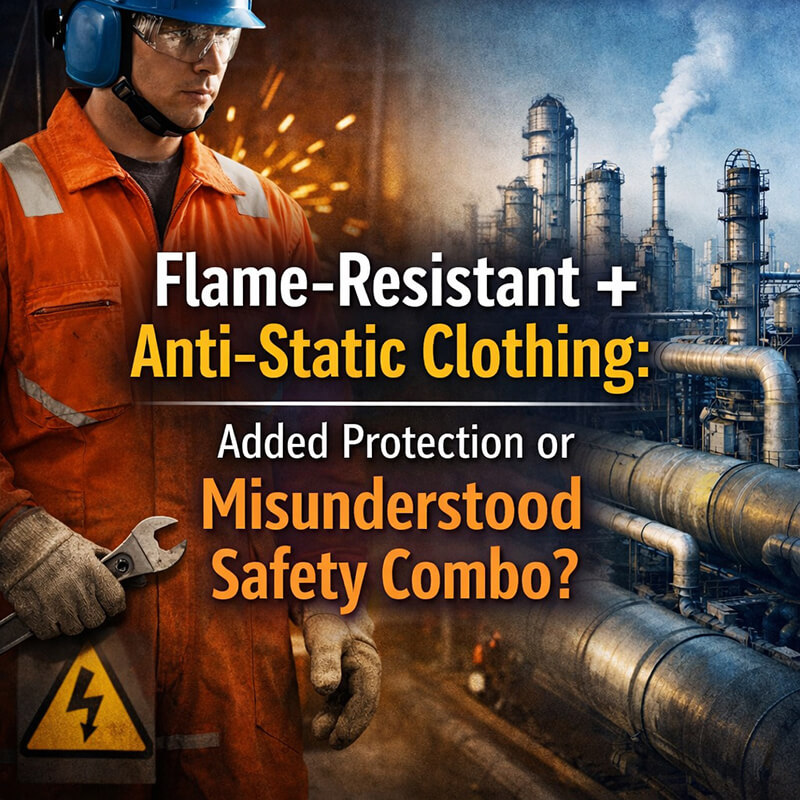
In many industrial environments, flame-resistant (FR) and anti-static properties are often bundled together and treated as a standard requirement for high-risk workwear.
For many buyers and site managers, the assumption is simple:
If a garment is both flame-resistant and anti-static, it must be safer.
In practice, however, this combination is not always an automatic upgrade in protection. In some cases, misunderstanding its purpose can even introduce new risks.
Why Are Flame-Resistant and Anti-Static Properties Often Combined?
From a risk-control perspective, this combination is logical.
In many industrial settings, fire hazards and static-electricity hazards coexist, such as:
-
Flammable gases or vapors
-
Dust-rich or enclosed environments
-
Chemical processing and energy facilities
-
Painting, cleaning, or tank maintenance operations
👉 Static discharge can act as an ignition source
👉 Open flames or hot surfaces can lead to sustained combustion
Flame-resistant clothing is designed to limit ignition and prevent continued burning,
while anti-static performance helps control static charge buildup and discharge.
On paper, the pairing makes sense.
The Real Issue: Do These Protections Truly “Stack”?
Misunderstandings usually occur at three key levels.
1️⃣ Anti-Static Does Not Mean “No Static”
A common misconception is that anti-static garments completely eliminate static electricity.
In reality:
-
Anti-static clothing controls charge accumulation and discharge paths
-
It does not remove static entirely
-
Performance depends on grounding, humidity, and correct use
In poorly grounded environments, static risks may remain—even when compliant fabrics are used.
2️⃣ Flame-Resistant Does Not Equal Full Heat Protection
Flame-resistant garments are designed to:
-
Resist ignition
-
Avoid sustaining flame
-
Self-extinguish after brief flame exposure
They are not intended to replace:
-
Thermal insulation garments
-
Radiant heat protection
-
Molten metal splash protection
👉 In high-heat or prolonged exposure scenarios, flame resistance alone is insufficient.
3️⃣ Dual Functions Do Not Mean “Double Safety”
There is a natural tendency to assume that more features equal more protection.
However, in safety engineering, adding functions does not reduce risk in a linear way.
If:
-
Static ignition is not a primary risk
-
Engineering controls already manage static effectively
-
The dominant hazard is radiant or conductive heat
Then an FR + anti-static garment may not address the most critical danger.
When Is This Combination Truly Necessary?
Flame-resistant and anti-static clothing provides the greatest value in environments where:
-
Flammable substances and ignition risks coexist
-
Workspaces are enclosed or semi-enclosed
-
Static cannot be fully controlled by infrastructure alone
-
Workers move frequently, increasing friction and charge buildup
Typical examples include:
-
Petrochemical maintenance
-
Tank and vessel entry
-
Solvent-based cleaning operations
-
Energy and process equipment servicing
In these cases, the two properties complement rather than duplicate each other.
The Overlooked Factor: Clothing Is Only One Part of the System
One of the most common mistakes is expecting a single garment to “solve” safety risks.
Effective flame-resistant and anti-static protection should be part of a broader safety system, including:
-
Compatible protective footwear and gloves
-
Proper grounding and environmental controls
-
Clear work procedures
-
Management of garment condition and service life
👉 PPE supports safety systems—it does not replace them.
Conclusion: A Valid Combination—When Used in the Right Context
Flame-resistant and anti-static clothing is neither a universal solution nor a marketing label.
When applied to:
-
The correct risk environment
-
Properly designed work processes
-
A complete protective system
It remains a proven and effective safety solution.
When used without understanding the underlying risks, however, even well-certified garments cannot prevent incidents.
The CHEAMYPPE Perspective
We believe that the real value of protective clothing lies not in feature stacking, but in correct risk interpretation.
Providing the right PPE starts with helping users make informed safety decisions.
Curious about how flame-resistant fabrics truly protect workers? Don’t miss Inherent vs Treated Flame-Resistant Fabrics: Which One Truly Protects Workers? and What Really Changes When Flame-Resistant Clothing Is Frequently Washed?.