Skip to content
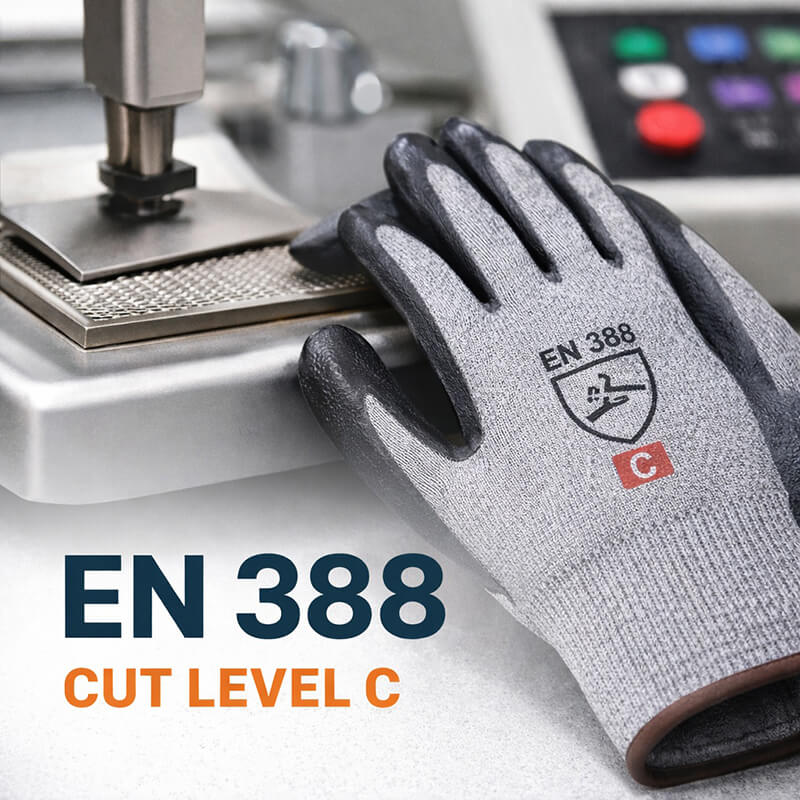
When sourcing cut-resistant gloves, EN 388 is almost always part of the conversation.
For years, many buyers focused mainly on the numbers:
Higher cut levels mean better protection — right?
However, after the EN 388 standard was updated, letter cut levels (A–F) began appearing on glove labels, raising a new and common question:
Are letter cut levels actually more reliable than the old numeric ratings?
In this article, we won’t repeat standard clauses. Instead, we’ll explain this change from a practical selection and real-use perspective.
1. A Quick Review: What Did the EN 388 Numbers Measure?
Under the old EN 388:2003 version, gloves were marked with four numbers representing:
- Abrasion resistance (0–4)
- Cut resistance (0–5) ⚠️ Coupe Test
- Tear resistance (0–4)
- Puncture resistance (0–4)
Among these, the second number — cut resistance — was often treated as the most critical indicator.
That’s exactly where the problem started.
2. Why the Old Numeric Cut Level Became Unreliable
The traditional Coupe Test uses a rotating circular blade that cuts back and forth over the glove material under constant pressure.
This method worked well years ago, but issues emerged as materials evolved:
- High-performance fibers (HPPE, glass fiber, steel fiber)
- Can quickly dull the rotating blade
- Artificially inflate test results
As a result:
Some gloves showed very high numeric cut levels, even though real-world cut protection was not proportionally better.
This limitation became one of the key drivers behind the EN 388 revision.
3. Where Do the Letter Cut Levels (A–F) Come From?
In EN 388:2016, a new test method was introduced — the TDM Test (ISO 13997).
How is it different?
- Uses a straight blade instead of a rotating one
- Measures the actual force required to cut through the material (in Newtons)
Based on the measured force, cut resistance is classified into six letter levels:
- A: lowest
- F: highest
This is the letter cut level you now see on many glove labels.
4. So — Are Letter Cut Levels More Reliable?
Short answer: yes, for assessing cut risk itself. But they are not a universal answer for every job.
Why letter levels are more reliable
- The test better reflects real cutting scenarios
- Less affected by blade dulling
- More meaningful for high-risk cut environments
For applications such as:
- Metal sheet handling
- Glass processing
- Heavy mechanical assembly
👉 The letter cut level is a very important reference.
5. Why Focusing Only on Letter Levels Can Still Lead to Wrong Choices
This is one of the most common mistakes in glove selection.
1️⃣ Letter cut level does not reflect durability or comfort
A Cut Level F glove:
- Is often thicker
- May reduce dexterity
- Can cause fatigue during long working hours
For tasks like:
- Assembly lines
- Light edge handling
- Precision work
An excessively high cut level can actually reduce efficiency.
2️⃣ Not all gloves are required to show a letter cut level
If a material does not dull the blade in the Coupe Test, the standard allows:
- Only numeric cut levels to be reported
- TDM testing to be omitted
This does not automatically mean the glove offers lower protection.
3️⃣ In many jobs, overall performance matters more than cut resistance alone
For example:
- High abrasion with moderate cut risk
- High dexterity combined with reliable grip
In these cases, pursuing the highest letter level alone does not improve overall safety.
6. CHEAMY PPE’s Perspective
At CHEAMY PPE, we focus on one key question:
Does this cut level truly match your application?
Rather than:
Does it simply look higher on paper?
The EN 388 letter cut level has made cut-risk evaluation more scientific, but it is only one part of proper glove selection, not the final answer.
7. Final Thoughts
EN 388 letter cut levels were not designed to replace numbers entirely.
Their real value lies in:
- Providing more realistic guidance for high cut-risk environments
- Preventing decisions based on misleading numeric ratings
When selecting cut-resistant gloves, it helps to ask:
- How serious is the actual cut risk?
- Do comfort and dexterity matter for this task?
Standards are tools. The right match is what truly delivers safety.
If you would like practical guidance on which cut levels (C / D / E / F) suit specific applications, feel free to contact us.