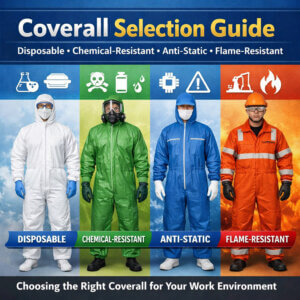
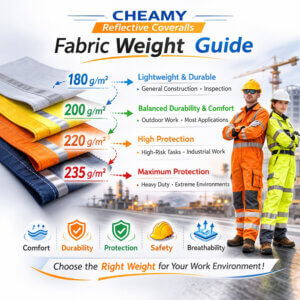
In industrial surface treatment, painting and abrasive blasting are often discussed together. Both involve surface preparation, airborne contaminants, and potential health risks to workers. However, when it comes to personal protective equipment (PPE), the underlying protection logic of these two processes is fundamentally different.
A common question is:
Why does painting PPE emphasize liquid penetration resistance, while blasting PPE focuses on abrasion and impact resistance?
The answer is simple but critical:
PPE is always designed around the primary hazard of the task.
1. Similar Processes, Fundamentally Different Risks
Although painting and blasting are both surface treatment operations, the dominant risk to the human body is not the same.
Painting Operations: Liquid and Chemical Exposure as the Primary Risk
During spray painting, workers are exposed to:
- Paint mist and liquid droplets
- Solvents, thinners, and chemical additives
- Wet overspray settling on clothing
- Chemical splashes during equipment cleaning
The key characteristic of these hazards is that they can penetrate materials.
If protective clothing allows liquids or aerosols to pass through:
- Chemicals may be absorbed through the skin
- Inner garments become contaminated, causing secondary exposure
- Long-term health risks increase significantly
For this reason, in painting environments, liquid penetration resistance is more critical than abrasion resistance.
2. Why Painting PPE Prioritizes Liquid Penetration Resistance
The primary objectives of painting protective clothing are to:
- Prevent liquid paint and solvent contact with skin
- Reduce chemical permeation through fabrics
- Maintain a continuous protective barrier during prolonged spraying
Common Design Features of Painting PPE
- Coated or laminated fabrics
- Low-porosity or microporous materials
- Taped or sealed seams
- Smooth outer surfaces that reduce wet paint adhesion
In painting operations:
Mechanical wear is usually limited, but chemical exposure is constant.
This defines the core protection logic of painting PPE.
3. Abrasive Blasting: High-Energy Mechanical Hazards
Blasting operations create a completely different risk profile.
During abrasive blasting, workers are exposed to:
- High-speed abrasive particles
- Continuous direct impact on the suit surface
- Rebounding media striking the body
- Dust and debris with high kinetic energy
Here, the main threat is not penetration by liquids, but material failure due to wear and impact.
If the protective fabric wears through:
- Abrasives can directly strike the skin
- Dust can enter the suit interior
- Protection can fail rapidly in high-stress zones
4. Why Abrasion and Impact Resistance Are Critical for Blasting PPE
Blasting protective suits are designed to:
- Withstand constant particle impact
- Resist rapid wear in high-friction areas
- Maintain structural integrity during long working hours
Common Design Features of Blasting PPE
- Thick, heavy-duty fabrics (canvas, leather, reinforced nylon, etc.)
- Multi-layer reinforcement on chest, arms, and legs
- Replaceable capes, sleeves, or front panels
- Structural durability prioritized over lightweight comfort
In blasting operations:
Once the material is worn through, protection fails immediately.
This makes abrasion resistance the lifeline of blasting PPE.
5. One Core Principle: PPE Design Always Follows the Primary Hazard
The essential difference between the two types of PPE can be summarized simply:
- Painting PPE protects against what can soak in
- Blasting PPE protects against what can wear through
Because of this:
- Painting suits are unsuitable for blasting operations
- Blasting suits cannot provide reliable chemical protection
Visual similarity does not mean functional equivalence.
6. The Risks of Using the Wrong PPE
In real-world applications, improper PPE selection often leads to:
- Insufficient protection
- Accelerated PPE failure
- Increased safety risks for workers
- Higher compliance and liability exposure for employers
PPE is not universal equipment — it is task-specific equipment.
7. Choosing the Right PPE Means Real Protection
Understanding the protection logic behind painting and blasting PPE helps companies:
- Match protective equipment accurately to job hazards
- Improve worker safety and comfort
- Avoid unnecessary PPE damage and replacement costs
- Build more professional safety management systems
Effective protection comes from understanding risk — not from judging appearance.
If you are evaluating PPE solutions for painting or abrasive blasting, remember this:
The safest PPE is not the thickest one, but the one designed for the right hazard.