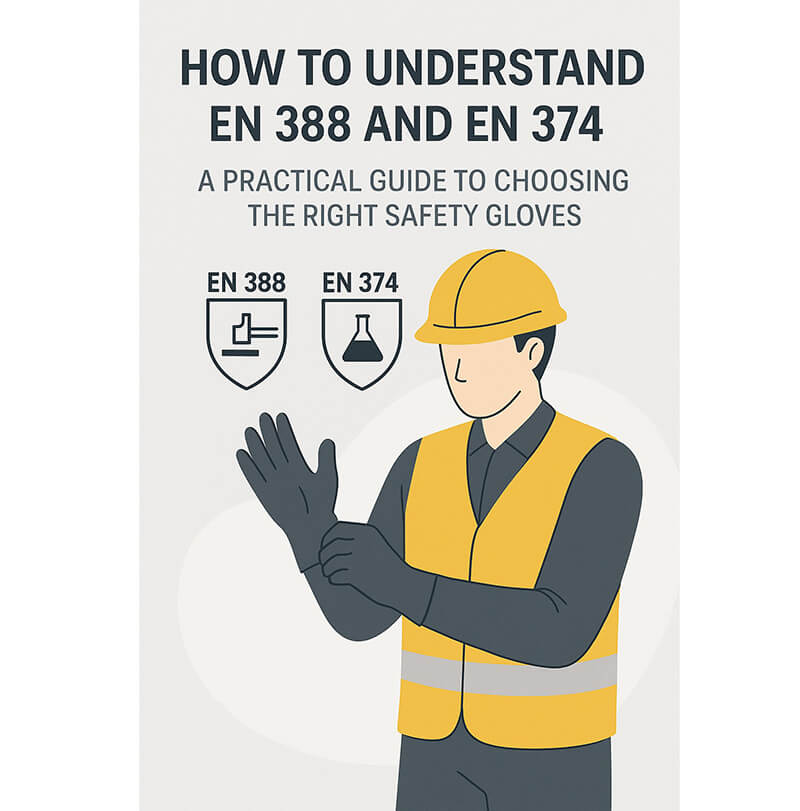
When choosing safety gloves, the codes EN388, EN374, 4X42F, or Type B often confuse buyers. Many workers and procurement teams simply pick gloves based on appearance — but the wrong choice may lead to injuries, discomfort, or unnecessary costs.
This guide explains the two most important glove standards — EN 388 (mechanical protection) and EN 374 (chemical & microorganism protection) — in a simple and practical way.
By the end, you’ll know exactly how to read the markings and choose the right gloves for your job.
01 What Is EN 388? (Mechanical Protection Standard)
EN 388 applies to work gloves used for mechanical risks, such as cuts, abrasion, tearing, and puncture.
You will see a symbol like:
EN 388: 4X42F
Each number or letter represents a level of protection:
🔹 Abrasion Resistance (1–4)
Higher number = better resistance to rough surfaces.
Ideal for: construction, masonry, material handling.
🔹 Cut Resistance – Coupe Test (1–5)
Traditional cut rating.
Lower accuracy with modern cut-resistant fibers.
🔹 Tear Resistance (1–4)
How well gloves resist ripping.
Important for: packaging, logistics, general handling.
🔹 Puncture Resistance (1–4)
Protection against nails, splinters, wires.
🔹 Cut Resistance – TDM (A–F)
Based on ISO 13997, more accurate for high-cut risks:
-
A–C → low–medium cut risk
-
D–F → high cut risk (metal work, glass handling)
Example:
If a glove shows EN388: 4X43D
-
Strong abrasion
-
High tear
-
Good puncture
-
Medium-high cut protection
02 What Is EN 374? (Chemical & Microorganism Protection Standard)
EN 374 applies to gloves used for chemicals, liquids, oils, and biological risks.
These gloves protect against:
-
Hazardous chemicals
-
Detergents and solvents
-
Oils and hydrocarbons
-
Viruses, bacteria, fungi
You may see icons like “Type A / B / C” on the glove.
🔹 Type A (≥30 min resistance to 6 chemicals)
Strong chemical protection.
Suitable for: laboratory work, chemical plants, heavy cleaning.
🔹 Type B (≥30 min resistance to 3 chemicals)
Moderate chemical protection.
Suitable for: cleaning work, automotive, food processing.
🔹 Type C (≥10 min resistance to 1 chemical)
Basic chemical contact protection.
Suitable for: splash protection, short use, light detergents.
Virus Resistance (ISO 16604)
If the glove protects against viruses, it will show the “VIRUS” symbol.
03 EN 388 vs. EN 374 — Which One Do You Need?
Choose EN 388 Gloves If Your Job Involves:
✔ Handling boxes, metal parts, wood, tools
✔ Working with sharp items (glass, sheet metal)
✔ Construction, logistics, automotive, warehouse
✔ Need cut, abrasion, or puncture protection
Choose EN 374 Gloves If Your Job Involves:
✔ Chemicals, oils, greases, solvents
✔ Cleaning, disinfection, lab work
✔ Handling liquids or biological materials
✔ Food processing or medical environments
Many jobs require both mechanical and chemical protection — and the same glove cannot provide all.
This is why choosing the correct standard is crucial.
04 The Fastest Way to Choose Gloves (Simple Decision Method)
Answer these questions:
1. Will your hands touch sharp objects?
-
Yes → Choose an EN 388 high cut rating (D–F)
-
No → Lower cut rating (A–C) is enough
2. Will your hands touch chemicals or liquids?
-
Yes → Choose EN 374 Type A or B
-
Light splash → Type C
3. Do you need grip in wet or oily conditions?
-
Yes → Choose nitrile-coated EN388 gloves
4. Will you wear gloves for a long time?
-
Choose breathable back material for comfort
If unsure, most industrial buyers choose:
EN388 Cut Level B–D + nitrile coating → Works for 80% of common tasks.
05 Why Understanding These Standards Saves Money
Many companies spend more than needed because they buy “the strongest gloves” instead of “the right gloves”:
-
A warehouse buys chemical gloves — unnecessary
-
A cleaning team buys cut-resistant gloves — no benefit
-
A chemical plant uses thin disposable gloves — unsafe
-
Construction workers use low cut-level fabric gloves — high risk
Choosing correctly reduces injuries, reduces cost, and improves worker comfort.
06 How CHEAMY Helps You Choose the Right Gloves
We provide:
-
Industry-based glove recommendations
-
EN 388 and EN 374 certified products
-
Samples for testing
-
Gloves with the right balance of protection, comfort, and cost
-
Support for bulk projects and long-term supply
We don’t just provide PPE — we provide safety.
Conclusion: Understanding EN388 and EN374 Makes the Right Choice Easy
Once you understand how EN 388 and EN 374 work, choosing the right safety gloves becomes simple:
-
EN 388 = mechanical risks
-
EN 374 = chemical & biological risks
Use the standard as your guide — and select gloves that truly match the job.