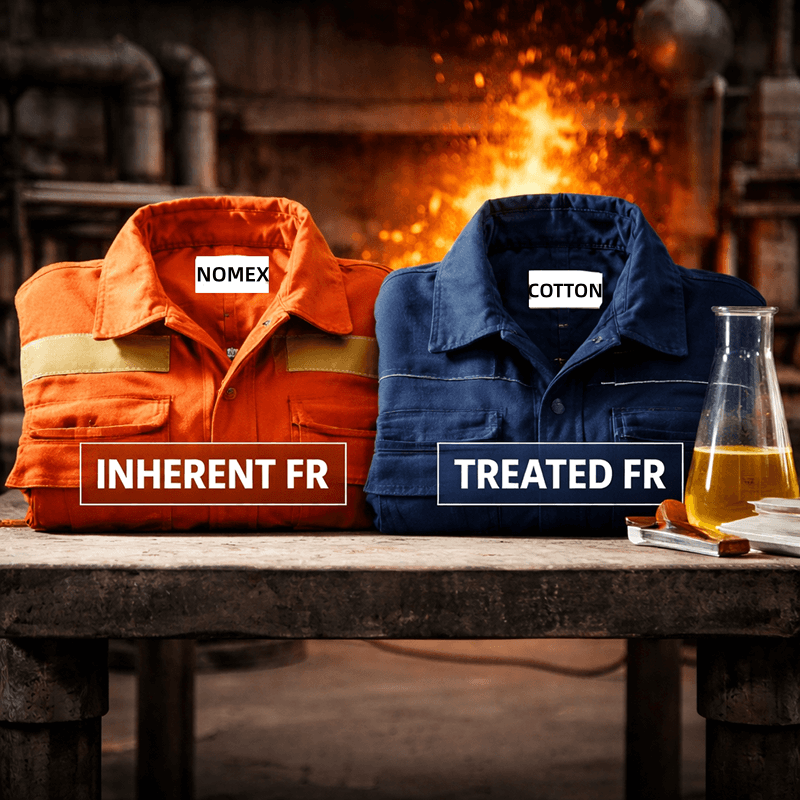
When it comes to flame-resistant (FR) clothing, not all fabrics are created equal. After understanding that “flame resistant” does not always mean real thermal protection, the next question becomes:
Which type of FR fabric actually delivers reliable protection in industrial environments?
This article explores the two main categories of FR fabrics—inherent and treated—and how their characteristics affect worker safety, durability, and performance.
1️⃣ Treated Flame-Resistant Fabrics
Treated FR fabrics start as ordinary fibers, usually cotton or polyester, which are then chemically treated to resist ignition and self-extinguish.
Key Features:
-
Cost-effective: Lower production cost compared to inherent FR fabrics.
-
Comfortable and breathable: Often made from natural fibers, suitable for moderate temperature work.
-
Limitations:
-
Performance may degrade after repeated washing.
-
Requires careful maintenance; some treated fabrics need re-treatment to maintain effectiveness.
-
Treated FR fabrics are suitable for general industrial use, but their protective performance may not be consistent under extreme heat or prolonged exposure.
2️⃣ Inherent Flame-Resistant Fabrics
Inherent FR fabrics are made from fibers that are naturally flame-resistant, such as Nomex, Kevlar, or PBI. The flame-resistant properties are built into the fiber itself and do not wash out or wear off.
Key Features:
-
Stable protection: Retains FR properties for the life of the garment.
-
High thermal resistance: Can withstand higher temperatures, flash fire, and electric arcs.
-
Durability: Resistant to wear, tear, and chemical exposure.
-
Cost: Higher upfront investment compared to treated FR fabrics.
Inherent FR fabrics are ideal for high-risk work environments, including welding, electrical, and chemical operations.
3️⃣ Comparing Inherent and Treated FR Fabrics
| Feature | Treated FR | Inherent FR |
|---|---|---|
| Flame resistance longevity | Degrades with washing | Permanent |
| Thermal protection | Moderate | High |
| Cost | Lower | Higher |
| Maintenance | Needs re-treatment | Minimal |
| Suitable for | General industrial tasks | High-risk heat/exposure tasks |
Insight: Choosing the right FR fabric is not just about the label “flame resistant.” Understanding the difference between inherent and treated fabrics ensures effective thermal protection and aligns PPE selection with actual work hazards.
4️⃣ Practical Tips for Employers and Workers
-
Evaluate the work environment: High heat or flash fire scenarios demand inherent FR fabrics.
-
Check garment history: Treated FR clothing may lose effectiveness after repeated washes.
-
Consider comfort and durability: Workers are more likely to wear protective clothing consistently if it is comfortable and breathable.
-
Follow manufacturer guidance: Always adhere to care instructions to maintain flame resistance.
Investing in the right FR fabric is an investment in real safety, not just compliance.
5️⃣ Conclusion
Flame-resistant clothing is an essential part of workplace safety, but the type of fabric matters. Treated FR fabrics may suffice for general tasks, while inherent FR fabrics provide long-lasting protection in high-risk conditions. Understanding these differences helps employers and safety managers make informed PPE decisions that truly protect workers.
Understanding the difference between fabric types can save lives. Explore related topics in Flame-Resistant + Anti-Static Clothing: Added Protection or a Misunderstood Safety Combination? and Why “Flame Resistant” Does Not Always Mean Real Thermal Protection.