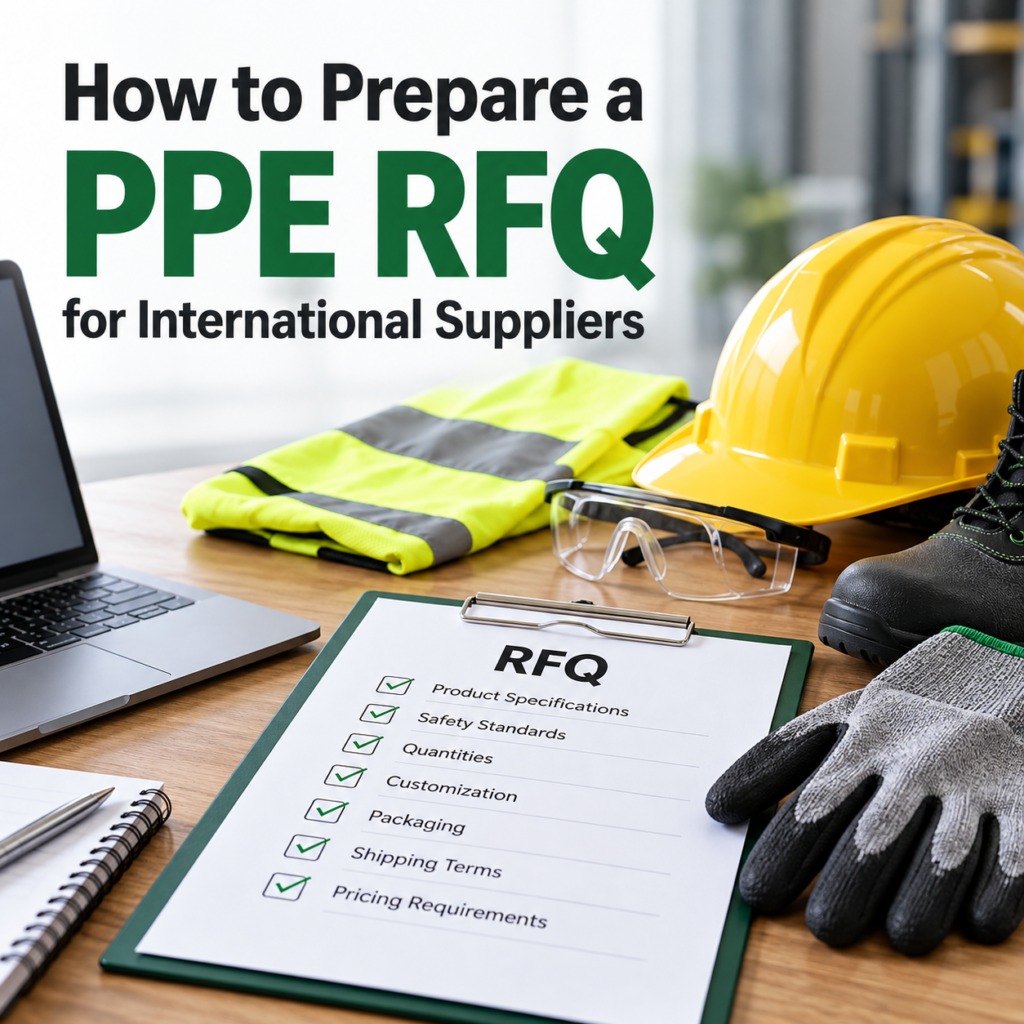
When sourcing personal protective equipment (PPE) from international suppliers, a clear Request for Quotation (RFQ) can make a significant difference to the purchasing process.
A well-prepared RFQ helps suppliers understand your product requirements, prepare accurate quotations, and identify potential issues before an order is placed. It also makes it easier to compare offers from different suppliers on a consistent basis.
For importers, distributors, contractors, and industrial procurement teams, this is particularly important when purchasing multiple PPE categories, customized products, or equipment that must meet specific safety standards.
Simply asking for a price list is rarely enough. To receive a useful quotation, buyers need to communicate what they want to purchase, how the products will be used, and what requirements the supplier must meet.
In this guide, we explain how to prepare a professional PPE RFQ, which details to include, and how to use the responses to make better purchasing decisions.
What Is a PPE RFQ?
An RFQ, or Request for Quotation, is a document sent to potential suppliers asking them to provide pricing and related commercial information for specified products.
A PPE RFQ typically includes:
- Product names and specifications
- Required quantities
- Applicable standards and certification requirements
- Materials, sizes, colors, and other product details
- Customization and packaging requirements
- Delivery destination and preferred trade terms
- Required delivery schedule
- Documentation requirements
The supplier uses this information to determine whether the requested products can be supplied and to prepare a quotation based on the specified requirements.
An RFQ is different from a general product inquiry. A general inquiry may simply ask whether a product is available, while an RFQ should provide enough detail for a supplier to quote the correct product and commercial terms.
Why Is a Clear PPE RFQ Important?
A detailed RFQ benefits both the buyer and the supplier.
1. Receive More Accurate Quotations
A product name alone rarely defines a complete specification.
For example, asking for 5,000 pairs of safety gloves does not explain the required coating, cut resistance, size distribution, or intended application.
Different suppliers may quote different products under the same description, making their prices difficult to compare.
Providing clear requirements helps reduce these differences.
2. Compare Suppliers on the Same Basis
A lower quotation does not necessarily represent better value.
One supplier may include individual packaging, while another may quote bulk packaging. One product may meet the requested standard, while another may have different performance characteristics.
A standardized RFQ allows buyers to compare product specifications, pricing, packaging, lead times, and supporting documentation more fairly.
3. Reduce Delays and Misunderstandings
Missing information often leads to repeated emails, revised quotations, and delays in order confirmation.
Clarifying the important details at the beginning helps both parties identify questions before proceeding to samples or bulk orders.
4. Improve Multi-Category Procurement
When purchasing safety helmets, protective gloves, workwear, safety footwear, and other PPE products together, the number of specifications and packaging requirements can increase quickly.
A structured RFQ makes it easier to organize multiple items and coordinate the purchasing process.
8 Essential Elements of a PPE RFQ
1. Product Names and Specifications
Start with a clear description of every item you want to purchase.
Avoid using only general product names such as “safety gloves,” “safety shoes,” or “protective clothing.”
Where applicable, include the following information:
| Product Category | Information to Specify |
|---|---|
| Safety helmets | Type, material, suspension, color, accessories |
| Safety glasses | Lens material, lens color, frame design, intended protection |
| Protective gloves | Material, coating, size, required performance, application |
| Protective clothing | Fabric, garment type, sizes, colors, design |
| High-visibility vests | Fabric, reflective tape, color, closure, applicable standard |
| Safety footwear | Toe protection, sole material, size range, required performance |
| Respiratory protection | Product type, intended application, filter requirements, applicable standard |
These are examples of information to consider, not universal requirements for every product.
If you already have a technical specification, product drawing, photograph, or reference sample, attach it to the RFQ.
If a particular detail is not yet decided, mark it as open for supplier recommendation rather than leaving it ambiguous.
2. Applicable Standards and Compliance Requirements
PPE requirements depend on the product, intended use, and destination market.
If a specific standard is required, identify it clearly in the RFQ.
Examples include:
- EN ISO 20471 for high-visibility clothing
- EN ISO 20345 for safety footwear
- EN 388 for mechanical risks to protective gloves
- EN 407 for thermal risks to protective gloves
- EN ISO 11612 for clothing protecting against heat and flame
- ANSI/ISEA 107 for high-visibility safety apparel in applicable North American markets
Do not assume that every product in a category automatically meets a particular standard.
Buyers should specify the required standard and performance level where applicable, then ask suppliers to confirm the offered product’s conformity and provide relevant supporting documentation.
For customized products, confirm that the proposed design and materials are consistent with the required performance and certification.
3. Quantities and Order Structure
Specify the estimated quantity for each product.
For example:
| Item | Product | Estimated Quantity |
|---|---|---|
| 1 | Safety helmets | 1,000 pcs |
| 2 | Cut-resistant gloves | 5,000 pairs |
| 3 | High-visibility vests | 2,000 pcs |
| 4 | Safety footwear | 800 pairs |
These figures are illustrative only.
If the order includes multiple sizes, colors, or configurations, provide a breakdown whenever possible.
For example, a requirement for 800 pairs of safety footwear should ideally include the size distribution rather than only the total quantity.
Also clarify whether the quantities are:
- Confirmed order quantities
- Estimated purchasing volumes
- Initial trial quantities
- Expected annual demand
This helps suppliers assess the appropriate pricing structure and available options.
If quantities are not finalized, ask suppliers to quote several quantity tiers, such as 500, 1,000, and 3,000 units, where commercially appropriate.
4. Materials, Sizes, Colors, and Customization
Product customization should be described as clearly as possible.
Relevant details may include:
- Material composition
- Color or Pantone reference
- Size range
- Logo placement and printing method
- Reflective tape configuration
- Label design
- Individual packaging
- Carton markings
- Private-label requirements
If you are developing a product under your own brand, attach artwork, logo files, design references, or packaging specifications where available.
For example, a customized high-visibility vest RFQ should ideally state the required fabric, vest color, reflective tape arrangement, size range, closure type, logo position, and applicable performance requirements.
The more specific the requirements, the easier it is for suppliers to assess feasibility and identify additional costs.
For details that remain flexible, invite suppliers to recommend suitable options and clearly distinguish their recommendations from confirmed specifications.
5. Required Documents and Test Reports
Documentation requirements should be identified before a quotation is finalized.
Depending on the product and destination market, buyers may need to request:
- Product technical datasheets
- Relevant test reports
- Applicable conformity documentation
- Certificates or declarations required for the intended market
- Product labels and user instructions
- Material or composition information
- Packaging specifications
Not every product requires the same documents. Buyers should identify the applicable requirements rather than requesting generic certificates without considering the product category.
It is also important to distinguish between a supplier’s general company documentation and documents that relate specifically to the offered product.
Ask suppliers to identify which documents are available for the exact model being quoted.
6. Packaging and Shipping Requirements
Packaging can affect both the total purchasing cost and the suitability of products for distribution.
Your RFQ should clarify whether you require:
- Individual polybags or boxes
- Standard export cartons
- Private-label packaging
- Barcode labels
- Carton markings
- Palletization
- Special packing instructions
If the goods will be shipped internationally, also provide the destination port or delivery address, as appropriate.
Specify your preferred Incoterm and named place or port, such as FOB Shanghai or CIF a specified destination port, where applicable.
If you are unsure which trade term is most suitable, request quotations under clearly identified alternatives so you can compare the costs and responsibilities.
For consolidated or multi-category shipments, ask suppliers to estimate the packing dimensions, gross weight, and shipment volume when this information is available.
7. Target Delivery Schedule
Indicate when the goods are required and whether the delivery date is fixed or flexible.
Relevant details include:
- Required shipment date
- Expected arrival date, if applicable
- Whether samples are needed first
- Whether products may be shipped in batches
- Whether the order depends on a project deadline
Ask suppliers to state their estimated lead time and identify any factors that could affect it, including customization, sample approval, material availability, or certification requirements.
A realistic delivery schedule is more useful than an unsupported promise of immediate shipment.
8. Commercial Terms and Quotation Validity
Your RFQ should request a clear breakdown of the commercial terms.
Ask suppliers to specify:
- Unit price and currency
- Minimum order quantity (MOQ)
- Quantity-based price breaks, if available
- Sample cost and sample lead time
- Production or sourcing lead time
- Payment terms
- Incoterm and named place or port
- Packaging charges, where applicable
- Tooling, printing, or customization costs
- Quotation validity period
If you are comparing FOB quotations, confirm that all suppliers are quoting under the same named port and comparable assumptions.
If one quotation includes customization or packaging costs separately while another incorporates them into the unit price, normalize the figures before comparing them.
The objective is not simply to obtain the lowest unit price, but to understand the total cost of purchasing the specified products.
How to Compare PPE Quotations from Different Suppliers
Once quotations arrive, organize them in a comparison sheet instead of relying on email summaries.
A practical comparison table may include:
| Evaluation Item | Supplier A | Supplier B | Supplier C |
|---|---|---|---|
| Product specification | Confirmed / Pending | Confirmed / Pending | Confirmed / Pending |
| Required standard | Meets / Pending | Meets / Pending | Meets / Pending |
| Unit price | Quoted price | Quoted price | Quoted price |
| MOQ | Quoted MOQ | Quoted MOQ | Quoted MOQ |
| Sample availability | Yes / No | Yes / No | Yes / No |
| Supporting documents | Available / Pending | Available / Pending | Available / Pending |
| Lead time | Quoted lead time | Quoted lead time | Quoted lead time |
| Packaging requirements | Confirmed / Pending | Confirmed / Pending | Confirmed / Pending |
| Payment terms | Quoted terms | Quoted terms | Quoted terms |
| Incoterm | Quoted term | Quoted term | Quoted term |
Use actual figures and specific comments when completing the table.
Do not mark a supplier as compliant simply because it has confirmed that it can supply the product. Verify the relevant specifications and supporting documents.
If important information is missing, ask the supplier to clarify it before making the final decision.
Common Mistakes to Avoid When Preparing a PPE RFQ
Mistake 1: Sending Only Product Names
A list containing only product names and quantities may result in quotations for different specifications.
Better approach: Provide technical requirements, photographs, reference models, or specification sheets wherever possible.
Mistake 2: Focusing Only on Price
The cheapest quotation may not include the required documentation, packaging, or product performance.
Better approach: Compare prices only after checking specification alignment and the complete commercial terms.
Mistake 3: Leaving Certification Requirements Unclear
A general request for “CE-certified PPE” may not provide enough information for suppliers to identify the correct product and documentation.
Better approach: Specify the intended application, destination market, relevant standard, required performance, and supporting documents.
Mistake 4: Ignoring Size Distribution
Providing only a total quantity can leave suppliers unable to quote accurately for products with multiple sizes.
Better approach: Include the size breakdown or request a preliminary quotation based on an identified size distribution.
Mistake 5: Changing Requirements After Receiving Quotations
Late changes to fabric, colors, packaging, logo placement, or standards may affect price and lead time.
Better approach: Separate mandatory requirements from optional preferences before sending the RFQ.
Mistake 6: Sending Different Requirements to Different Suppliers
If each supplier receives a different specification, the resulting quotations will not be directly comparable.
Better approach: Use one master RFQ and communicate any subsequent revisions to every supplier being evaluated.
A Practical PPE RFQ Template for International Buyers
You can use the following template as a starting point when contacting international PPE suppliers.
Subject: Request for Quotation – PPE Products
Dear Sales Team,
We are interested in sourcing the following PPE products for our market and would appreciate your quotation based on the requirements below.
1. Product Requirements
- Product name:
- Required specifications:
- Applicable standards and performance requirements:
- Sizes and colors:
- Estimated quantity:
- Customization requirements:
- Packaging requirements:
Please refer to the attached specification sheets, photographs, or other technical documents where applicable.
2. Documents Required
Please indicate which relevant product datasheets, test reports, conformity documents, and other supporting documents are available for the proposed products.
3. Commercial Requirements
Please provide the following information:
- Unit price and currency
- MOQ
- Sample cost and availability
- Lead time
- Payment terms
- Quotation validity
- Incoterm and named place or port
- Estimated packing dimensions and gross weight, if available
4. Additional Information
Please advise whether the proposed products meet the stated requirements and highlight any deviations, limitations, or alternative options.
If any specification requires clarification, please let us know before finalizing your quotation.
We look forward to reviewing your offer and discussing potential cooperation.
Best regards,
[Your Name]
[Company Name]
[Country]
[Contact Information]
For multi-category orders, attach a product schedule with a separate row for each item. This is generally easier to manage than placing every specification in the body of an email.
How CHEAMY PPE Supports International Buyers
Preparing an RFQ is an important first step, particularly when the purchasing requirement covers several PPE categories.
At CHEAMY PPE, we support international buyers with multi-category PPE sourcing, product specification coordination, customization requirements, packaging arrangements, and order documentation.
Our product range covers head protection, eye and face protection, hearing protection, respiratory protection, protective gloves, workwear, safety footwear, fall protection, and traffic safety products.
For buyers sourcing multiple products within one purchasing program, a structured RFQ helps us understand the requirements more clearly and coordinate the quotation process more efficiently.
We also support suitable OEM and ODM projects involving logo branding, color selection, product specifications, and packaging customization, subject to product feasibility and applicable requirements.
Whether you are preparing an initial inquiry or planning a larger purchasing program, providing clear specifications and commercial expectations helps establish a more productive starting point.
Looking for a sourcing partner for multiple PPE categories? Contact CHEAMY PPE with your product list and requirements to discuss your project.
Conclusion
A professional PPE RFQ does more than request prices. It establishes a clear basis for evaluating product suitability, technical requirements, documentation, packaging, delivery, and commercial terms.
Before sending your RFQ, make sure you have:
- Defined the required products and specifications
- Identified applicable standards and documentation
- Confirmed quantities and size distributions
- Explained customization and packaging needs
- Specified delivery expectations and trade terms
- Requested comparable quotations from suppliers
The more clearly you communicate your requirements, the easier it becomes to evaluate offers, identify gaps, and move toward a well-defined purchase order.
A better PPE purchasing decision starts with a better RFQ.