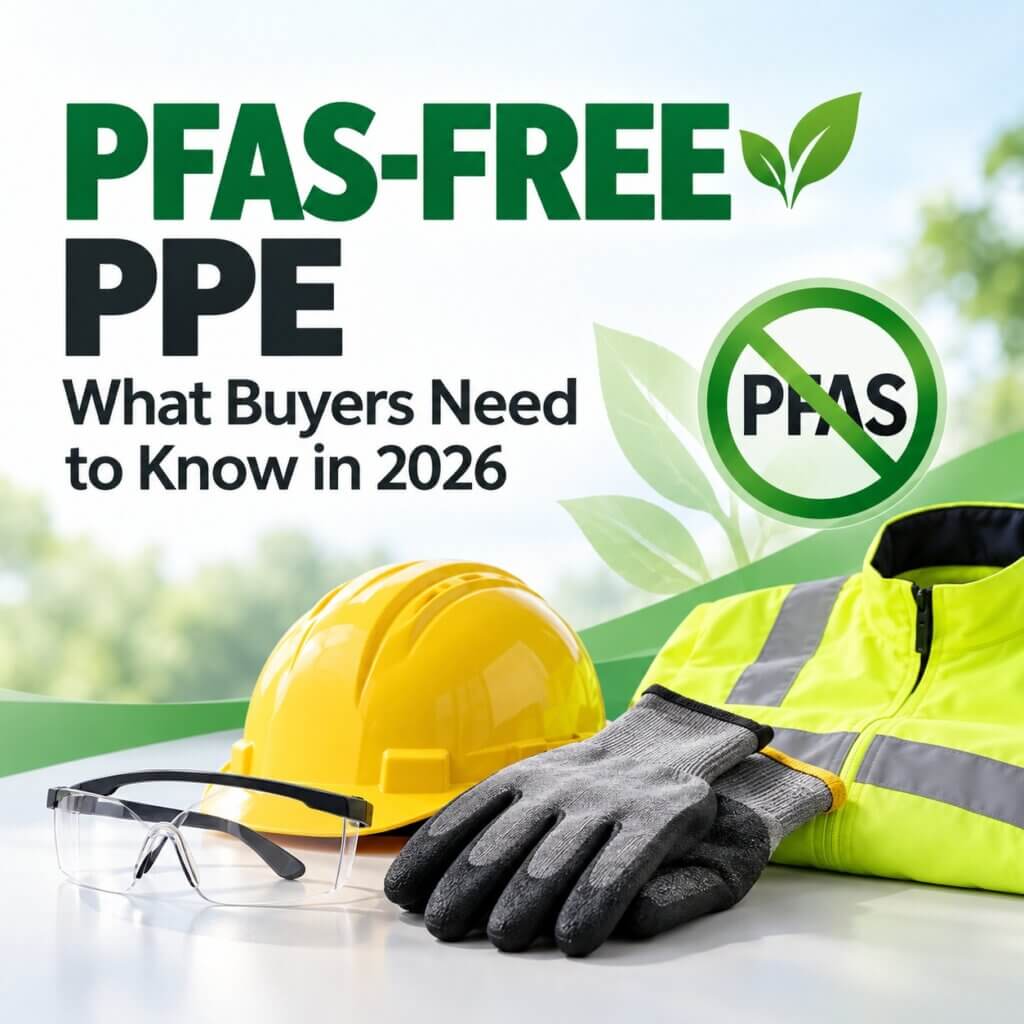
PFAS-free materials are becoming an important consideration for businesses purchasing personal protective equipment (PPE). As environmental policies evolve and companies review their chemical management requirements, international buyers are paying closer attention to the materials used in protective clothing, gloves, and other workplace safety products.
However, choosing PFAS-free PPE involves more than finding a product labeled “PFAS-free.” Buyers also need to understand the intended application, verify supplier claims, and ensure that alternative materials provide the protection required for the job.
This guide explains what PFAS-free PPE means, which products may require closer material checks, and what international buyers should ask their suppliers before placing an order.
1. What Does PFAS-Free PPE Mean?
PFAS stands for per- and polyfluoroalkyl substances, a large group of synthetic chemicals with different properties and applications. Some PFAS are valued for their resistance to water, oil, grease, stains, or high temperatures.
These properties have made certain PFAS useful in specialized industrial materials, surface treatments, and protective equipment. At the same time, concerns about the persistence of many PFAS in the environment have led to increased regulatory attention and demand for alternatives.
PFAS-free PPE generally refers to protective equipment manufactured without intentionally added PFAS, or equipment that meets a specific PFAS restriction or testing requirement.
The exact meaning depends on the product specification and the claim being made. A product described as “PFAS-free” should not automatically be assumed to contain absolutely no detectable PFAS.
For procurement purposes, buyers should clarify three points:
- Does the requirement prohibit intentionally added PFAS, or does it set a maximum concentration?
- Which PFAS substances or groups are covered?
- What testing method, detection limit, or documentation is required?
Defining these requirements before requesting quotations can help prevent misunderstandings between buyers and suppliers.
2. Which PPE Products May Require PFAS Checks?
Not every PPE product uses PFAS, and the material composition varies by product design and manufacturer. Buyers should pay particular attention to products with specialized coatings, finishes, or performance requirements.
Protective Clothing and Workwear
Some water-repellent, oil-repellent, and stain-resistant textile treatments may involve PFAS. Buyers sourcing waterproof workwear, protective coveralls, or specialized industrial garments should ask suppliers about the fabric composition and any applied finishes.
When PFAS restrictions apply, alternatives may be available, but their water resistance, durability, breathability, and suitability for the intended work environment should be assessed.
Flame-Resistant and Heat-Protective Clothing
Certain specialized protective textiles and finishes may involve fluorinated materials. However, flame resistance does not automatically mean a garment contains PFAS, and PFAS-free does not automatically mean a garment provides adequate flame protection.
For flame-resistant clothing, buyers should continue to verify the applicable performance requirements and test reports. Any material change should be evaluated against the garment’s intended protective function.
Chemical-Protective Clothing
Chemical-protective suits and garments are designed for specific hazards and exposure conditions. Their suitability depends on factors such as material composition, chemical permeation resistance, seams, and garment construction.
A PFAS-related material requirement should therefore be assessed alongside the required chemical protection. A supplier should not substitute a material solely because it is marketed as PFAS-free without confirming its suitability for the intended chemicals and working conditions.
Gloves and Other Protective Equipment
Some gloves, eye protection products, and other PPE items may use specialized coatings, treatments, or components that warrant closer review.
The presence of a particular material cannot be determined reliably from a product photograph or general product description. Buyers should request product-specific information rather than assuming that an entire product category either contains or excludes PFAS.
3. Why Are PPE Buyers Paying More Attention to PFAS?
There are several practical reasons for reviewing PFAS requirements during procurement.
Environmental and chemical management policies
Many companies are strengthening their chemical management programs and reviewing materials used throughout their supply chains. PFAS requirements may form part of internal purchasing policies even when a specific product is not subject to a general prohibition.
Changing regulatory requirements
Regulatory developments in the United States, European Union, and other markets may affect certain PFAS, products, uses, or supply chains. Requirements differ by jurisdiction and application, so buyers should identify the rules relevant to their destination market.
Customer and tender specifications
Large companies, public-sector buyers, and industrial procurement teams may introduce material restrictions in their own specifications. These requirements can be relevant to a supplier even when they go beyond the minimum legal requirements for a particular product.
Supply chain transparency
Clear material declarations and reliable supporting documents help purchasing teams evaluate products, compare suppliers, and reduce the risk of receiving goods that do not meet contractual requirements.
For international buyers, the practical question is not simply whether PFAS are restricted in general. It is whether the specific product meets the requirements of the intended application and market.
4. How Can Buyers Verify a PFAS-Free Claim?
A supplier’s statement is a useful starting point, but buyers may need additional evidence depending on the contract, destination market, and risk level of the product.
Request a Written Material Declaration
Ask the supplier to clarify whether PFAS are intentionally added to the product, its coatings, finishes, and relevant components.
The declaration should identify the product or model covered, the scope of the claim, and any applicable limitations. A general company statement may not establish the composition of every item in a product range.
Review Relevant Test Reports
Where testing is required, ask for reports that match the actual product and the buyer’s specification.
Check the following details:
- Product name, model, or material identification
- Laboratory name and report date
- PFAS substances or groups included in the test
- Test method and reporting or detection limits
- Results and any stated limitations
A test that covers only selected PFAS cannot establish that every substance within the broader PFAS group is absent. Likewise, a result below the laboratory’s reporting limit does not necessarily mean absolute zero.
The required testing scope should be agreed before samples are submitted.
Confirm the Scope of Compliance Documents
A product’s CE documentation, PPE conformity documents, or general quality certificate should not automatically be treated as proof of PFAS-free status.
These documents serve different purposes. Buyers should confirm that the evidence specifically addresses the requested material restriction and the relevant product.
Check Whether the Evidence Applies to the Final Product
If a garment uses fabric from one supplier and a coating or finish from another, the buyer should clarify which materials are covered by the declaration or test report.
For customized products, confirm whether the selected color, coating, logo-printing process, or other modification changes the material specification.
5. PFAS-Free PPE Procurement Checklist
Before confirming an order, international buyers can use the following checklist.
| Procurement item | What to confirm |
|---|---|
| Product application | What hazard and working conditions must the PPE address? |
| PFAS requirement | Is the requirement based on no intentionally added PFAS, a concentration limit, or a specific regulation? |
| Material composition | Are the fabric, coating, finish, and relevant components covered? |
| Supporting evidence | Are written declarations or product-specific test reports required? |
| Protective performance | Does the product still meet the required safety standards and performance levels? |
| Customization | Could colors, finishes, printing, or other modifications affect compliance? |
| Order consistency | Will the approved material specification remain unchanged during production? |
| Documentation | Can the supplier provide the documents needed for the buyer’s internal review or destination market? |
This checklist can be incorporated into a request for quotation (RFQ), supplier questionnaire, or product approval process.
6. Questions to Ask Your PPE Supplier
Clear questions can help buyers obtain more useful information and avoid vague assurances.
Consider asking:
- Does this specific product contain intentionally added PFAS?
- Does your PFAS-free declaration cover the fabric, coating, surface treatment, and other relevant components?
- Can you provide a material declaration or relevant laboratory test report?
- Which PFAS substances or groups are covered by the available evidence?
- Does the product meet our required safety standards and performance specifications?
- Will the material composition remain the same for repeat orders?
- Can you confirm whether customization will affect the material declaration or test requirements?
Buyers should provide the supplier with the intended application, destination market, and exact specification. This allows the supplier to assess the request against the actual product instead of giving a broad answer that may not address the buyer’s needs.
7. PFAS-Free Materials Must Still Meet PPE Performance Requirements
One of the most important purchasing considerations is that material restrictions must not compromise worker protection.
For example, a water-repellent finish on workwear should be evaluated for the required water resistance and durability. Flame-resistant garments must still provide the specified flame protection, while chemical-protective clothing must be suitable for the chemicals and exposure conditions involved.
Alternative materials may perform differently in durability, breathability, cleaning, maintenance, or service life. These differences should be evaluated through relevant specifications and testing rather than assumed from a supplier’s marketing claims.
The best procurement decision balances material requirements with the product’s intended protective function, applicable standards, and actual workplace risks.
8. Final Thoughts: Make PFAS Requirements Part of Your PPE RFQ
PFAS-free PPE is a developing procurement consideration, but there is no single answer that applies to every product, industry, or destination market.
International buyers can make better decisions by defining the required scope, requesting product-specific evidence, verifying relevant performance standards, and confirming that the approved materials will remain consistent throughout production.
At CHEAMY PPE, we understand that PPE procurement involves more than comparing unit prices. Clear specifications, reliable communication, product suitability, and consistent documentation all contribute to a smoother sourcing process.
If your company has specific material restrictions or PFAS-related requirements, share them with your PPE supplier at the quotation stage. Early clarification can help identify suitable products, establish realistic documentation requirements, and reduce avoidable changes later in the order process.
Looking for PPE sourcing support? Contact CHEAMY PPE to discuss your product specifications, customization needs, and documentation requirements.