China is an important sourcing market for personal protective equipment (PPE), offering a wide range of safety products, customization options, and supply capabilities.
But sourcing PPE from China is not simply about finding a supplier with a low price.
International buyers also need to consider product specifications, applicable standards, samples, MOQ, lead time, quality control, customization, documentation, shipping, and long-term supply consistency.
A well-planned sourcing process can help buyers reduce unnecessary risks and make better purchasing decisions.
This guide explains the main steps international buyers should consider when sourcing PPE from China.
1. Why Source PPE from China?
China has a large and diverse PPE supply chain covering many product categories.
International buyers can source products such as:
- Safety helmets
- Safety glasses
- Protective gloves
- Safety footwear
- High-visibility vests
- Coveralls
- Workwear
- Chemical protective clothing
- Flame-resistant clothing
- Respiratory protection
- Welding PPE
- Fall protection equipment
- Other industrial safety equipment
One advantage of sourcing from China is the ability to combine different PPE categories through one supply network.
For buyers managing large projects, this can simplify procurement compared with purchasing every product from a separate supplier.
However, product availability alone does not guarantee a good sourcing experience.
The right supplier should match the buyer’s product requirements, quality expectations, order quantities, customization needs, and delivery schedule.
2. Define Your PPE Requirements Before Searching
One of the most common mistakes is contacting suppliers before defining what you actually need.
Before starting your supplier search, prepare the basic purchasing requirements.
These may include:
- Product name
- Product model
- Application
- Material
- Size
- Color
- Quantity
- Applicable standards
- Required performance
- Packaging
- Labeling
- Customization
- Required delivery date
- Destination country
For example, instead of requesting:
“Safety gloves, 5,000 pairs.”
a better request might specify the intended application, material, size range, required performance, color, packaging, and applicable standard.
The more clearly the requirements are defined, the easier it becomes for suppliers to provide comparable quotations.
3. Decide Whether You Need Standard or Customized PPE
Not every PPE order needs customization.
Standard products may be suitable when:
- The required specification is already available
- No private branding is needed
- The buyer needs a smaller initial quantity
- Delivery speed is important
- The product will be used for a short-term requirement
Customized PPE may be more appropriate when buyers need:
- Company logos
- Custom colors
- Special labels
- Custom packaging
- Specific materials
- Special product configurations
- Project-specific requirements
Customization can increase MOQ, cost, sample requirements, and lead time.
Therefore, buyers should decide early whether they need standard PPE or customized PPE.
4. Find Suitable PPE Suppliers in China
Once the requirements are clear, buyers can begin looking for potential suppliers.
Possible sources include:
- Supplier websites
- B2B platforms
- Trade exhibitions
- Industry directories
- Business referrals
- Professional networks
- Search engines
Do not select a supplier based only on search ranking or the lowest quotation.
Instead, create a shortlist and compare suppliers based on relevant factors such as:
- Product range
- Product specifications
- Experience with export orders
- Customization capability
- Quality-control process
- Documentation
- MOQ
- Lead time
- Communication
- Shipping support
- Ability to supply multiple PPE categories
A supplier that understands international purchasing requirements may be more useful than a supplier offering the lowest unit price.
5. Understand the Difference Between a PPE Supplier and a Manufacturer
When sourcing PPE from China, buyers may communicate with different types of companies.
These can include:
- Manufacturers
- Trading companies
- PPE distributors
- One-stop PPE suppliers
- Specialized product suppliers
A manufacturer may focus on its own production capabilities.
A trading company or one-stop PPE supplier may source different products from multiple qualified production partners.
Neither model is automatically better.
The important question is:
Which supply model best fits your purchasing requirements?
If a project requires helmets, gloves, protective clothing, safety footwear, reflective vests, and other products, working with a supplier capable of coordinating multiple categories may simplify procurement.
This topic is also worth discussing separately in:
China PPE Supplier vs PPE Manufacturer: What Buyers Should Know
6. Send a Clear PPE RFQ
After identifying potential suppliers, send a clear Request for Quotation (RFQ).
A good PPE RFQ should include:
- Product description
- Quantity
- Technical specifications
- Standards
- Sizes
- Colors
- Customization
- Packaging
- Delivery destination
- Required delivery date
- Requested quotation terms
Avoid sending only a product name and quantity if the product has important technical requirements.
For example:
“Please quote 10,000 safety vests.”
leaves many questions unanswered.
A better RFQ gives the supplier enough information to understand exactly what should be quoted.
This can significantly reduce back-and-forth communication.
7. Compare Quotations Beyond Unit Price
Once quotations are received, do not immediately choose the lowest price.
Compare:
- Unit price
- MOQ
- Product specification
- Material
- Standards
- Customization
- Packaging
- Production lead time
- Payment terms
- Shipping terms
- Documentation
- Sample availability
A lower unit price may not represent a lower overall purchasing cost.
For example, one quotation may exclude customized packaging while another includes it.
One supplier may offer a lower price but require a much higher MOQ.
Another may have a slightly higher price but provide a specification closer to your actual requirement.
A useful quotation comparison starts with making sure you are comparing the same product.
8. Request Samples Before a Large Order
For important or customized PPE purchases, requesting a sample can reduce uncertainty.
A sample can help buyers evaluate:
- Appearance
- Fit
- Size
- Material
- Workmanship
- Color
- Logo placement
- Accessories
- Overall usability
For customized products, sample approval can become an important milestone before bulk production.
However, a sample should not be treated as a replacement for applicable testing or certification.
A visual sample helps answer:
“Is this the product we want to buy?”
Applicable technical documents and testing address different questions regarding product requirements and performance.
9. Read the PPE Datasheet Carefully
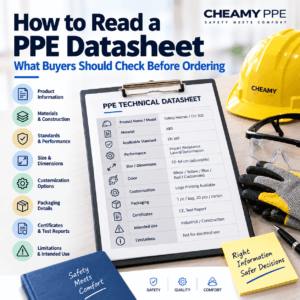
A PPE datasheet provides technical information about the product.
Depending on the product, buyers may find information about:
- Materials
- Dimensions
- Weight
- Sizes
- Performance
- Standards
- Product configuration
- Applications
- Limitations
- Packaging
The datasheet should be compared with:
Quotation + Sample + Technical Requirements
If these three sources describe different configurations, clarify the difference before ordering.
A useful procurement rule is:
Quotation tells you what you are being offered.
Sample shows you what you can examine.
Datasheet explains what the product is specified to be.
All three can contribute to a better purchasing decision.
10. Check Applicable PPE Standards and Documents
PPE requirements vary depending on the product, market, application, and project.
Buyers should identify which standards or regulatory requirements apply to the product they intend to purchase.
Depending on the PPE category and destination, buyers may need to review documents such as:
- Product datasheets
- Test reports
- Certificates
- Declarations of conformity, where applicable
- Inspection records
- Other project-specific documentation
Do not assume that a supplier mentioning a standard automatically means every version or configuration of the product meets every relevant requirement.
Check:
Product → Model → Specification → Standard → Supporting Document
The documentation should correspond to the actual product being purchased.
11. Confirm MOQ Before Planning Your Order
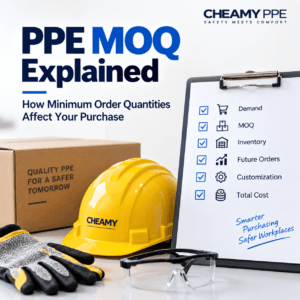
Minimum Order Quantity (MOQ) can affect both purchasing cost and inventory.
A supplier may have MOQ requirements based on:
- Product
- Color
- Size
- Customization
- Packaging
- Production batch
For example, a supplier may accept a small order for a standard product but require a larger quantity for customized PPE.
Buyers should therefore ask:
- What is the MOQ?
- Is MOQ per product?
- Is MOQ per color?
- Is MOQ per size?
- Is MOQ affected by customization?
- Can a trial order be arranged?
The right MOQ is not necessarily the lowest MOQ.
The better question is:
“What order quantity makes sense for our actual demand?”
12. Plan PPE Lead Time Carefully
Production lead time and delivery time are not the same.
A typical international order may involve:
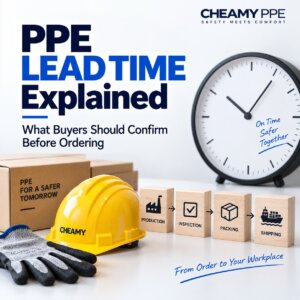
Order Confirmation → Material Preparation → Production → Inspection → Packing → Export Preparation → Shipping → Customs Clearance → Local Delivery
Ask the supplier:
- When does production start?
- Are materials available?
- Does customization add time?
- When will the goods be ready for shipment?
- What is the expected transportation time?
- What delivery date should be planned?
For project-based procurement, work backward from the date when the PPE needs to be available at the job site.
The shortest quoted lead time is not necessarily the most realistic schedule.
13. Confirm Payment and Shipping Terms
Before placing an order, make sure the commercial terms are clearly understood.
Depending on the transaction, buyers may need to confirm:
- Payment terms
- Trade terms
- Shipping method
- Destination port
- Insurance responsibility
- Freight responsibility
- Customs responsibility
- Required shipping documents
Common international trade terms include FOB and CIF, while other arrangements may be appropriate depending on the order.
The important point is not simply choosing a trade term.
Both buyer and supplier should understand who is responsible for each stage of the shipment.
14. Check Packaging and Labeling Requirements
Packaging should be confirmed before production rather than at the last minute.
Depending on the project, buyers may specify:
- Individual packaging
- Inner cartons
- Master cartons
- Quantity per carton
- Carton dimensions
- Product labels
- Size labels
- Barcodes
- Shipping marks
- Customer information
Packaging can affect:
- Storage
- Transportation
- Warehouse handling
- Product identification
- Shipping volume
- Project requirements
For large PPE orders, packaging is part of the purchasing specification—not simply an afterthought.
15. Control PPE Quality Before Shipment
Before the goods leave China, buyers should confirm that the finished order matches the agreed requirements.
Pre-shipment quality control can include:
Product
- Material
- Appearance
- Workmanship
- Dimensions
- Sizes
- Colors
- Components
Quantity
- Total quantity
- Quantity by size
- Quantity by color
- Quantity by model
Customization
- Logo
- Printing
- Labels
- Product markings
- Custom packaging
Documentation
- Commercial Invoice
- Packing List
- Applicable certificates
- Test reports
- Datasheets
- Other required documents
The purpose of pre-shipment inspection is not simply to find defective products.
It is to confirm:
“Is the finished order what we agreed to purchase?”
16. Keep Clear Records for Repeat Orders
If you plan to purchase the same PPE again, keep a clear record of the approved order.
Useful references include:
- Product specification
- Approved sample
- Datasheet
- Product photos
- Logo artwork
- Packaging specification
- Inspection requirements
- Previous order information
- Quality issues and corrective actions
This makes future orders easier to manage.
Instead of saying:
“Please supply the same product as last time.”
you can provide a clear reference for what “the same product” means.
This is particularly important for customized PPE and long-term purchasing programs.
17. Build a Long-Term Relationship With the Right Supplier
For recurring PPE requirements, the supplier relationship should go beyond individual transactions.
A reliable sourcing relationship can make it easier to:
- Maintain product consistency
- Plan repeat orders
- Manage customization
- Forecast demand
- Coordinate multiple products
- Address quality issues
- Plan production schedules
- Improve communication
However, long-term cooperation should still be supported by clear specifications and quality-control procedures.
A good relationship does not replace good procurement controls.
Trust is valuable, but clear requirements make trust easier to manage.
18. Common Mistakes When Sourcing PPE from China
International buyers can avoid many problems by watching for these common mistakes:
Choosing Only by Price
The cheapest quotation may not provide the best overall value.
Sending an Incomplete RFQ
Missing specifications can lead to incomparable quotations.
Skipping Samples
This increases uncertainty before a large order.
Ignoring MOQ
A low unit price may come with a quantity that exceeds actual demand.
Confusing Production Time With Delivery Time
Production completion does not mean the goods have arrived.
Checking Certificates Without Checking the Product
Documentation should correspond to the actual product and configuration.
Changing Specifications After Production Starts
Late changes can cause additional cost and delays.
Ignoring Repeat-Order Consistency
A successful first order does not automatically guarantee identical future production.
A structured purchasing process helps reduce these risks.
19. A Practical PPE Sourcing Process
For international buyers, the complete sourcing process can be simplified into the following steps:
1. Define Requirements
↓
2. Find Suitable China PPE Suppliers
↓
3. Send RFQ
↓
4. Compare Quotations
↓
5. Review Specifications and Documents
↓
6. Request Samples
↓
7. Approve Product
↓
8. Confirm MOQ and Order Quantity
↓
9. Confirm Lead Time and Commercial Terms
↓
10. Place Purchase Order
↓
11. Monitor Production
↓
12. Conduct Pre-Shipment Quality Control
↓
13. Check Shipping Documents
↓
14. Arrange Shipment
↓
15. Evaluate the Order for Future Purchases
This process provides a practical framework for both one-time projects and long-term PPE sourcing.
20. Questions to Ask a China PPE Supplier
Before placing an order, international buyers can ask:
Product
- What is the exact product model?
- What materials are used?
- What sizes and colors are available?
- What standards apply?
- Can you provide a datasheet?
Quality
- Can you provide samples?
- How is production quality controlled?
- Can pre-shipment inspection be arranged?
- How are quality issues handled?
Customization
- Can you provide OEM or ODM services?
- What customization options are available?
- What is the MOQ for customization?
- How long does customization take?
Order
- What is the MOQ?
- What is the production lead time?
- When does the lead time start?
- What is the packaging specification?
Shipping
- Which shipping terms are available?
- What documents will be provided?
- What is the estimated shipping schedule?
- Who is responsible for each part of the shipment?
Clear answers to these questions can help buyers compare suppliers more effectively.
21. When Is a China PPE Supplier a Good Choice?
Sourcing from China can be particularly useful for buyers who need:
- Multiple PPE categories
- Bulk purchasing
- Product customization
- OEM or ODM services
- Competitive sourcing options
- Project-based PPE supply
- Long-term repeat orders
- Consolidated procurement
However, the right supplier depends on the buyer’s specific requirements.
A supplier should be evaluated not only by the products it can offer, but also by its ability to coordinate specifications, quality, customization, documentation, production, and delivery.
Why CHEAMY PPE for China PPE Sourcing?
For international buyers looking to source multiple PPE categories from China, CHEAMY PPE provides a one-stop sourcing approach covering product selection, customization, order coordination, quality control, and export arrangements.
As a PPE trade company and supplier, CHEAMY works with different production partners to support buyers across multiple PPE categories rather than focusing on a single product line.
The focus is simple:
Clear Requirements → Suitable Products → Controlled Quality → Reliable Supply
For buyers planning bulk PPE purchases or long-term sourcing programs, clear communication and consistent requirements are essential to building an efficient supply relationship.
Final Thoughts
Sourcing PPE from China does not need to be complicated, but it does require a structured approach.
The most important steps are:
Define your requirements.
Find suitable suppliers.
Send a clear RFQ.
Compare complete specifications, not just prices.
Request samples when necessary.
Check applicable standards and documents.
Confirm MOQ and lead time.
Control quality before shipment.
Keep clear references for repeat orders.
The goal is not simply to find a supplier that can offer PPE at a low price.
The goal is to build a sourcing process that consistently delivers the right PPE, at the right quality, quantity, cost, and time.
For international buyers, that is what turns PPE sourcing from China from a simple purchasing transaction into a more reliable long-term supply strategy.