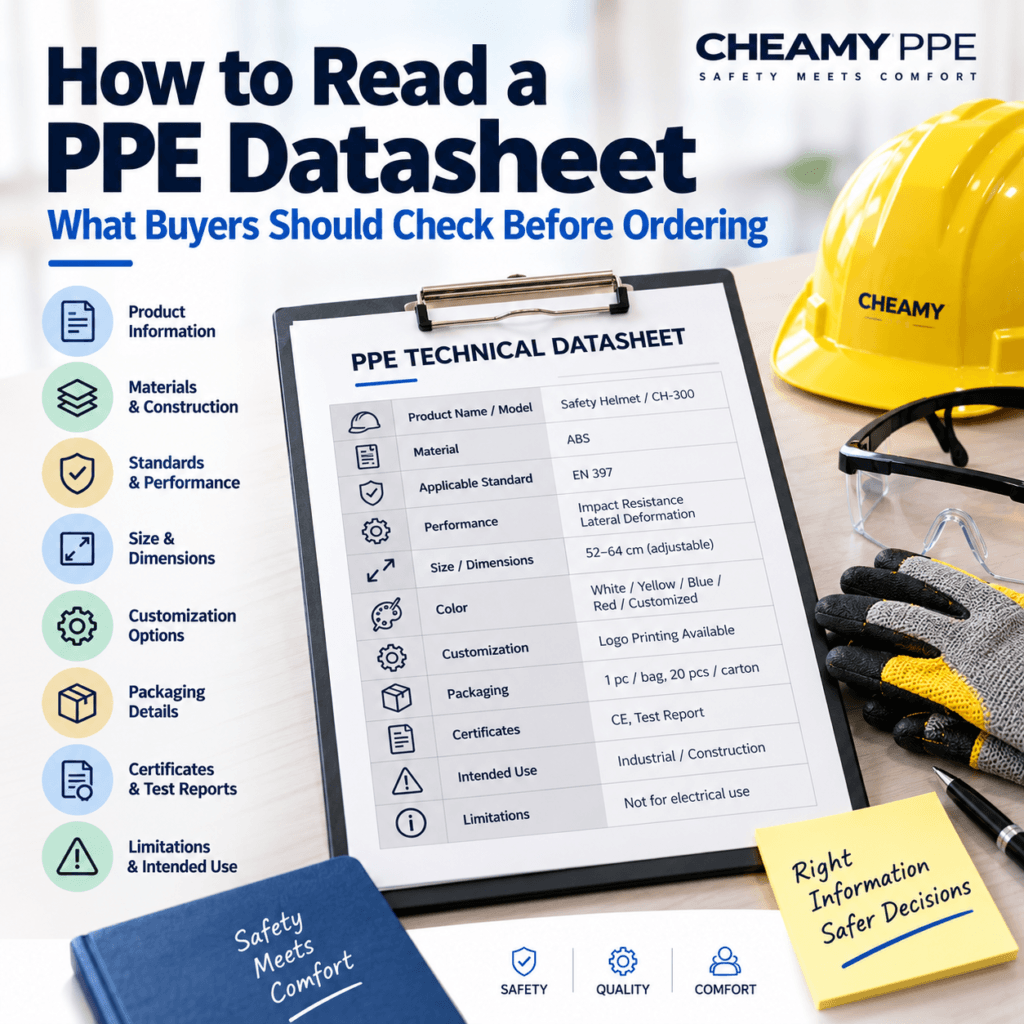
When buying PPE, many procurement decisions start with a product photo, a quotation, or a simple product name.
But these details rarely tell the whole story.
A safety helmet may look like another safety helmet. Two pairs of protective gloves may appear almost identical. Two coveralls may have similar colors and designs.
The differences often appear in the PPE datasheet.
A PPE datasheet provides technical information that helps buyers understand what a product is made of, how it is designed, what requirements it is intended to meet, and which specifications should be confirmed before ordering.
For international buyers sourcing PPE from China or other markets, knowing how to read a datasheet can make supplier communication much clearer and reduce the risk of ordering the wrong product.
What Is a PPE Datasheet?
A PPE datasheet, also called a PPE technical data sheet or product specification sheet, is a document that describes the key characteristics of a PPE product.
Depending on the product, it may include information such as:
- Product name and model
- Materials
- Dimensions
- Weight
- Sizes
- Colors
- Performance characteristics
- Applicable standards
- Protection levels
- Construction details
- Packaging information
- Product limitations
- Available configurations
The exact information varies by PPE category.
A glove datasheet will not look the same as a safety helmet datasheet, and a protective coverall datasheet will contain different information from a respirator datasheet.
The purpose is the same:
To give buyers enough technical information to understand what they are actually purchasing.
1. Start With the Exact Product Name and Model
The first thing to check is surprisingly simple:
What exactly is the product?
Look for:
- Product name
- Model number
- Item code
- Product type
- Product version, where applicable
This is important because one supplier may offer several similar products under almost identical names.
For example:
Cut-Resistant Gloves
is not a complete technical identification.
A better description may specify:
Cut-resistant glove, knitted liner, coated palm, specified cut-performance level, available in sizes M–XL.
When comparing products from different suppliers, always make sure you are comparing the same model or equivalent specification.
2. Check the Intended Application
A datasheet may indicate the intended application or working environment.
This helps buyers determine whether the product is appropriate for the actual task.
For example, different gloves may be designed for:
- General handling
- Mechanical risks
- Cut hazards
- Chemical handling
- Heat exposure
- Impact protection
- Oil-related handling conditions
Similarly, protective clothing may be designed for different hazards and working environments.
A product should therefore be evaluated based on:
What hazard does the worker face?
rather than:
What product looks suitable?
The intended application should match the actual risk assessment and purchasing requirement.
3. Check the Material
Material is one of the most important sections of a PPE datasheet.
Depending on the product, look for information such as:
Gloves
- Liner material
- Coating material
- Coating coverage
- Cuff material
- Reinforcement
Protective Clothing
- Fabric composition
- Fabric weight
- Coating or finish
- Reflective material
- Closure system
- Reinforced areas
Safety Helmets
- Shell material
- Suspension material
- Adjustment system
- Accessories
Material information helps buyers distinguish products that may look similar but have different construction and performance characteristics.
For customized PPE, material specifications should be confirmed before bulk production.
4. Check the Product Dimensions and Weight
Dimensions are often overlooked when buyers focus on appearance and price.
Depending on the product, check:
- Product length
- Width
- Thickness
- Weight
- Size range
- Adjustable range
- Packaging dimensions
For example, the weight of a safety helmet can affect wearer comfort, while the thickness and dimensions of protective clothing can influence movement and fit.
For products purchased in large quantities, packaging dimensions can also affect warehouse space and shipping volume.
5. Check the Size Range
Never assume that a product is available in the sizes you need.
Check the actual size range stated in the datasheet.
For example:
S / M / L / XL / XXL
may not mean that every size is available for every color or customization option.
For workwear, gloves, footwear, and other fitted PPE, also check whether the supplier provides a size chart.
A good procurement process should distinguish between:
Size availability
and
Actual fit.
A size chart helps with selection, while samples help verify practical fit.
6. Check the Applicable Standard
Standards are often one of the most important parts of a PPE datasheet.
Depending on the product and target market, you may see references to standards such as:
- EN 388
- EN 407
- EN 374
- EN 166
- EN ISO 20345
- EN ISO 20471
- EN 397
- ASTM standards
- ANSI/ISEA standards
- NFPA requirements
However, buyers should not stop at seeing a standard number.
Ask:
Which standard?
Which performance level?
Which product or model does it apply to?
Is the documentation applicable to the quoted product?
This distinction matters.
Simply writing:
“EN standard”
does not provide enough technical information for a meaningful purchasing decision.
7. Look at Performance Levels
Some PPE standards contain different performance levels or classifications.
The datasheet may therefore include specific test results or performance ratings.
For example, depending on the product, buyers may need to evaluate characteristics related to:
- Abrasion
- Cut resistance
- Tear resistance
- Puncture
- Heat resistance
- Impact protection
- Visibility
- Chemical resistance
- Electrical protection
The correct performance level depends on the intended application.
A higher number is not automatically “better” for every application, and different performance characteristics should not be treated as interchangeable.
The key question is:
Does the product provide the performance required for the specific workplace hazard?
8. Understand the Difference Between a Datasheet and a Certificate
This is an important distinction for PPE buyers.
PPE Datasheet
Usually explains:
What the product is and what its stated specifications are.
Test Report
Provides information about:
Testing performed on a product against specified requirements.
Certificate
Depending on the applicable regulatory or certification system, may provide evidence of conformity or certification under specified conditions.
These documents serve different purposes.
A supplier saying:
“Certificate available”
does not mean the buyer has already verified all relevant technical information.
When purchasing PPE, check whether the documentation corresponds to:
- The exact product
- The correct model
- The relevant standard
- The appropriate manufacturer or responsible party
- The required market or regulatory framework
9. Check Product Configuration
A product may have several configurations.
For example, a safety helmet may be available with:
- Different colors
- Different suspension systems
- Chin straps
- Visors
- Ear protection
- Different adjustment systems
Protective clothing may have different:
- Fabric options
- Reflective tape configurations
- Pockets
- Closures
- Colors
- Sizes
- Logo options
Make sure the datasheet describes the configuration you are actually ordering.
Otherwise, the supplier’s standard model and your final customized product may not be exactly the same.
10. Check Customization Details
For OEM or customized PPE, the datasheet alone may not contain every customization detail.
Additional requirements may include:
- Logo position
- Logo size
- Printing method
- Embroidery
- Label design
- Product color
- Pantone reference
- Packaging
- Carton markings
- Customized specifications
These details should be separately confirmed and ideally incorporated into the final approved product specification.
For a China PPE supplier, clear communication of customization requirements is particularly important when the product will be manufactured or sourced specifically for the buyer.
11. Check Packaging Information
Packaging information may seem less important than technical performance, but it matters in bulk PPE procurement.
A datasheet or quotation may specify:
- Individual packaging
- Pieces per polybag
- Pieces per carton
- Carton dimensions
- Gross weight
- Net weight
For large international orders, packaging can influence:
- Shipping volume
- Warehouse space
- Handling
- Distribution
- Product protection
If packaging is important to your project, confirm it before production rather than treating it as a last-minute detail.
12. Look for Product Limitations
A professional datasheet should not only help buyers understand what a product can do.
It should also help them understand what it cannot do.
Depending on the PPE category, limitations may relate to:
- Specific hazards
- Exposure conditions
- Temperature
- Chemical compatibility
- Duration of use
- Environmental conditions
- Product compatibility
This is particularly important for specialized PPE.
A product should never be selected simply because a datasheet contains an impressive list of protection claims.
The claims need to be relevant to the actual application.
13. Compare the Datasheet With the Quotation
This is where the datasheet becomes especially useful for procurement.
Do not keep the quotation and technical documentation separate in your decision-making process.
Compare them directly.
| Item | Quotation | Datasheet | Buyer Check |
|---|---|---|---|
| Product Model | ✓ | ||
| Material | ✓ | ||
| Standard | ✓ | ||
| Performance | ✓ | ||
| Size | ✓ | ||
| Color | ✓ | ||
| Customization | ✓ | ||
| Packaging | ✓ | ||
| MOQ | ✓ | ||
| Lead Time | ✓ |
If the quotation says one thing and the datasheet says another, clarify the difference before placing the order.
14. Compare the Datasheet With the Sample
For products where physical evaluation is appropriate, the next step is to compare the technical document with the actual sample.
Check:
- Product construction
- Materials
- Dimensions
- Color
- Logo
- Labels
- Fit
- Functional features
- Accessories
- Packaging
This creates three useful checkpoints:
Datasheet
What is specified?
Quotation
What is commercially offered?
Sample
What does the actual product look and feel like?
For larger orders, these three should tell a consistent story.
15. Check for Missing Information
A datasheet does not have to contain every possible detail.
But missing information can be a reason to ask questions.
For example:
Product name: Safety Gloves
Material: Nylon
Standard: EN 388
This may still leave important questions unanswered.
Depending on the product, buyers may need to clarify:
- Exact model
- Performance level
- Coating
- Thickness
- Size range
- Test documentation
- Application
- Packaging
- Product limitations
Missing information is not necessarily a problem. Unexplained missing information is.
16. Watch for These PPE Datasheet Warning Signs
Before placing a bulk order, pay attention to the following:
1. Generic product descriptions
The datasheet contains very little information about the actual product.
2. Unclear model numbers
It is difficult to determine which product the document refers to.
3. Standards listed without details
A standard is mentioned, but the relevant performance information is unclear.
4. Documentation that does not clearly match the product
The document refers to a different model or product configuration.
5. Specifications that change between documents
The quotation, datasheet, sample, and other documents do not match.
6. No clear revision or version information
For customized or repeatedly purchased products, version control can become important.
7. Overly broad protection claims
The document appears to suggest that one product protects against many hazards without clearly explaining the applicable conditions.
When in doubt, ask the supplier to clarify the technical requirement before confirming the order.
17. Create a Buyer-Friendly PPE Specification Checklist
Before approving a PPE product, buyers can use a simple checklist:
Product Identification
- Product name
- Model number
- Item code
Technical Specification
- Material
- Dimensions
- Weight
- Size range
- Color
- Construction
Protection
- Intended application
- Applicable standard
- Performance level
- Limitations
Documentation
- Datasheet
- Test report, where required
- Certificate or conformity documentation, where applicable
- User information
Commercial Requirements
- MOQ
- Customization
- Packaging
- Lead time
- Delivery terms
Final Verification
- Sample checked
- Specification confirmed
- Documentation reviewed
- Bulk production reference confirmed
This checklist can help turn a technical datasheet into a practical purchasing tool.
How a Good PPE Datasheet Supports Better Procurement
A good datasheet does more than provide technical information.
It creates a common reference between:
Buyer → Supplier → Quality Control → Production → Inspection
When the specification is clear, everyone has a better understanding of what is expected.
This becomes especially valuable for customized PPE and repeat orders.
For example, if a buyer needs the same protective clothing again six months later, a clear technical specification can help reduce uncertainty about:
- Fabric
- Color
- Reflective tape
- Logo
- Construction
- Size
- Packaging
The goal is not simply to have more documents.
The goal is to have clear and consistent information.
Final Thoughts
A PPE datasheet should not be treated as a document to download and file away.
It is a practical tool for making purchasing decisions.
Before ordering, ask:
What exactly is this product?
What is it made of?
What protection does it provide?
Which standard and performance requirements apply?
Does the documentation match the product?
Does the sample match the specification?
Are the commercial and customization details clear?
For buyers working with a China PPE supplier, these checks can make communication more precise and help reduce misunderstandings before bulk production.
A quotation tells you how much the product costs.
A sample shows you what the product looks and feels like.
A datasheet helps you understand what the product is supposed to be.
When all three tell the same story, you are in a much stronger position to place the order.