When sourcing PPE, buyers often focus on unit price, product specifications, and delivery time.
But there is another number that can significantly affect the purchasing decision:
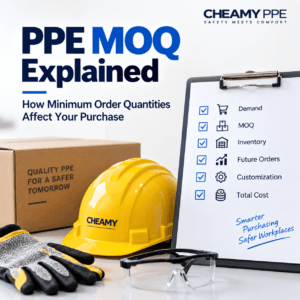
MOQ — Minimum Order Quantity.
A supplier may offer an attractive price, but if the minimum order quantity is much higher than your actual requirement, the deal may not be as attractive as it first appears.
For international buyers working with PPE suppliers, understanding MOQ can help control inventory, cash flow, customization costs, and overall procurement risk.
What Does PPE MOQ Mean?
MOQ stands for Minimum Order Quantity.
It is the minimum quantity a supplier requires a buyer to order under specified purchasing conditions.
For example:
MOQ: 5,000 pairs
This may mean that the buyer needs to purchase at least 5,000 pairs of the product.
However, the important question is:
5,000 pairs of what exactly?
The MOQ could apply to:
- One product model
- One color
- One size
- One customized specification
- One packaging configuration
- The entire order
Therefore, buyers should always clarify how the supplier defines its MOQ.
1. Why Do PPE Suppliers Set MOQs?
MOQ is not necessarily a sign that a supplier is unwilling to work with smaller buyers.
There are practical reasons behind minimum quantities.
Raw Materials
Suppliers may need to purchase fabrics, coatings, plastics, rubber, packaging materials, or other components in minimum quantities.
Production Setup
Some PPE products require preparation before production starts.
For customized products, this may include:
- Printing
- Embroidery
- Molds
- Labels
- Packaging
- Special materials
- Color matching
Small quantities may not efficiently cover these setup costs.
Production Efficiency
Producing a larger quantity can make production more efficient.
For example, changing between colors, sizes, materials, or product configurations can require additional setup time.
Customized Packaging
A buyer requesting customized cartons, labels, or individual packaging may face a higher MOQ than a buyer purchasing standard packaging.
MOQ is therefore often connected to the way a product is sourced, prepared, customized, and produced.
2. Standard PPE vs Customized PPE
MOQ can be very different depending on whether the product is standard or customized.
Standard PPE
Standard products may offer more flexibility because the supplier may already have:
- Existing materials
- Standard colors
- Existing molds
- Regular packaging
- Available production arrangements
Customized PPE
Customized products may have additional MOQ requirements because the supplier needs to prepare specific materials or production arrangements.
Examples include:
- Custom logo
- Custom color
- Pantone color matching
- Customized labels
- Customized packaging
- Special product specifications
- Private labeling
For example, a supplier may accept a relatively small quantity of a standard safety vest but require a larger quantity for a vest with customized fabric, color, logo, and packaging.
3. Is MOQ Per Order, Per Product, or Per Color?
This is one of the most important questions buyers should ask.
Suppose a supplier says:
MOQ: 5,000 pcs
There are several possible interpretations.
Option A — Total Order
You can order:
2,000 blue + 2,000 yellow + 1,000 orange
Total:
5,000 pcs
Option B — Per Color
You may need:
5,000 blue
5,000 yellow
5,000 orange
Option C — Per Size
The supplier may require:
5,000 pcs per size
Option D — Per Product Model
If you order several models, each model may have its own MOQ.
These differences can have a major effect on inventory requirements.
Never assume that “MOQ 5,000 pcs” means 5,000 pcs for the entire purchase order.
Ask the supplier to define it clearly.
4. MOQ and Your Actual Demand
The right MOQ depends partly on how much PPE you actually need.
Imagine your project requires:
3,000 pairs of protective gloves
but the supplier’s MOQ is:
5,000 pairs
You now have several options.
Option 1: Accept the MOQ
You purchase 5,000 pairs and keep the remaining 2,000 for future use.
This can make sense if you expect continued demand.
Option 2: Negotiate a Lower MOQ
You can ask whether the supplier can accept 3,000 pairs, potentially with a different price.
Option 3: Adjust the Product
A standard product may have a lower MOQ than a fully customized product.
Option 4: Plan a Repeat Order
If you expect regular purchases, you can discuss a longer-term supply arrangement.
The best solution depends on the product, demand, customization, and supplier’s production conditions.
5. Lower MOQ Does Not Always Mean Lower Cost
A lower MOQ can be attractive, but it may come with a higher unit price.
For example:
| Order Quantity | Unit Price | Total Product Cost |
|---|---|---|
| 2,000 pcs | $4.20 | $8,400 |
| 5,000 pcs | $3.70 | $18,500 |
| 10,000 pcs | $3.40 | $34,000 |
The 10,000-piece order has the lowest unit price.
But that does not automatically make it the best purchasing decision.
The buyer also needs to consider:
- Actual demand
- Inventory
- Storage
- Cash flow
- Product shelf life, where applicable
- Future projects
- Product changes
- Customization requirements
The lowest unit price and the lowest overall procurement cost are not always the same thing.
6. Higher MOQ Does Not Always Mean Better Value
The opposite is also true.
A supplier may offer a much lower price for a very large order.
But if the buyer only needs a fraction of the quantity, excess inventory can become a hidden cost.
For example:
Required: 6,000 pcs
Supplier MOQ: 20,000 pcs
The lower unit price may look attractive.
But the buyer now needs to store an additional 14,000 pieces.
That may create:
- Warehouse costs
- Cash flow pressure
- Inventory management
- Distribution problems
- Risk of unused stock
Before accepting a high MOQ, ask:
Will we realistically use the additional quantity?
7. MOQ and Customization
Customization deserves special attention.
A standard PPE product and a customized PPE product may have very different MOQ requirements.
For example, customization may involve:
Product
- Special material
- Special color
- Special dimensions
- Modified construction
Branding
- Logo printing
- Embroidery
- Labels
Packaging
- Custom polybags
- Custom cartons
- Printed packaging
- Special carton markings
The more customized the order becomes, the more important it is to discuss MOQ at the beginning of the project.
Do not finalize the product design first and ask about MOQ later.
8. MOQ and Sizes
Size distribution is another detail that buyers should clarify.
Suppose the total requirement is:
5,000 coveralls
with:
- S: 500
- M: 1,500
- L: 2,000
- XL: 800
- XXL: 200
The total quantity is 5,000 pieces.
But what if the supplier’s MOQ applies separately to each size?
The purchasing conditions could become very different.
Therefore, ask:
Can different sizes be mixed within the MOQ?
This is especially important for:
- Gloves
- Safety footwear
- Workwear
- Coveralls
- Protective clothing
- Respiratory products with size options
9. MOQ and Colors
The same issue applies to colors.
For example, a buyer may need:
3,000 yellow safety vests
1,000 orange safety vests
1,000 red safety vests
Total:
5,000 pcs
But the supplier may require a minimum quantity for each color.
Color requirements should therefore be confirmed before approving the quotation.
This becomes even more important when custom colors or Pantone matching are involved.
10. MOQ and Packaging
Packaging can also affect MOQ.
Standard packaging may allow greater flexibility.
Customized packaging may require a minimum quantity for:
- Printed bags
- Cartons
- Labels
- Stickers
- Inserts
For example, if a buyer wants individually customized packaging for a relatively small order, the packaging supplier may have its own minimum production quantity.
Therefore, buyers should ask whether the quoted MOQ applies to:
The PPE product only, or the complete customized package?
11. MOQ for Trial Orders
A trial order can be useful when working with a new PPE supplier.
Instead of immediately committing to a large customized order, buyers can discuss whether a smaller initial quantity is possible.
A trial order can help evaluate:
- Product quality
- Fit
- Worker acceptance
- Packaging
- Customization
- Delivery
- Supplier communication
If the product performs well, the buyer can then move toward larger orders.
However, a trial quantity may have a different unit price from the supplier’s standard bulk price.
That is normal.
The purpose of a trial order is not necessarily to achieve the lowest unit price.
Its purpose is to reduce uncertainty before a larger commitment.
12. Can PPE MOQ Be Negotiated?
Sometimes, yes.
Whether MOQ can be adjusted depends on factors such as:
- Product type
- Standard vs customized product
- Material availability
- Production schedule
- Existing inventory
- Packaging requirements
- Order frequency
- Relationship with the supplier
Buyers can improve their chances of negotiating a lower MOQ by explaining their actual purchasing plan.
For example:
“Our initial requirement is 3,000 pieces, but we expect repeat orders every quarter.”
This gives the supplier more useful information than simply saying:
“Your MOQ is too high.”
How to Choose the Right PPE Order Quantity
The right order quantity should be based on more than the supplier’s MOQ.
Before placing an order, buyers should consider four main factors:
1. Current Demand
Start with the actual PPE requirement for the current project or workforce.
For example:
Current requirement: 5,000 pairs
This gives you a starting point, but it should not automatically become the final order quantity.
2. Expected Future Demand
If the same PPE is likely to be used again, it may make sense to purchase additional quantities.
For example:
Current requirement: 5,000 pairs
Expected future requirement: 2,000 pairs
Ordering 7,000 pairs may be more practical than placing a second small order later, provided the product remains suitable and the additional inventory can be stored.
3. Existing Inventory
Check what you already have before placing a new order.
A simple planning approach is:
Current Demand + Reasonable Safety Stock + Expected Future Demand − Existing Inventory = Suggested Order Quantity
This is not a fixed formula for every PPE product, but it provides a useful starting point for purchasing discussions.
4. Inventory and Cash Flow
Additional quantity means additional inventory.
Before accepting a higher MOQ, consider:
- Warehouse capacity
- Cash flow
- Product shelf life, where applicable
- Expected consumption
- Risk of specification changes
- Future project requirements
For customized PPE, buyers should be particularly careful. A large quantity of products carrying a specific logo, color, or customized specification may be difficult to use for another project.
A Practical Example
Suppose a buyer needs:
5,000 safety vests
The supplier offers:
MOQ: 10,000 pcs
Before automatically accepting the MOQ, the buyer should ask:
- Will another project need the same vest?
- Can the remaining 5,000 pcs be used within a reasonable period?
- Is the product customized?
- Is there enough warehouse space?
- Does ordering 10,000 pcs provide a meaningful price advantage?
- Would a smaller trial order be more appropriate?
If there is no clear reason to purchase the additional 5,000 pieces, a lower MOQ may be worth discussing with the supplier.
The best order quantity is not simply the largest quantity the supplier can offer. It is the quantity that matches your actual purchasing plan.
13. Practical Ways to Manage a High MOQ
If the supplier’s MOQ is higher than your immediate requirement, consider:
Combine Sizes
Ask whether multiple sizes can count toward the same MOQ.
Combine Colors
Check whether colors can be mixed within the minimum quantity.
Use Standard Products
A standard product may have more flexible purchasing conditions.
Reduce Customization
Standard packaging or existing colors may reduce MOQ requirements.
Plan Future Demand
If the product is regularly consumed, additional quantity may be reasonable.
Discuss Repeat Orders
A longer-term purchasing plan may help create more flexible arrangements.
Compare Suppliers
Different PPE suppliers may have different MOQ policies for similar products.
The goal is not simply to force the MOQ lower.
It is to find a purchasing arrangement that works for both sides.
14. Questions Buyers Should Ask About PPE MOQ
Before accepting a quotation, ask the supplier:
- What is the exact MOQ?
- Is the MOQ per order or per product?
- Is it per size?
- Is it per color?
- Can sizes be mixed?
- Can colors be mixed?
- Does customization change the MOQ?
- Does customized packaging change the MOQ?
- Is the MOQ different for standard and customized products?
- Can a smaller trial order be arranged?
- Is the unit price different below the standard MOQ?
- Does the MOQ change for repeat orders?
These questions can prevent misunderstandings before an order is confirmed.
15. PPE MOQ Buyer Checklist
Before placing a bulk PPE order, confirm:
Product
- Exact product model confirmed
- Specification confirmed
- Standard confirmed
- Size range confirmed
- Color confirmed
MOQ
- Total MOQ confirmed
- MOQ per model confirmed
- MOQ per size confirmed
- MOQ per color confirmed
- MOQ for customization confirmed
Commercial
- Unit price confirmed
- Price breaks confirmed
- Packaging confirmed
- Payment terms confirmed
- Lead time confirmed
Planning
- Actual demand estimated
- Future demand considered
- Inventory capacity checked
- Additional quantity justified
Final Verification
- Sample approved where applicable
- Customized details confirmed
- Final purchasing quantity confirmed
MOQ Should Be Part of the Purchasing Decision
MOQ should never be evaluated separately from the rest of the procurement process.
A practical PPE purchasing decision considers:
Product Specification
Unit Price
MOQ
Customization
Packaging
Lead Time
Inventory Requirement
Total Procurement Cost
This is particularly important when sourcing PPE from China, where suppliers may offer different combinations of standard products, customized products, packaging options, and order quantities.
A supplier with a slightly higher unit price but a more suitable MOQ may ultimately be a better fit for the buyer.
Final Thoughts
MOQ is more than a number on a PPE quotation.
It affects how much you buy, how much money you commit, how much inventory you hold, and how flexible your purchasing plan can be.
Before accepting an MOQ, ask:
Does the quantity match our actual demand?
Can sizes and colors be mixed?
Will customization increase the MOQ?
Can we start with a trial order?
What happens when we place repeat orders?
The right MOQ is not necessarily the lowest MOQ.
It is the quantity that balances price, demand, inventory, customization, and future purchasing needs.
A good PPE purchasing strategy does not simply ask, “How much can we buy?” It asks, “How much should we buy?”