Skip to content
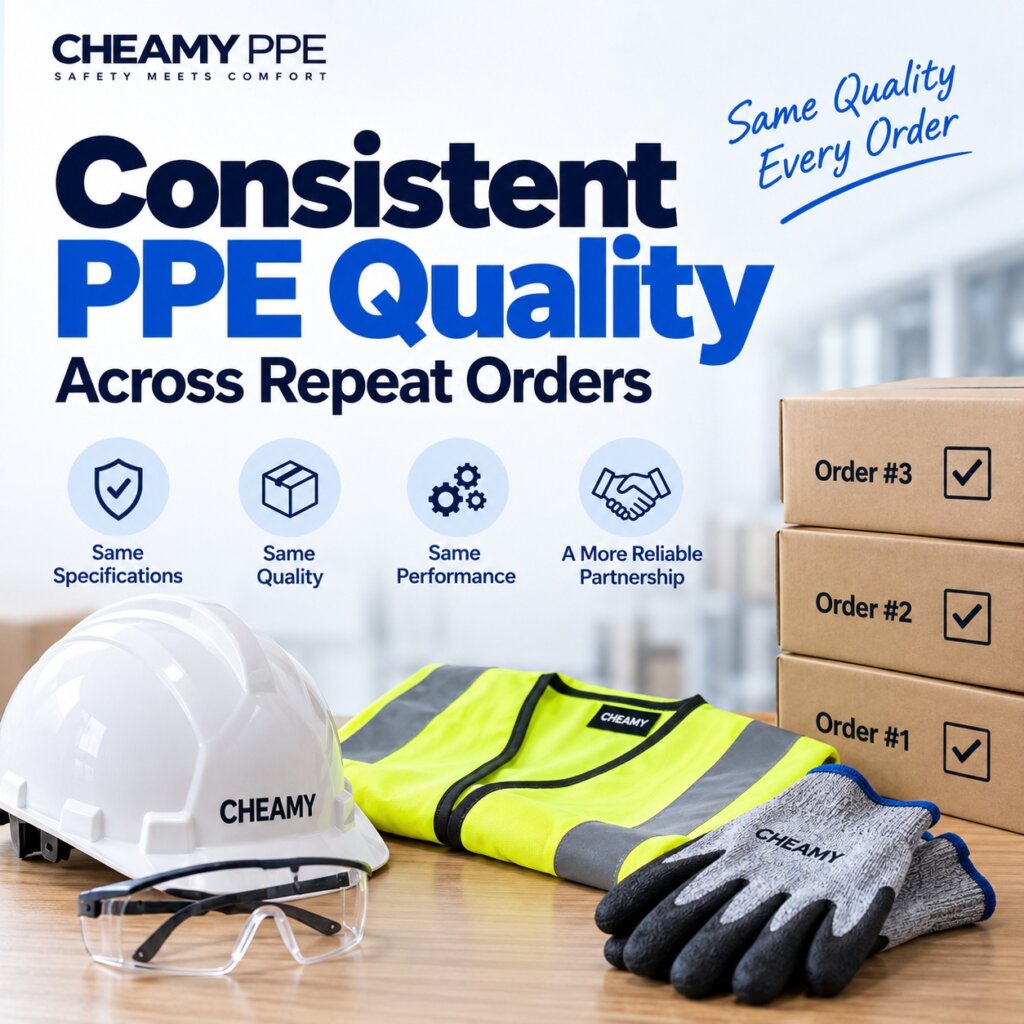
For a one-time PPE purchase, quality control usually focuses on whether the current shipment matches the agreed requirements.
Repeat orders are different.
A buyer may receive the first order exactly as expected, but several months later, the next shipment may look slightly different. The material may feel different. Colors may vary. Packaging may change. A logo may be printed in a different position. Even when the product name and model number remain the same, the actual product can sometimes change.
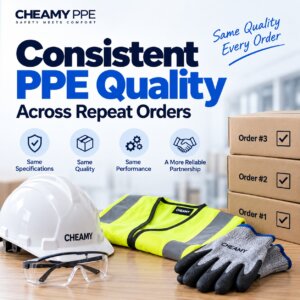
For companies purchasing PPE regularly, maintaining consistency across repeat orders is just as important as checking the first shipment.
The goal is not simply to find a good PPE product once. It is to make sure the same agreed quality can be reproduced order after order.
1. Why PPE Quality Can Change Between Orders
A repeat order does not automatically mean an identical production result.
Several factors can affect consistency:
- Raw material changes
- Different material batches
- Production adjustments
- Changes in components
- Different production lines
- Changes in subcontractors or suppliers
- Updated packaging
- Changes in product specifications
- Different workers or production conditions
- Customization changes
For example, a buyer may approve a pair of work gloves based on its material, coating, color, size, and workmanship.
Six months later, the supplier may still use the same product name, but a material or component has changed.
The product may still look acceptable at first glance, but it may no longer be exactly the same product that was originally approved.
Repeat-order quality starts with controlling what is allowed to change.
2. Keep a Clear Reference for the Approved Product
One of the most effective ways to maintain consistency is to create a clear reference for the product being purchased.
Depending on the PPE category, this may include:
- Product model
- Material specification
- Dimensions
- Weight
- Size range
- Color
- Performance requirements
- Applicable standards
- Components
- Logo artwork
- Labels
- Packaging
- Approved sample
- Product datasheet
For customized PPE, an approved physical sample can be particularly useful.
The reference should answer a simple question:
“What exactly did we approve?”
Without a clear reference, each repeat order may gradually become a new interpretation of the product.
3. Do Not Rely Only on the Product Name
A product name or model number is not always enough to guarantee consistency.
For example:
Safety Gloves Model A
does not tell the buyer everything about the product.
The actual specification may involve:
- Base material
- Coating
- Thickness
- Cuff design
- Color
- Size
- Packaging
- Labeling
- Performance requirements
Two products with the same commercial name can potentially have different configurations.
For repeat orders, buyers should therefore refer to the complete agreed specification, not just the product name.
4. Use the First Approved Sample as a Reference
For customized or important PPE products, keeping an approved sample can provide a useful physical reference.
The sample can be compared with future production for:
- Color
- Material appearance
- Shape
- Dimensions
- Workmanship
- Logo position
- Labels
- Accessories
- Overall construction
However, a sample should not be treated as the only quality requirement.
If the product is subject to specific standards or performance requirements, the relevant technical documentation, testing, and certification requirements should also be considered.
The sample answers:
“Does the product look and feel consistent with what we approved?”
It does not replace applicable performance verification.
5. Control Material Changes
Material changes are one of the most important areas to control during repeat orders.
A supplier may change a raw material because of:
- Availability
- Cost
- Supplier changes
- Production requirements
- Market conditions
Even a small material change can affect:
- Weight
- Thickness
- Flexibility
- Durability
- Color
- Comfort
- Performance
For this reason, buyers can establish a simple rule:
No significant material change without prior confirmation.
If a supplier proposes a material change, ask for the new specification and determine whether a new sample or additional testing is required.
6. Maintain Consistent Colors
Color consistency is particularly important for:
- High-visibility vests
- Workwear
- Coveralls
- Safety helmets
- Gloves
- Customized PPE
A buyer may approve a specific color during the first order, but future production can vary if color requirements are not clearly defined.
For customized products, buyers should keep records of:
- Color reference
- Pantone reference where applicable
- Approved sample
- Logo colors
- Reflective material appearance
For important projects, the buyer should avoid relying only on phrases such as:
“Yellow”
“Orange”
“Navy blue”
A more specific color reference reduces ambiguity.
7. Keep Customization Consistent
Customization is another area where small differences can become noticeable.
For repeat orders, check:
- Logo size
- Logo position
- Printing method
- Printing color
- Embroidery
- Label design
- Label position
- Packaging artwork
- Barcode
- Product markings
For example, if a logo was approved at a specific position on a safety vest, that position should remain part of the repeat-order specification.
The buyer should not have to approve the same basic artwork from scratch every time.
Standardizing customization reduces both errors and unnecessary communication.
8. Review Packaging, Not Just the Product
Packaging can change between orders even when the product itself remains consistent.
Changes may include:
- Carton size
- Quantity per carton
- Inner packaging
- Polybag design
- Labels
- Carton markings
- Shipping marks
Packaging changes can affect:
- Storage
- Warehouse space
- Transportation costs
- Quantity calculations
- Product identification
- Project requirements
For repeat orders, packaging specifications should therefore be included in the purchasing reference.
9. Compare Repeat Orders With Previous Orders
One effective quality-control method is to compare the current order against the previous approved order.
Buyers can compare:
| Item | Previous Order | Current Order |
|---|---|---|
| Product model | Confirmed | Confirmed |
| Material | Approved | Check |
| Color | Approved | Check |
| Size | Approved | Check |
| Weight | Reference | Check |
| Customization | Approved | Check |
| Packaging | Approved | Check |
| Labels | Approved | Check |
The purpose is not to assume that every number must always be identical.
Instead, it helps identify unexpected changes that need clarification.
10. Establish a Change-Control Process
Long-term PPE procurement becomes easier when buyers and suppliers agree on how changes should be handled.
For example:
Supplier identifies a proposed change
↓
Buyer is informed
↓
New specification reviewed
↓
Sample or documentation provided if necessary
↓
Buyer approves or rejects the change
↓
Updated specification recorded
↓
Production begins
This prevents an important change from being introduced without the buyer knowing about it.
A simple change-control process is particularly useful for long-term supply relationships.
11. Do Not Assume the First Order Guarantees Future Quality
A successful first order is a good starting point, but it does not guarantee that every future order will be identical.
Repeat-order quality should be monitored continuously.
Buyers can periodically review:
- Product consistency
- Defect rates
- Customer or worker feedback
- Packaging changes
- Documentation
- Supplier communication
- Delivery performance
If quality begins to drift, it is better to address the issue early rather than wait until it becomes a major problem.
Consistency is something that must be maintained, not simply achieved once.
12. Use the Same Quality Criteria for Repeat Orders
If the acceptance criteria change from one order to another, it becomes difficult to determine whether quality is actually improving or declining.
For repeat PPE purchases, buyers should try to maintain consistent criteria for:
- Appearance
- Dimensions
- Materials
- Workmanship
- Sizes
- Colors
- Customization
- Packaging
- Applicable performance requirements
This creates a stable basis for comparing different production batches.
For large or important orders, buyers may also define inspection and acceptance requirements in advance.
13. Keep Documentation Updated
Long-term PPE procurement often involves multiple documents.
Important records may include:
- Approved specifications
- Product datasheets
- Approved samples
- Test reports
- Certificates
- Artwork
- Packaging specifications
- Inspection records
- Previous order references
These documents should be organized so that the purchasing team can easily identify the latest approved version.
This is especially important when different employees are involved in purchasing over time.
A clear document system helps prevent an old specification from being used accidentally.
14. How to Handle a Quality Difference in a Repeat Order
If the buyer notices a difference between the current and previous order, the first step should be to identify exactly what changed.
Instead of saying:
“The quality is different.”
provide specific information:
“The current gloves appear thinner than the approved sample.”
or:
“The logo position differs from the previous approved production.”
Specific observations make it easier for the supplier to investigate.
The buyer can then ask:
- Was the material changed?
- Was a different component used?
- Was the production process changed?
- Is the difference within the agreed specification?
- Does the change affect product performance?
- Is a new sample required?
The objective should be to determine the cause and impact of the difference, not simply to criticize the supplier.
15. A Practical Repeat-Order Quality Checklist
Before confirming a repeat PPE order, buyers can review:
Product Specification
☐ Same product model
☐ Same material requirements
☐ Same dimensions
☐ Same size range
☐ Same color requirements
☐ Same performance requirements
Customization
☐ Same logo artwork
☐ Same logo position
☐ Same printing or embroidery requirements
☐ Same labels
☐ Same product markings
Packaging
☐ Same packaging specification
☐ Same quantity per carton
☐ Same carton markings
☐ Same shipping marks
Documentation
☐ Latest datasheet confirmed
☐ Applicable certificates confirmed
☐ Relevant test reports checked
☐ Approved sample available for reference
Quality Control
☐ Any material changes disclosed
☐ Any specification changes disclosed
☐ Inspection requirements confirmed
☐ Previous quality issues reviewed
This checklist can be adapted to different PPE products and purchasing programs.
16. When Should a New Sample Be Requested?
Not every repeat order requires a completely new sample.
However, a new sample or additional confirmation may be appropriate when:
- The material has changed
- The product design has changed
- The color has changed
- The customization has changed
- A component has changed
- The packaging has changed significantly
- The buyer has identified quality inconsistencies
- A long period has passed since the previous production
- The applicable requirements have changed
The key principle is simple:
If an important part of the approved product changes, the buyer should know before mass production.
17. Build a Long-Term Quality Agreement With Your PPE Supplier
For companies purchasing PPE regularly, quality should become part of the overall supplier relationship.
A long-term purchasing arrangement can define:
- Product specifications
- Approved samples
- Material requirements
- Change-control procedures
- Inspection requirements
- Packaging
- Documentation
- Communication procedures
- Handling of quality issues
This creates a shared reference for both parties.
Instead of discussing the same quality requirements from the beginning for every order, the buyer and supplier can work from an established standard.
18. Quality Consistency Is More Than Product Appearance
A repeat PPE order should be evaluated from several perspectives.
Good consistency means more than:
“It looks the same.”
It can also include:
Specification consistency
Does the product still meet the agreed requirements?
Material consistency
Are the agreed materials and components being used?
Customization consistency
Are logos, labels, colors, and markings unchanged?
Packaging consistency
Can the goods be stored, identified, and transported in the same way?
Documentation consistency
Do the relevant technical and compliance documents remain appropriate?
Performance consistency
Where applicable, does the product continue to meet the required performance criteria?
This broader view helps buyers manage quality more effectively over time.
19. How Repeat-Order Quality Saves Procurement Time
Maintaining consistent quality does more than protect the product.
It can also simplify procurement.
When a product is standardized:
- Specifications are easier to confirm
- Samples may not need to be recreated unnecessarily
- Artwork does not need to be redesigned
- Packaging requirements are clearer
- Inspection becomes more efficient
- Internal approvals become easier
- Supplier communication becomes faster
In other words, quality consistency can make repeat purchasing more efficient as well as safer.
20. Final Thoughts
A successful first PPE order is only the beginning of a long-term purchasing relationship.
For repeat orders, buyers should not simply say:
“Please supply the same product again.”
They should make “the same product” measurable through clear specifications, approved samples, documented customization, packaging requirements, and appropriate quality-control procedures.
When something changes, the change should be identified and reviewed before production whenever possible.
The goal is not to prevent every small variation.
The goal is to make sure that important changes do not happen without the buyer’s knowledge or approval.
For long-term PPE procurement, consistency creates confidence.
The best repeat order is not one that looks similar to the previous order. It is one that can be traced back to the same clear, approved requirements.
For buyers working with a China PPE supplier, clear specifications, approved samples, change control, and repeat-order quality checks can help maintain consistent product quality over time. CHEAMY PPE supports international buyers with product sourcing, customization, and repeat-order coordination based on agreed requirements.