Skip to content
When purchasing PPE, buyers often ask a simple question:
“What is your lead time?”
A supplier may answer:
“15–30 days.”
At first glance, this seems clear. But what does the 15–30 days actually include?
Does the lead time start from the purchase order, payment, or sample approval? Does it include customization, inspection, and packaging? Does it refer to production completion or final delivery?
For international PPE buyers, these differences can have a major impact on purchasing schedules.
Understanding PPE lead time is therefore not simply about asking how many days a supplier needs. It is about understanding what those days represent, when the clock starts, and what can affect the schedule.
1. What Does PPE Lead Time Mean?
PPE lead time generally refers to the time required to prepare an order from an agreed starting point until the goods reach an agreed production or shipment milestone.
However, suppliers may define lead time differently.
For example:
- Stocked products may be available immediately or within a few days.
- Standard production may require several weeks.
- Customized PPE may require additional time for samples, materials, printing, or packaging.
- Large or complex orders may require a longer production schedule.
These timelines are not directly comparable unless the starting and ending points are clear.
Before placing an order, buyers should ask:
- When does the lead time start?
- When does it end?
- Is customization included?
- Is inspection included?
- Is packaging included?
- Does it include shipping?
A lead-time number without a clear definition is difficult to use for project planning.
2. Production Lead Time Is Not Shipping Time
One of the most important points in international PPE purchasing is the difference between production lead time and transportation time.
A typical order may follow this process:
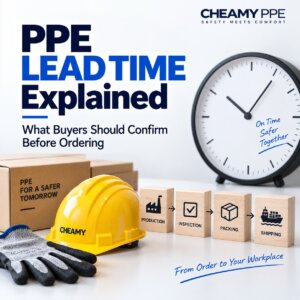
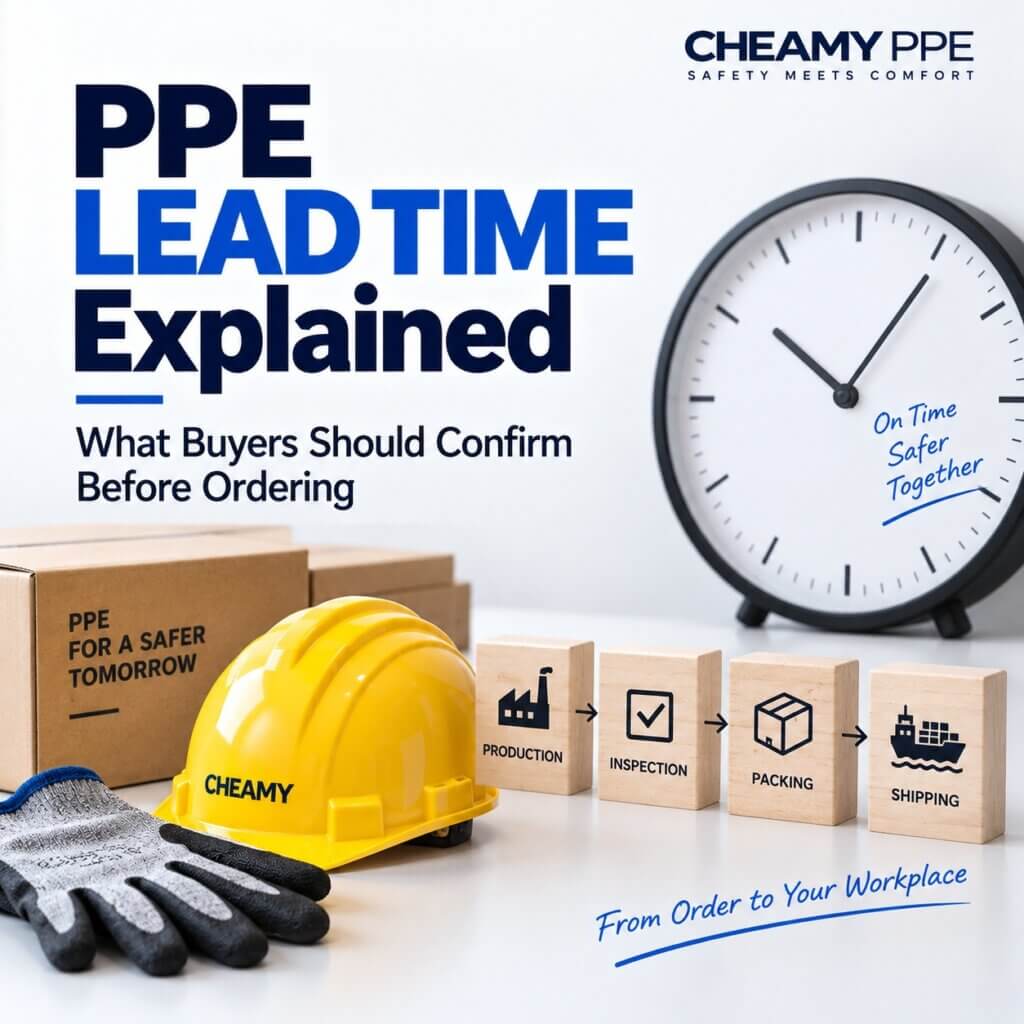
Order Confirmation → Production → Inspection → Packing → Export Preparation → Shipment → Customs Clearance → Local Delivery
A supplier may say:
“Production will take 20 days.”
This does not mean the goods will arrive at the buyer’s warehouse in 20 days.
The actual purchasing timeline may include:
| Stage | Typical Consideration |
|---|---|
| Order confirmation | Specifications and quantity finalized |
| Material preparation | Depends on material availability |
| Production | Depends on product and quantity |
| Inspection & packing | Final quality and packaging checks |
| Export preparation | Shipping and documentation arrangements |
| International transit | Depends on shipping method and route |
| Customs clearance | Depends on destination |
| Local delivery | Depends on final destination |
For international orders, total delivery time is more important than production lead time alone.
3. What Can Affect PPE Lead Time?
PPE lead time can change depending on several factors.
Product Type
Different PPE products require different production processes.
A standard pair of safety gloves may be easier to prepare than:
- Customized coveralls
- Safety helmets with custom colors
- Branded reflective vests
- Specialized protective clothing
- Customized packaging
- Products requiring multiple sizes and colors
Buyers should therefore avoid assuming that every PPE product has the same lead time.
Order Quantity
Order quantity can also affect production scheduling.
Producing 500 pieces is very different from producing 20,000 pieces.
A large order may require:
- More raw materials
- Additional production capacity
- Multiple production batches
- More quality inspection
- Additional packaging preparation
For this reason, buyers should confirm lead time based on their actual order quantity, rather than relying only on a supplier’s standard lead-time statement.
4. Customization Usually Requires More Time
Customization is another important factor.
Standard PPE may be relatively straightforward to prepare, while customized products may require additional steps such as:
- Logo printing
- Embroidery
- Custom colors
- Custom labels
- Custom packaging
- Special materials
- Product modifications
- Special size requirements
For example, a standard reflective vest may be available sooner than a customized vest that requires special fabric, printing, labels, and packaging.
A customized order may follow this process:
Specification Confirmation → Sample → Approval → Material Preparation → Production → Customization → Inspection → Packing
This is why buyers should ask for the lead time of the actual customized configuration, rather than the standard product.
5. Sample Approval Can Affect the Production Schedule
For customized PPE, sample approval can be an important milestone.
If a sample needs to be modified several times, mass production may start later than originally expected.
A typical purchasing process could be:
Requirement Confirmation
↓
Quotation
↓
Sample Development
↓
Sample Approval
↓
Purchase Order
↓
Material Preparation
↓
Mass Production
↓
Inspection
↓
Packing
↓
Shipment
Buyers should confirm which stage officially starts the production lead time.
For example, if a supplier’s lead time starts only after final specification and sample approval, that should be clearly understood before the order is confirmed.
6. Check Material Availability Before Confirming the Date
Production capacity is only one part of the lead-time calculation.
Material availability can also have a significant effect.
Before placing an order, ask:
- Are the main raw materials available?
- Do any materials need to be purchased after order confirmation?
- Are customized colors available?
- Is special fabric or material required?
- Are packaging materials ready?
- Are components and accessories available?
For example, customized workwear may require a particular fabric color. If that material needs to be specially produced first, the actual lead time may be longer than the normal production time.
A realistic delivery schedule should consider material availability before production begins.
7. Peak Seasons Can Affect PPE Lead Time
Production schedules may become tighter during periods of high demand, holidays, or supply-chain disruptions.
Potential factors include:
- Seasonal demand
- Factory production schedules
- Public holidays
- Raw material shortages
- Transportation capacity
- Port congestion
- Sudden increases in project orders
For large or customized PPE orders, buyers should therefore plan ahead instead of relying on the shortest possible production time.
Instead of asking:
“Can you deliver in 20 days?”
a more useful question is:
“Based on our quantity and specifications, what is the realistic production completion date?”
This encourages a more practical discussion about the actual order.
8. How to Tell If a PPE Lead Time Is Realistic
A short lead time is not necessarily a better lead time.
Before accepting a supplier’s promise, buyers should consider:
Is the product standard or customized?
Standard products may be easier to prepare than products requiring special materials or customization.
Are materials already available?
If important materials need to be sourced or produced first, the quoted production time may not represent the complete preparation period.
Has the quantity been considered?
A lead time for a small sample order should not automatically be applied to a large bulk order.
Is sample approval required?
For customized products, production may not begin until the final sample or specifications are approved.
Does the timeline include inspection and packing?
Ask whether the stated date means production finished or goods ready for shipment.
Is the schedule based on current capacity?
A supplier’s normal lead time may change when production capacity is heavily booked.
The most useful lead time is not the shortest number. It is the most realistic schedule based on the actual order.
9. Confirm the Lead Time in Writing
Once an order is confirmed, the agreed timeline should be documented.
Important information can include:
- Product model
- Quantity
- Specifications
- Approved sample
- Customization requirements
- Packaging requirements
- Production start condition
- Estimated completion date
- Shipping arrangement
- Required delivery date
For example:
Production Lead Time: 20–25 days after receipt of deposit and final confirmation of specifications.
This is much clearer than simply stating:
Lead Time: 20 days.
Clear wording helps both the buyer and supplier understand when the production clock starts and what the estimated completion date means.
10. Do Not Confuse “Ready to Ship” With “Delivered”
Another common misunderstanding is the phrase:
“The goods will be ready in 20 days.”
This normally refers to production completion or readiness for shipment.
It does not necessarily mean that the goods will arrive at the buyer’s warehouse in 20 days.
For international PPE orders, buyers should consider:
Production Time + Inspection & Packing + Export Preparation + Transit Time + Customs Clearance + Local Delivery
This distinction is particularly important for project-based PPE procurement.
If workers need PPE before a project starts, the buyer should work backward from the required on-site date, rather than simply calculating from the supplier’s production completion date.
11. Build a Buffer Into the Purchasing Plan
Even when a supplier provides a realistic lead time, unexpected delays can occur.
Possible causes include:
- Material delays
- Production adjustments
- Quality issues
- Rework
- Packaging changes
- Vessel schedule changes
- Port congestion
- Customs clearance delays
For time-sensitive projects, buyers should avoid planning around the absolute minimum possible timeline.
For example:
Required on-site date: June 30
Instead of planning for the PPE to arrive exactly on June 30, a buyer may set an internal target of:
June 20–23
The additional time provides some flexibility if an unexpected issue occurs.
A reasonable buffer is particularly important when PPE is required for a fixed project start date.
12. Questions Buyers Should Ask About PPE Lead Time
Before placing an order, buyers can ask the supplier:
Production
- What is the production lead time?
- When does the lead time start?
- When will production be completed?
- Is the quoted lead time based on current production capacity?
Materials
- Are the main materials available?
- Are any materials made to order?
- Will customized colors or materials affect the schedule?
Customization
- How long does logo printing or other customization take?
- Does custom packaging require additional time?
- Is sample approval required before production?
Quality Control
- Is inspection included in the production schedule?
- When will final inspection be completed?
- Could rework affect the shipment date?
Logistics
- Does the quoted lead time include shipping?
- What is the estimated transit time?
- How should the delivery schedule account for customs clearance?
These questions turn a vague delivery promise into a more practical purchasing timeline.
13. How to Plan the Right PPE Purchasing Timeline
Instead of looking only at the supplier’s production lead time, buyers can build the complete timeline:
Order Confirmation
↓
Production Lead Time
↓
Inspection & Packing
↓
Export Preparation
↓
International Transit
↓
Customs Clearance
↓
Local Delivery
↓
Required On-Site Date
For example, if production requires 20 days and international transportation requires several additional weeks, placing an order only 20 days before the project starts will not be sufficient.
The correct question is not:
“How fast can the supplier produce it?”
It is:
“When do we need to place the order to have the PPE available when and where we need it?”
That is a much more useful procurement question.
14. What to Do When PPE Lead Time Is Too Long
If a supplier’s lead time does not meet your schedule, there may be several options.
Consider Stocked Alternatives
Ask whether standard products are available from existing stock.
Split the Shipment
If some products are ready earlier, consider whether shipping available products first is practical.
Simplify Customization
If customization is causing the delay, consider whether some requirements can be simplified for the initial order.
Place Repeat Orders Earlier
For recurring PPE requirements, forecast future demand instead of waiting until inventory is nearly exhausted.
Discuss the Production Schedule in Advance
For large projects, discussing the purchasing plan early may help suppliers prepare materials and production capacity more effectively.
The best solution depends on the product, quantity, customization requirements, project schedule, and logistics arrangement.
15. PPE Lead Time Checklist
Before confirming an order, buyers can use this checklist:
☐ Product specifications confirmed
☐ Quantity confirmed
☐ MOQ confirmed
☐ Sample approved if required
☐ Customization confirmed
☐ Packaging confirmed
☐ Material availability confirmed
☐ Production lead time confirmed
☐ Production start condition confirmed
☐ Estimated completion date confirmed
☐ Shipping time considered
☐ Customs clearance considered
☐ Buffer time included
☐ Required delivery date communicated
A simple checklist can prevent many avoidable scheduling problems.
16. Lead Time Should Be Part of the Purchasing Decision
PPE purchasing is not simply about finding a product at the right price.
A successful order also requires:
- The right specification
- The right quantity
- The right quality
- The right documentation
- The right production schedule
- The right delivery plan
A supplier offering a slightly lower price may not be the better choice if the order arrives too late for the project.
Price tells you what you pay. Lead time tells you when you can use what you bought.
Both matter.
Final Thoughts
PPE lead time should never be treated as just a number in a quotation.
Before placing an order, buyers should understand:
- When production starts
- What the quoted lead time includes
- Whether materials are available
- Whether customization adds time
- When the goods will actually be ready for shipment
- How long transportation and customs may take
- How much buffer the project requires
For international PPE procurement, the goal is not simply to find the supplier who promises the shortest lead time.
The goal is to build a realistic purchasing timeline that gets the right PPE to the right place at the right time.
That approach helps buyers plan more accurately, reduce last-minute purchasing pressure, and minimize the risk of project delays.
Looking for a China PPE supplier for your next project? CHEAMY PPE can help you clarify product specifications, customization requirements, quantities, production schedules, and shipping arrangements before ordering.