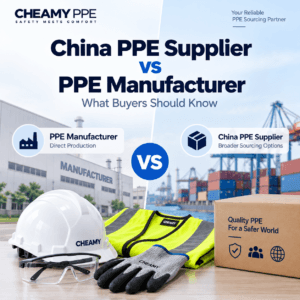
When sourcing personal protective equipment (PPE) from China, buyers often use the terms supplier, manufacturer, and factory interchangeably.
But they are not always the same thing.
A PPE manufacturer may produce specific products in its own facility. A PPE supplier may provide products from one or multiple production partners. A trading company may coordinate sourcing, customization, quality control, documentation, and export arrangements without owning a production facility.
For international buyers, the important question is not simply:
“Is this company a manufacturer?”
A better question is:
“Which type of supplier is best suited to our purchasing requirements?”
Understanding the difference can help buyers choose a more suitable sourcing model, especially when purchasing multiple PPE categories or managing customized and project-based orders.
1. What Is a PPE Manufacturer?
A PPE manufacturer is a company involved directly in producing PPE products.
Depending on its business model, a manufacturer may operate its own production facilities and control processes such as:
- Raw material processing
- Product assembly
- Production
- Quality inspection
- Packaging
- Production scheduling
A manufacturer may specialize in one product category or several related categories.
For example, a manufacturer may focus primarily on:
- Safety helmets
- Protective gloves
- Safety footwear
- Protective clothing
- Respiratory protection
The advantage of working directly with a manufacturer can be strong product-specific expertise and direct access to production.
However, a manufacturer may not necessarily be the best option for every purchasing requirement.
2. What Is a PPE Supplier?
A PPE supplier is a broader term.
A supplier may provide PPE directly from its own production facilities, source products from manufacturing partners, or combine both approaches.
A PPE supplier may focus on helping customers manage the overall purchasing process, including:
- Product sourcing
- Supplier coordination
- Quotation
- Customization
- Quality control
- Packaging
- Documentation
- Logistics coordination
This can be particularly useful when a buyer needs several different PPE categories from one source.
For example, a project may require:
Safety helmets + safety glasses + gloves + coveralls + safety footwear + reflective vests
Instead of contacting six different specialized manufacturers, the buyer may prefer to work with a supplier capable of coordinating the complete requirement.
3. What Is a PPE Trading Company?
A trading company typically does not manufacture all the products it sells.
Instead, it may work with different manufacturers and production partners to source products according to customer requirements.
A trading company can add value through:
- Supplier selection
- Product sourcing
- Price negotiation
- Order coordination
- Quality control
- Export documentation
- Consolidated shipments
This business model is common in international trade.
It does not automatically mean that the products are lower quality.
The important question is:
How does the company control the products and suppliers it works with?
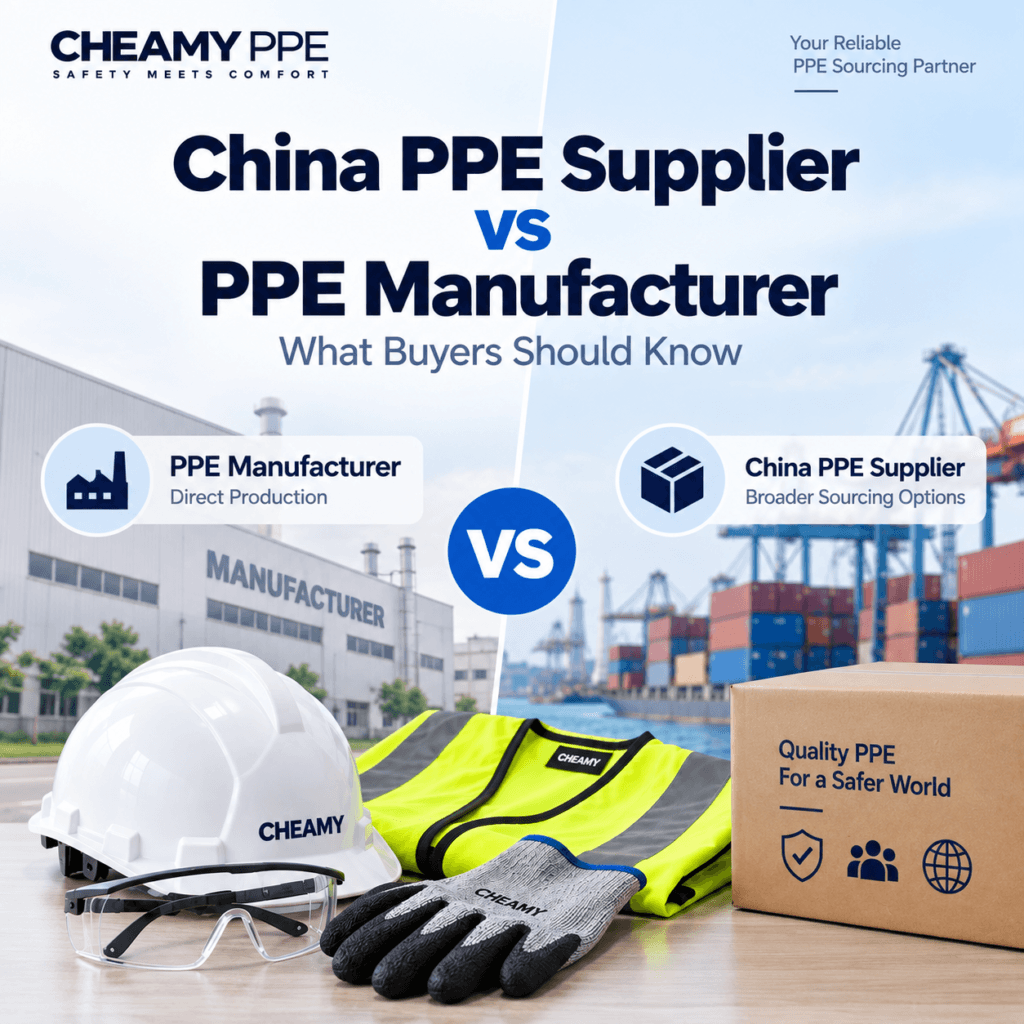
4. Manufacturer vs Supplier: The Basic Difference
The difference can be simplified as follows:
| PPE Manufacturer | PPE Supplier | |
|---|---|---|
| Own production facility | Usually | Not necessarily |
| Produces products directly | Yes, for its production range | May or may not |
| Product range | Often more specialized | Often broader |
| Multiple PPE categories | May be limited | Often easier to coordinate |
| Customization | Depends on factory | Can coordinate with manufacturers |
| Supplier coordination | Mainly internal | May coordinate multiple partners |
| One-stop procurement | Usually limited | Often a key advantage |
| Suitable for | Product-focused purchasing | Multi-category or project purchasing |
Neither model is automatically better.
The right choice depends on the buyer’s requirements.
5. Why Does the Difference Matter to Buyers?
Understanding the business model helps buyers know what to expect.
For example, if you need one highly specialized product in very large quantities, working directly with a specialized manufacturer may make sense.
But if your project requires ten or twenty different PPE products, managing multiple factories can create additional work.
You may need to coordinate:
- Multiple quotations
- Different MOQs
- Different lead times
- Different packaging
- Different production schedules
- Different quality-control processes
- Different shipping arrangements
- Multiple sets of documentation
A capable one-stop PPE supplier may simplify this process.
The best sourcing model depends on the complexity of the purchasing requirement.
6. When Should You Buy Directly From a Manufacturer?
Working directly with a manufacturer can be useful when:
You Need One Specialized Product
If your purchasing requirement focuses heavily on one product category, direct manufacturer cooperation may be practical.
You Need Large Volumes
Large and stable volumes may justify direct communication with a specialized production facility.
You Need Deep Product Customization
Some manufacturers have strong capabilities for product-specific customization.
You Need Direct Production Communication
For technically complex products, direct access to the production team may be valuable.
However, buyers should still evaluate quality, documentation, capacity, lead time, and communication before making a decision.
7. When Is a One-Stop PPE Supplier More Practical?
A one-stop PPE supplier can be particularly useful when the buyer needs multiple categories.
For example:
“We need helmets, gloves, safety glasses, coveralls, safety footwear, and reflective vests for one project.”
Instead of managing multiple factories independently, a supplier may coordinate the products through its sourcing network.
Potential advantages include:
- One purchasing contact
- Consolidated quotations
- Easier communication
- Coordinated production
- Combined quality-control management
- Simplified documentation
- Potentially easier shipment coordination
This can be particularly valuable for contractors, distributors, procurement companies, and industrial projects.
8. Does Buying From a Manufacturer Always Mean Lower Prices?
Not necessarily.
A common assumption is:
Manufacturer = lowest price
But the final purchasing cost depends on many factors.
These can include:
- Product specification
- Order quantity
- MOQ
- Customization
- Packaging
- Payment terms
- Quality requirements
- Inspection
- Logistics
- Supplier margin
- Order complexity
A manufacturer may offer a competitive factory price, but if the buyer needs products from several manufacturers, the overall procurement process can become more complicated.
A supplier may charge a margin while providing sourcing and coordination services.
Therefore, buyers should compare total purchasing value, not simply the factory price.
9. What About MOQ?
MOQ can be very different between manufacturers and suppliers.
A manufacturer may set an MOQ based on:
- Production batch size
- Raw material requirements
- Machine setup
- Customization
- Packaging
A supplier may sometimes coordinate smaller quantities by combining customer requirements or sourcing from a suitable production partner.
However, this depends on the specific product and supplier arrangement.
Buyers should always ask:
- What is the MOQ?
- Is it per product?
- Is it per size?
- Is it per color?
- Is it per customization?
- Can a trial order be arranged?
A lower MOQ is not automatically better if it comes with a significantly higher unit cost.
10. What About Quality Control?
This is one of the most important questions when working with a PPE supplier.
If the supplier does not manufacture the product itself, buyers should understand how quality is controlled.
Ask:
- Who produces the product?
- How is the manufacturer selected?
- What specifications are provided?
- Is a sample approved?
- How is production monitored?
- Is pre-shipment inspection conducted?
- How are quality problems handled?
- Are the relevant documents available?
A supplier does not need to own every factory to provide effective quality management.
What matters is whether there is a clear and reliable quality-control process.
11. What About PPE Certifications and Test Reports?
Buyers should not assume that a company’s business model determines whether a product is compliant.
Whether buying directly from a manufacturer or through a supplier, buyers should verify the documents related to the actual product and configuration.
Depending on the PPE category and market, relevant documents may include:
- Product datasheets
- Test reports
- Certificates
- Declarations of Conformity, where applicable
- Inspection records
- Other project-specific documentation
The key is to connect:
Product → Model → Specification → Applicable Requirement → Supporting Documentation
A certificate should not be evaluated separately from the product it is supposed to cover.
12. How Can Buyers Verify Who Actually Makes the Product?
Buyers sometimes want to understand the production source behind a PPE order.
Depending on the purchasing requirement, useful questions include:
- Where is the product manufactured?
- What production facility is involved?
- Is the product standard or customized?
- Who controls the production?
- Can production photos or videos be provided?
- Can a factory audit be arranged when necessary?
- Who conducts quality inspection?
- Who is responsible for correcting quality problems?
The level of transparency required can depend on the size and importance of the project.
For a large customized order, buyers may reasonably require more detailed information than for a small standard purchase.
13. Manufacturer, Supplier, or Both?
The choice does not always have to be one or the other.
Some PPE businesses operate with a combination of:
Own Production + External Manufacturing Partners + Sourcing Network
This model can provide access to specialized production while also allowing the supplier to offer a broader range of PPE products.
For buyers, the important issue is not the label.
It is whether the company can reliably manage:
- Product specifications
- Production
- Quality
- Customization
- Documentation
- Delivery
Look at the actual supply capability, not just the company title.
14. What Should Buyers Check Before Choosing a PPE Supplier?
Regardless of whether the company is a manufacturer or trading company, buyers should evaluate several areas.
Product Capability
Can the company supply the products you actually need?
Technical Understanding
Can it understand and communicate your specifications correctly?
Quality Control
Does it have a clear process for controlling product quality?
Documentation
Can it provide appropriate technical and compliance documents?
Customization
Can it manage your logo, colors, packaging, labels, or other requirements?
MOQ
Does its MOQ fit your purchasing plan?
Lead Time
Can it provide a realistic production schedule?
Communication
Can the company respond clearly and consistently?
Logistics
Can it coordinate export documentation and shipment arrangements?
These factors often matter more than whether the company describes itself as a “manufacturer.”
15. Red Flags Buyers Should Watch For
Whether dealing with a manufacturer or supplier, buyers should pay attention to warning signs such as:
- Unclear product specifications
- Inconsistent information between quotation and datasheet
- Certificates that do not clearly correspond to the product
- Unwillingness to provide samples
- Unclear production arrangements
- Unrealistic lead times
- Constantly changing prices
- Poor communication
- No clear quality-control process
- Major specification changes without explanation
One warning sign does not necessarily mean that a supplier is unsuitable.
However, several unresolved issues should encourage further investigation before placing a large order.
16. How to Choose Between a Manufacturer and a PPE Supplier
A simple decision framework can help.
Choose a Manufacturer When:
- You need a highly specialized product
- Your order volume is large and stable
- Direct production communication is important
- The manufacturer meets your technical and quality requirements
Consider a One-Stop PPE Supplier When:
- You need multiple PPE categories
- You want one purchasing contact
- You need different products from different production sources
- You need customization across several product categories
- You want coordinated quality control and documentation
- You prefer consolidated procurement
Consider Both When:
- Some products require specialized manufacturers
- Other products can be sourced through a broader PPE supplier
- You want to balance specialization and procurement efficiency
There is no universal answer.
The best model is the one that matches your actual purchasing needs.
17. Questions to Ask Before Placing an Order
Before working with a new China PPE supplier or manufacturer, buyers can ask:
About the Company
- Are you a manufacturer, trading company, supplier, or a combination?
- Which PPE categories do you specialize in?
- Which products are produced directly and which are sourced?
About the Product
- What is the exact product specification?
- What materials are used?
- What standards apply?
- Can you provide a datasheet?
- Can you provide samples?
About Quality
- How is production quality controlled?
- Can pre-shipment inspection be arranged?
- How are quality issues handled?
About Customization
- Can you provide OEM or ODM services?
- What is the MOQ for customization?
- Can custom packaging and labels be provided?
About Orders
- What is the MOQ?
- What is the production lead time?
- When does lead time start?
- What are the packaging requirements?
About Shipping
- What shipping terms are available?
- Which export documents will be provided?
- Can multiple PPE products be consolidated into one shipment?
Clear answers to these questions help buyers understand not only what the company sells, but also how the company manages the supply process.
18. The Best Supplier Is Not Always the Biggest Factory
For international PPE procurement, bigger does not automatically mean better.
A large manufacturer may have excellent production capabilities but may not be interested in managing a broad multi-category order.
A smaller supplier may offer more flexible coordination but need to rely on production partners.
The important question is:
Can this company reliably deliver the products, quality, documentation, customization, and service that our project requires?
That is more meaningful than simply asking:
“How large is your factory?”
19. Where CHEAMY PPE Fits
CHEAMY PPE operates as a PPE trade company and one-stop PPE supplier, rather than presenting itself as a single-product factory.
This model allows CHEAMY to coordinate different PPE categories through production partners according to customer requirements.
For international buyers, this can be useful when a project requires multiple products such as:
- Safety helmets
- Safety glasses
- Protective gloves
- Safety footwear
- High-visibility vests
- Coveralls
- Workwear
- Respiratory protection
- Other industrial PPE
The focus is on coordinating the overall sourcing process, including:
Product Selection → Specification Confirmation → Customization → Quality Control → Packaging → Documentation → Shipment
This approach is designed for buyers who value consolidated PPE sourcing rather than managing every product through a separate factory.
20. Final Thoughts
There is no simple answer to the question:
“Is a PPE manufacturer better than a PPE supplier?”
It depends on what you are buying.
A specialized manufacturer may be the right choice for a focused, high-volume product requirement.
A one-stop PPE supplier may be more practical when you need multiple categories, customized products, coordinated quality control, and consolidated procurement.
The key is to look beyond the label.
Before choosing a China PPE supplier or manufacturer, evaluate:
Product capability.
Technical requirements.
Quality control.
Documentation.
MOQ.
Lead time.
Customization.
Communication.
Shipping support.
The best sourcing partner is not necessarily the company with the biggest factory or the lowest price.
It is the company that can reliably deliver what your project actually requires.