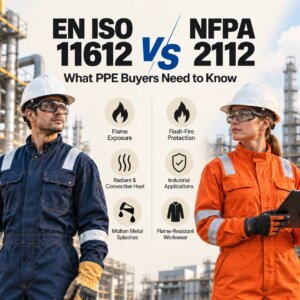
EN ISO 11612 vs NFPA 2112: What PPE Buyers Need to Know
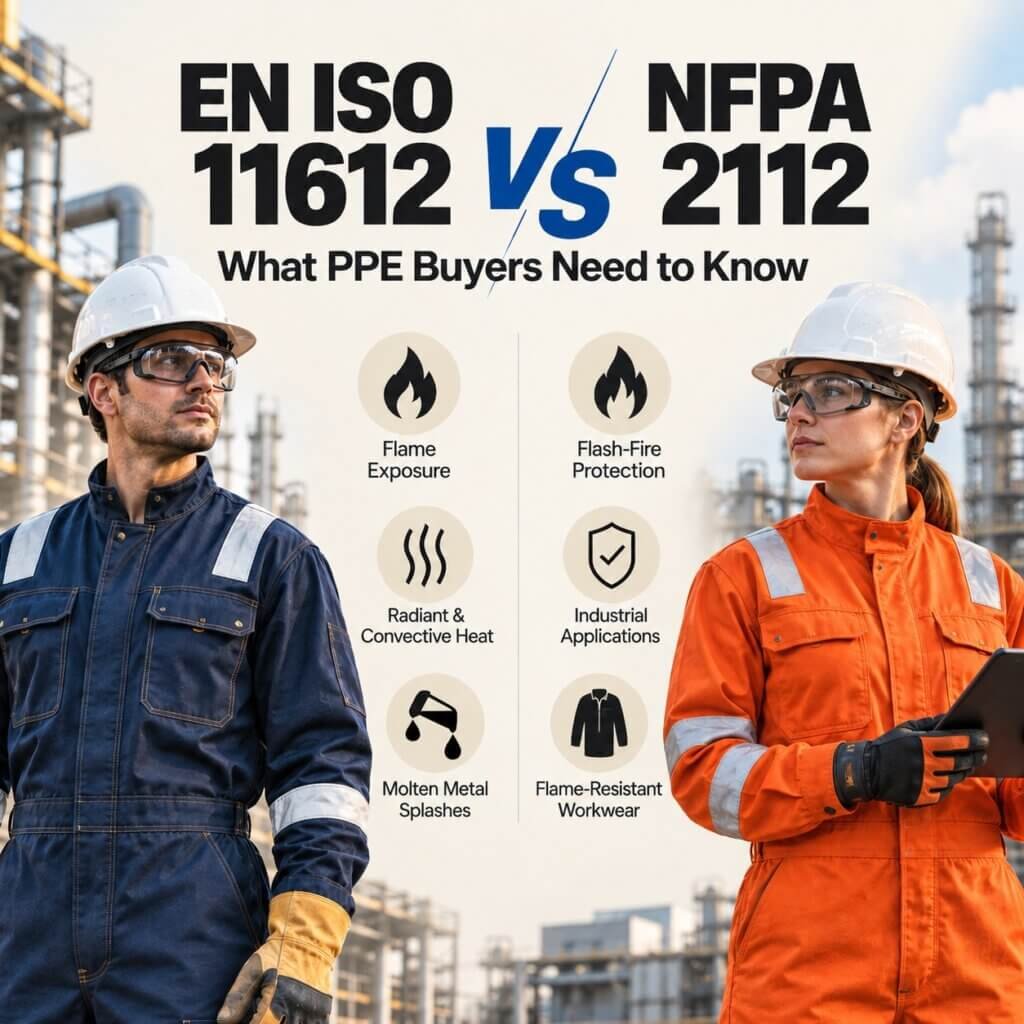
When sourcing flame-resistant clothing for industrial workers, buyers may encounter two important standards: EN ISO 11612 and NFPA 2112. Both address protective clothing against heat and flame, but they have different scopes and should not be treated as interchangeable.
For international PPE buyers, understanding the differences helps avoid specification errors, improves supplier communication, and supports more informed purchasing decisions.
In this guide, we compare EN ISO 11612 and NFPA 2112, explain their intended applications, and outline what buyers should check before ordering flame-resistant workwear.
1. What Is EN ISO 11612?
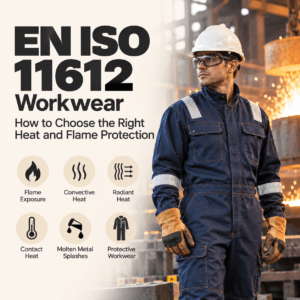
EN ISO 11612 is a European-adopted standard for protective clothing designed to protect the body, excluding the hands, against certain types of heat and flame.
Its scope includes clothing intended for environments where workers may encounter:
- Limited flame spread hazards
- Convective heat
- Radiant heat
- Contact heat
- Molten aluminium splashes
- Molten iron splashes
The specific protection provided depends on the garment’s tested performance classifications and construction. Not every garment certified or declared to this standard provides protection against every hazard listed above.
For buyers sourcing protective workwear for manufacturing, metal processing, industrial maintenance, and other heat-related applications, EN ISO 11612 can be an important part of the product specification.
2. What Is NFPA 2112?
NFPA 2112 is a US standard titled Standard on Flame-Resistant Clothing for Protection of Industrial Personnel Against Short-Duration Thermal Exposures from Fire.
It establishes requirements and test methods for flame-resistant garments intended to help protect industrial personnel against short-duration thermal exposure from fire, including flash-fire hazards.
The standard addresses garment design, materials, performance testing, and certification requirements within its scope.
NFPA 2112 is particularly relevant when industrial employers specify flame-resistant clothing for workers who may face flash-fire risks. Learn more in our guide to [NFPA 2112: The Importance of Industrial Flame-Resistant Clothing].
However, NFPA 2112 compliance alone should not be interpreted as proof that clothing is suitable for every thermal hazard or for electrical arc-flash protection.
3. EN ISO 11612 vs NFPA 2112: Key Differences
The most important distinction is the type of hazard each standard is designed to address.
| Comparison | EN ISO 11612 | NFPA 2112 |
|---|---|---|
| Main focus | Protection against specified heat and flame hazards | Protection against short-duration thermal exposure from fire |
| Typical applications | Industrial heat and flame protection, including certain metalworking environments | Industrial environments with flash-fire risk |
| Performance scope | Includes several thermal hazard categories, depending on tested classifications | Focuses on flame-resistant clothing for short-duration fire exposure |
| Testing | Uses applicable test methods and performance classifications for different hazards | Uses specified garment and material performance requirements and test methods |
| Product selection | Match declared classifications to the workplace hazard assessment | Verify that the garment meets the applicable NFPA 2112 requirements for the intended use |
| Market relevance | Commonly specified in European and other international procurement | Commonly specified in US industrial safety procurement |
Important: These standards are not direct equivalents. A garment meeting one standard should not automatically be assumed to meet the other. Buyers must verify the actual conformity documentation and performance requirements applicable to their project.
4. Which Standard Should Buyers Choose?
There is no single answer for every workplace. The appropriate standard depends on the hazards, market requirements, and specifications established by the employer or end user.
Scenario 1: General Industrial Heat and Flame Protection
Workers may encounter radiant heat, contact heat, or limited flame exposure during industrial processing and maintenance.
In these cases, EN ISO 11612 may be relevant, provided the garment’s tested classifications match the identified hazards.
Scenario 2: Flash-Fire Risk in Industrial Operations
Workers may face short-duration thermal exposure from an accidental fire in an industrial environment.
Where the employer or project specification requires NFPA 2112, buyers should source garments that meet the applicable requirements and have the necessary supporting documentation.
Scenario 3: International Projects with Multiple Requirements
Some projects involve contractors, workers, or end users operating across different markets.
In such cases, the purchasing specification should clearly identify the required standards, editions, certification requirements, and intended applications.
Do not assume that a garment complying with one standard can automatically be substituted for a product specified under another.
5. Can One Garment Meet Both EN ISO 11612 and NFPA 2112?
Potentially, yes. However, compliance with both standards must be established separately.
A garment may be designed and tested to meet multiple standards, but its appearance, fabric composition, or general flame-resistant description is not sufficient evidence.
Before approving a dual-standard garment, buyers should check:
- Whether the exact garment model is covered by the relevant documentation
- Whether the required tests and performance criteria have been met under each standard
- Whether applicable certificates or conformity documents are valid and relevant
- Whether the garment’s design and protection are appropriate for the intended workplace
- Whether the required labels and instructions support the claimed compliance
Where both standards are required, request documentation for both rather than accepting a supplier’s general statement that the product is suitable for international markets.
6. What About Electrical Arc-Flash Protection?
Electrical arc-flash protection is a separate consideration.
Although EN ISO 11612 and NFPA 2112 both relate to heat and flame hazards, neither should be used on its own as proof that a garment provides the electrical arc protection required for a particular task.
For electrical work, buyers should identify the applicable arc-related standards and requirements, such as those specified by the employer or relevant market regulations.
The selection process should consider the complete protective clothing system and the results of the relevant hazard assessment.
7. What Should PPE Buyers Check Before Ordering?
Once the applicable standard has been identified, buyers should evaluate the product and its documentation before placing a bulk order.
7.1 Confirm the Required Standard and Edition
Ask the end user which standard is required and whether a specific edition or certification scheme is specified.
Standards can be revised, and adopted national or regional editions may differ. Check the version applicable to the destination market and procurement contract.
7.2 Review Test Reports and Certificates
Request relevant test reports and applicable certificates for the exact garment model.
Confirm that the documentation matches the product offered, including its fabric, construction, and claimed performance.
For products intended for the European market, check the applicable EU PPE conformity documentation. For NFPA 2112 projects, verify the relevant certification and product listing requirements.
7.3 Check Fabric and Garment Construction
Evaluate fabric composition, weight, stitching, closures, fit, and coverage.
These details can affect comfort, durability, and suitability for the intended application. Do not infer protective performance from fabric composition alone.
7.4 Consider Comfort and Maintenance
Workers may wear protective garments for extended periods, so fit, movement, and thermal comfort matter.
Check the manufacturer’s washing and maintenance instructions. Improper care, unauthorized alterations, or unsuitable repairs may affect garment performance.
7.5 Verify Customization Requirements
If the project requires logo printing, specific colors, special sizing, or other customization, confirm that the proposed changes are compatible with the garment’s tested construction and applicable conformity requirements.
Do not assume that every alteration leaves the original certification or performance claims unchanged.
8. How to Source Flame-Resistant Clothing from China
For international buyers, sourcing from China can provide access to a wide range of protective clothing options and customization services. However, supplier evaluation should focus on technical suitability and documentation rather than price alone.
When assessing a PPE supplier in China, buyers should:
- Provide the required standard and intended workplace application.
- Specify the necessary performance classifications and garment design.
- Request relevant test reports and conformity documents.
- Confirm whether the exact product model meets the project requirements.
- Review samples, sizing, construction, and workmanship where appropriate.
- Agree on production specifications, inspection arrangements, packaging, and delivery schedules.
As a PPE supplier in China, CHEAMY PPE supports international buyers in sourcing protective clothing and other personal protective equipment according to their specifications and purchasing requirements.
For projects requiring EN ISO 11612 or NFPA 2112 clothing, buyers should communicate the required standard, intended application, and documentation expectations before confirming an order.
9. Frequently Asked Questions
Is EN ISO 11612 equivalent to NFPA 2112?
No. Their scopes and requirements differ. Buyers should check the applicable standard and verify compliance separately for each requirement.
Is NFPA 2112 mainly for flash-fire protection?
NFPA 2112 addresses flame-resistant clothing for protection against short-duration thermal exposure from fire, including flash-fire hazards.
Does EN ISO 11612 cover molten metal splashes?
The standard includes performance classifications for certain molten metal splash hazards, including molten aluminium and molten iron. Buyers should verify the relevant classifications and performance levels for the intended application.
Can flame-resistant clothing protect against electrical arc flash?
Only when the garment has the appropriate arc-related performance for the intended task. Compliance with EN ISO 11612 or NFPA 2112 alone does not establish suitability for every electrical arc hazard.
What documents should buyers request from a supplier?
Request the applicable test reports, certificates or conformity documents, product identification, labels, and instructions for use. Ensure that the documents match the exact product being offered.
Conclusion
EN ISO 11612 and NFPA 2112 both play important roles in flame-resistant clothing procurement, but they address different requirements and should not be treated as interchangeable.
The right choice depends on the workplace hazards, project specifications, destination-market requirements, and verified product performance.
For PPE buyers, the most reliable approach is to define the intended application first, confirm the applicable standard, and review the supporting documentation before approving a garment or placing a bulk order.
Sourcing EN ISO 11612 and NFPA 2112 Workwear with CHEAMY PPE
Selecting flame-resistant clothing requires careful attention to workplace risks, product specifications, and supporting technical documents.
CHEAMY PPE supports international buyers in sourcing protective workwear and other PPE according to their purchasing requirements, including discussions about product specifications, customization, and documentation.
Contact CHEAMY PPE to discuss your flame-resistant workwear sourcing requirements.