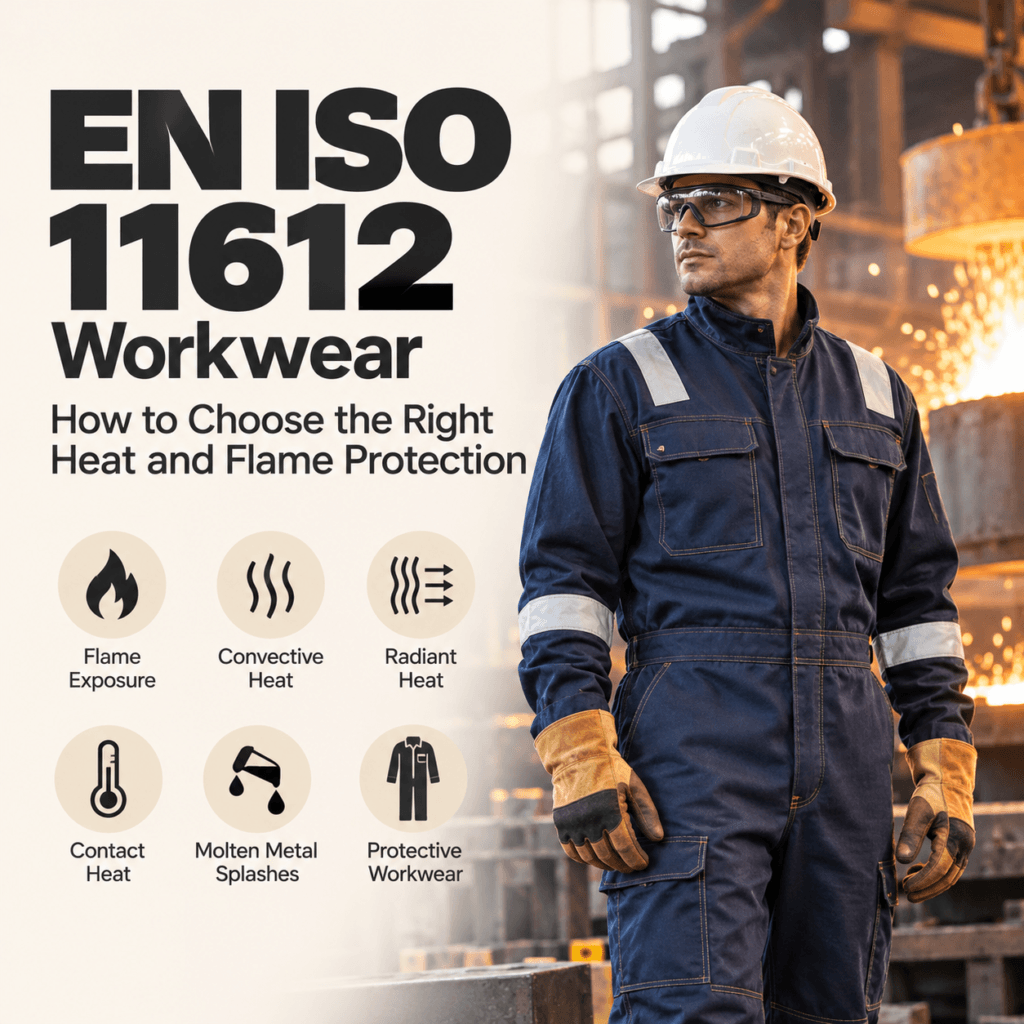
When sourcing flame-resistant workwear, buyers need to look beyond fabric descriptions and product labels. Different industrial environments expose workers to different types and levels of heat, flame, and molten metal hazards. Selecting the right protective clothing requires a clear understanding of workplace risks, product performance, and applicable safety requirements.
EN ISO 11612 is an important standard for protective clothing designed to protect workers against heat and flame. For international PPE buyers, understanding this standard helps simplify product evaluation, supplier communication, and purchasing decisions.
In this guide, we explain how to select suitable EN ISO 11612 workwear, what technical documents to check, and which factors matter when sourcing flame-resistant clothing for industrial applications.
1. What Is EN ISO 11612 Workwear?
EN ISO 11612 specifies minimum performance requirements for clothing designed to protect the wearer against heat and flame. It applies to garments made from flexible materials intended to protect the body, excluding the hands, against certain types of heat exposure.
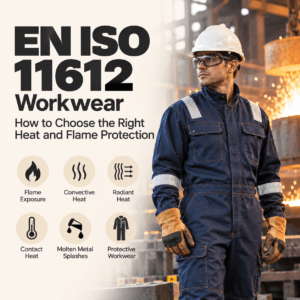
Depending on the product’s tested performance, protective clothing under this standard may provide protection against hazards such as:
- Limited flame spread
- Convective heat
- Radiant heat
- Contact heat
- Molten aluminium splashes
- Molten iron splashes
Not every EN ISO 11612 garment provides protection against all these hazards. Performance depends on the garment’s design, materials, test results, and declared protection levels.
For buyers, the key question is not simply whether a garment references EN ISO 11612, but whether its verified performance matches the intended working environment.
2. Identify the Workplace Heat and Flame Hazards
Before choosing protective workwear, buyers should identify the main hazards workers may encounter. The required protection can vary significantly between industries and even between tasks at the same facility.
Manufacturing and Industrial Processing
Workers in manufacturing facilities may face brief flame exposure, hot surfaces, or radiant heat from industrial equipment.
Depending on the task and risk assessment, suitable workwear may need to provide limited flame spread protection and additional thermal performance.
Welding and Metalworking
Welding and metalworking can involve sparks, hot particles, radiant heat, and molten metal splashes.
Buyers should determine whether EN ISO 11612 clothing provides the relevant tested performance for the specific task. Additional welding-specific clothing requirements may also apply, depending on the work involved.
Foundries and Metal Casting
Foundry workers may encounter intense radiant heat and splashes of molten metal.
In these environments, buyers should pay particular attention to the relevant molten-metal performance classifications, garment coverage, closures, and the complete protective clothing system.
Industrial Maintenance
Maintenance workers may operate in areas where heat exposure or accidental flame contact is possible.
The correct clothing depends on the equipment, process, exposure conditions, and workplace risk assessment. A general flame-resistant garment should not automatically be considered suitable for every maintenance task.
Buyer tip: Ask the end user to describe the actual hazards and working conditions before requesting quotations. This makes it easier to compare products on technical suitability rather than price alone.
3. Understand EN ISO 11612 Performance Classifications
EN ISO 11612 uses performance codes to identify different aspects of heat and flame protection. Buyers should understand these codes when reviewing garment labels, declarations, and test reports.
| Code | Protection type |
|---|---|
| A1 / A2 | Limited flame spread, assessed using different ignition procedures |
| B | Convective heat |
| C | Radiant heat |
| D | Molten aluminium splashes |
| E | Molten iron splashes |
| F | Contact heat |
The applicable code and performance level indicate which type of protection has been assessed and the level achieved under the relevant test method.
For example, a garment marked with a B code has been assessed for convective heat performance, while a garment with a D code has been assessed for molten aluminium splash performance.
However, the presence of one code does not mean that the garment provides every type of heat protection.
Buyers should check the complete marking and corresponding documentation to confirm which performance classifications apply to the specific model.
4. How to Choose the Right EN ISO 11612 Workwear
Once the workplace hazards are understood, buyers can evaluate suitable garments using several practical criteria.
4.1 Match Performance to the Application
Start by identifying the required protection against flame, convective heat, radiant heat, contact heat, or molten metal splashes.
Then compare the required performance with the garment’s declared classifications and supporting test reports.
Avoid selecting a product solely because it is described as flame-resistant. The term alone does not establish its suitability for a particular hazard.
4.2 Check the Fabric and Garment Construction
Fabric composition, weight, construction, seams, closures, and overall garment design can affect performance and usability.
When evaluating a product, request information about:
- Fabric composition and weight
- Garment construction and coverage
- Available sizes and fit
- Closure and fastening design
- Care instructions and maintenance limitations
The actual performance should be supported by appropriate product testing rather than inferred from fabric composition alone.
4.3 Consider Comfort and Daily Wear
Protective clothing must be suitable for the work being performed. Poor fit, excessive weight, or restricted movement may affect worker comfort and practical use.
Consider the following factors when selecting workwear:
- Breathability and thermal comfort
- Freedom of movement
- Fit over other required PPE
- Garment weight and flexibility
- Ease of cleaning and maintenance
At CHEAMY PPE, the goal is to help buyers balance protection requirements with practical considerations such as comfort, fit, and customization.
4.4 Check Compatibility with Other PPE
EN ISO 11612 clothing is only one part of a workplace protection system.
Depending on the task, workers may also need suitable helmets, gloves, safety footwear, eye protection, or specialized protective equipment.
Buyers should check that garments work appropriately with other PPE and that exposed areas or gaps do not undermine the intended protection.
Where electrical arc hazards are present, separate requirements for arc-rated clothing and the complete protective system may apply. EN ISO 11612 compliance alone does not establish arc-flash protection.
5. What Documents Should Buyers Request?
For international procurement, technical documentation is essential. Before confirming an order, request and review the documents applicable to the product and destination market.
Product Test Reports
Check the relevant test reports for the exact garment or product construction being offered. Confirm that the model, fabric, and claimed performance classifications match the documentation.
EU Declaration of Conformity
For products placed on the EU market as PPE, request the applicable EU Declaration of Conformity and verify that it identifies the correct product and applicable legislation and standards.
A supplier’s general statement that a product is compliant is not a substitute for the required documentation.
Product Marking and Instructions
Review the product label, manufacturer or responsible economic operator information where applicable, performance classifications, and instructions for use.
Care instructions are particularly important because unsuitable washing, repairs, or alterations may affect protective performance.
Certification and Traceability
Where applicable, verify the relevant EU type-examination certificate and the conformity-assessment documentation required for the product category.
Check certificate validity and scope through the issuing body or appropriate verification channel. Documentation for a different model should not be assumed to cover the garment being purchased.
6. Common Mistakes When Buying Flame-Resistant Workwear
Even experienced PPE buyers can overlook important details when comparing quotations.
Mistake 1: Choosing by price alone
Two garments may look similar but have different tested performance, construction, or documentation. Compare equivalent specifications before evaluating price.
Mistake 2: Assuming every FR garment provides the same protection
Flame-resistant clothing can be designed for different applications. Always check the specific performance classifications required for the task.
Mistake 3: Ignoring garment care requirements
Incorrect washing, unauthorized alterations, or unsuitable repairs may affect garment performance. Confirm maintenance requirements before purchase.
Mistake 4: Overlooking the complete PPE system
A garment may meet its declared requirements but still be unsuitable if it does not work with the other equipment workers must wear.
Mistake 5: Accepting documents without checking product identity
Test reports and certificates should be relevant to the product being supplied. Verify model references, product construction, and declared performance before placing a bulk order.
7. How to Source EN ISO 11612 Workwear from China
For international buyers, sourcing flame-resistant clothing from China can provide access to a range of product options, specifications, and customization possibilities. Successful procurement, however, depends on clear requirements and reliable documentation.
When evaluating a PPE supplier in China, consider the following points:
- Product specification: Clearly define the required EN ISO 11612 performance classifications, garment type, fabric requirements, and sizes.
- Technical documentation: Request relevant test reports and applicable conformity documents before confirming the order.
- Customization: Discuss available colors, sizing, garment design, labels, and logo application where supported.
- Sample evaluation: Where appropriate, review samples for fit, construction, and workmanship before approving bulk production.
- Quality consistency: Confirm how the supplied garments will be matched to the approved specifications and documented product model.
- Communication and lead time: Agree on sample approval, production schedules, packaging, inspection arrangements, and shipping terms.
As a PPE supplier in China, CHEAMY PPE supports international buyers in sourcing protective clothing and other personal protective equipment according to their specifications and purchasing requirements.
Our focus is to help buyers clarify product requirements, compare suitable options, and coordinate sourcing for industrial safety applications.
Contact CHEAMY PPE to discuss your flame-resistant workwear requirements and customization needs.
8. Frequently Asked Questions
Is EN ISO 11612 the same as flame-resistant clothing?
EN ISO 11612 is a standard specifying minimum performance requirements for certain protective clothing against heat and flame. The term “flame-resistant clothing” is broader and does not, by itself, confirm compliance with this standard.
Does EN ISO 11612 clothing protect against every type of heat?
No. Protection depends on the garment’s tested performance classifications. Buyers should confirm that the product’s declared performance matches the hazards identified in the workplace risk assessment.
Does EN ISO 11612 cover molten metal protection?
The standard includes performance classifications for molten aluminium splashes and molten iron splashes. Buyers should verify the applicable D and E classifications and their performance levels for the intended application.
Can EN ISO 11612 clothing be used for electrical arc-flash protection?
Not on the basis of EN ISO 11612 compliance alone. Electrical arc hazards require a separate assessment and appropriate arc-related protection requirements.
What should buyers check before ordering EN ISO 11612 workwear?
Review the intended application, required performance classifications, relevant test reports, applicable conformity documentation, garment construction, sizing, care instructions, and compatibility with other PPE.
Conclusion
Choosing the right EN ISO 11612 workwear starts with understanding the hazards workers face and matching those hazards to verified product performance.
For professional buyers, the most important steps are to define the required protection, review technical documentation, assess comfort and garment construction, and confirm compatibility with the complete PPE system.
By evaluating these factors before purchasing, buyers can make more informed sourcing decisions and select flame-resistant clothing that better matches their workplace requirements.
Sourcing EN ISO 11612 Workwear with CHEAMY PPE
Choosing flame-resistant workwear involves more than comparing prices. Buyers need to match protective performance with workplace hazards, verify technical documentation, and consider garment comfort, fit, and customization requirements.
As a PPE supplier in China, CHEAMY PPE supports international buyers in sourcing protective clothing and other personal protective equipment according to their specifications and purchasing needs.
From product selection to customization requirements, we aim to help buyers find practical PPE solutions that balance safety, quality, and comfort.
Contact CHEAMY PPE to discuss your EN ISO 11612 workwear requirements.