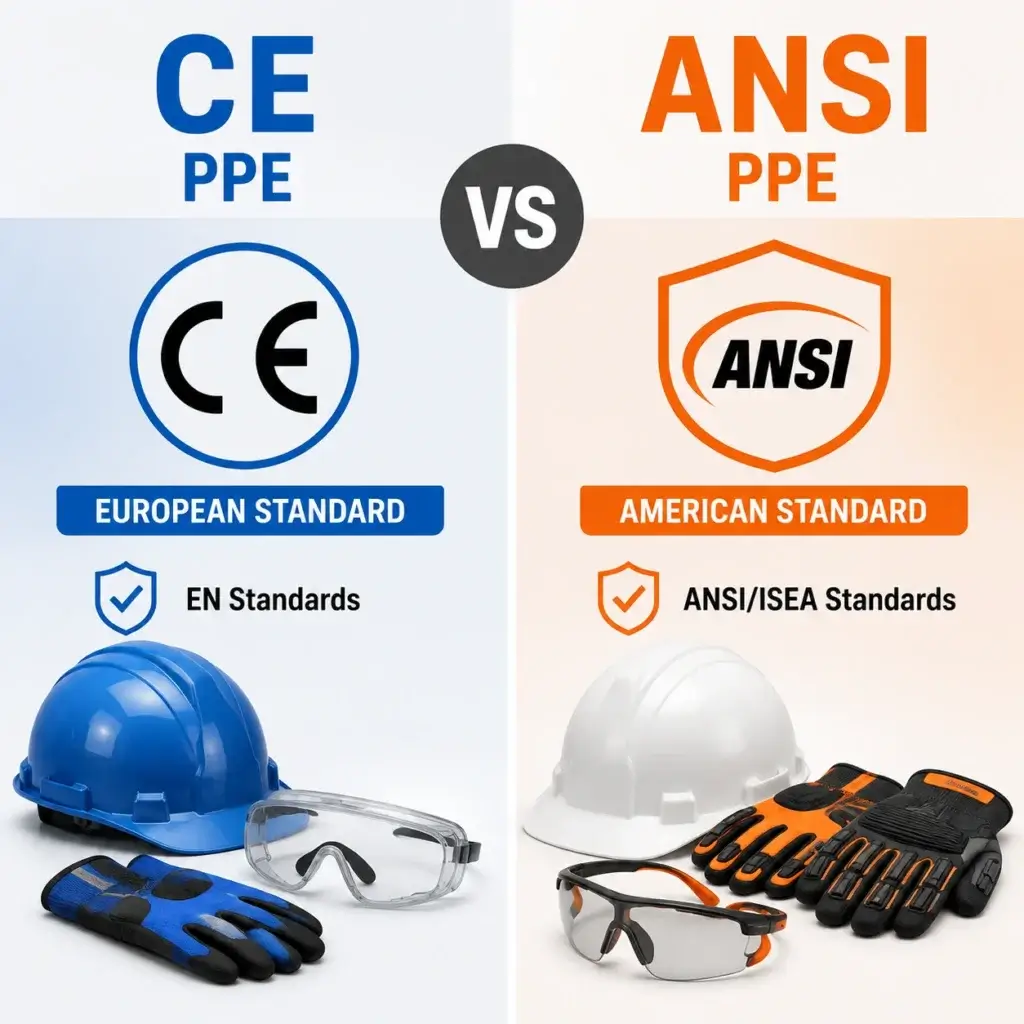
When purchasing Personal Protective Equipment (PPE), you may notice products labeled with CE or ANSI certifications. Both are widely recognized safety standards, but they are designed for different markets and follow different regulatory frameworks.
For importers, distributors, employers, and safety managers, understanding the difference between CE and ANSI standards is essential for selecting compliant PPE and meeting local workplace safety requirements.
This guide explains what CE and ANSI mean, how they differ, and how to choose the right PPE for your business.
What Is CE Certification?
CE stands for Conformité Européenne, which means “European Conformity.”
A CE mark indicates that a product complies with the essential health, safety, and environmental requirements of the European Union (EU).
For PPE, CE certification generally demonstrates compliance with the EU PPE Regulation (EU) 2016/425, along with applicable European (EN) standards.
Products commonly carrying CE certification include:
- Safety helmets
- Safety gloves
- Safety glasses
- Respirators
- Protective clothing
- Safety footwear
- Hearing protection
The CE mark allows compliant PPE to be sold throughout the European Economic Area (EEA).
What Are ANSI Standards?
ANSI stands for the American National Standards Institute.
Unlike CE, ANSI itself does not certify products. Instead, ANSI develops and approves consensus standards that define performance requirements and testing methods for various types of PPE used in the United States.
Examples include:
- ANSI/ISEA Z89.1 for industrial safety helmets
- ANSI/ISEA Z87.1 for eye and face protection
- ANSI/ISEA 105 for hand protection
- ANSI/ISEA 107 for high-visibility clothing
Manufacturers test their products against these standards to demonstrate compliance with U.S. market expectations.
Key Differences Between CE and ANSI PPE
Although both systems focus on worker safety, there are several important differences.
1. Geographic Scope
CE
- European Union and European Economic Area
- Required for many PPE products sold in Europe
ANSI
- Primarily used in the United States
- Frequently referenced by employers and safety regulations
2. Regulatory Framework
CE certification is based on European legislation and mandatory requirements for covered products.
ANSI standards are voluntary consensus standards but are widely adopted through workplace safety regulations, customer specifications, and industry practices.
3. Testing Standards
CE-certified PPE is generally tested against EN standards.
ANSI-compliant PPE is tested according to ANSI/ISEA standards.
Although testing methods may differ, both systems aim to ensure products provide reliable protection under specified conditions.
4. Product Marking
CE products display the CE mark.
ANSI-compliant products typically include markings indicating compliance with the applicable ANSI standard rather than a universal ANSI logo.
Which Standard Is Better?
Neither standard is universally “better.”
The right choice depends on:
- Where the PPE will be used
- Local regulations
- Customer requirements
- Industry specifications
For example:
- PPE sold in Europe generally requires CE compliance.
- PPE used in the United States often follows ANSI/ISEA standards.
- Global suppliers may offer products certified to both CE and ANSI requirements whenever applicable.
Can PPE Meet Both CE and ANSI Standards?
Yes.
Many international PPE manufacturers design products that comply with both European and American standards.
Examples include:
- Safety glasses tested to both EN 166 and ANSI/ISEA Z87.1
- High-visibility clothing meeting both EN ISO 20471 and ANSI/ISEA 107
- Some safety gloves evaluated under both EN and ANSI cut-resistance methods
Dual-compliant products can simplify purchasing for companies operating in multiple regions.
How to Choose the Right PPE Standard
Before purchasing PPE, consider:
- Where will the equipment be used?
- Which regulations apply?
- What hazards are present?
- Does the customer require CE, ANSI, or both?
- Has the PPE been tested by a reputable laboratory?
- Are certificates and technical documentation available?
Selecting certified PPE from reliable suppliers helps improve workplace safety and simplifies compliance.
Common Mistakes to Avoid
Many buyers assume all PPE certifications are interchangeable.
Avoid these common mistakes:
- Purchasing CE products for markets requiring ANSI compliance without verification.
- Assuming every product marked “ANSI” has been tested to the latest standard.
- Ignoring applicable local workplace regulations.
- Focusing only on price instead of certification and quality.
- Failing to verify supplier documentation.
Certification should always be verified before placing large orders.
Conclusion
Understanding the difference between CE and ANSI PPE helps buyers make informed purchasing decisions and ensure workplace compliance. While CE certification supports access to the European market and ANSI standards are widely recognized in the United States, both systems are designed to improve worker safety through rigorous testing and performance requirements.
For international buyers, choosing PPE that meets the appropriate standards—or both, when necessary—provides greater flexibility, confidence, and protection across global operations.