Skip to content
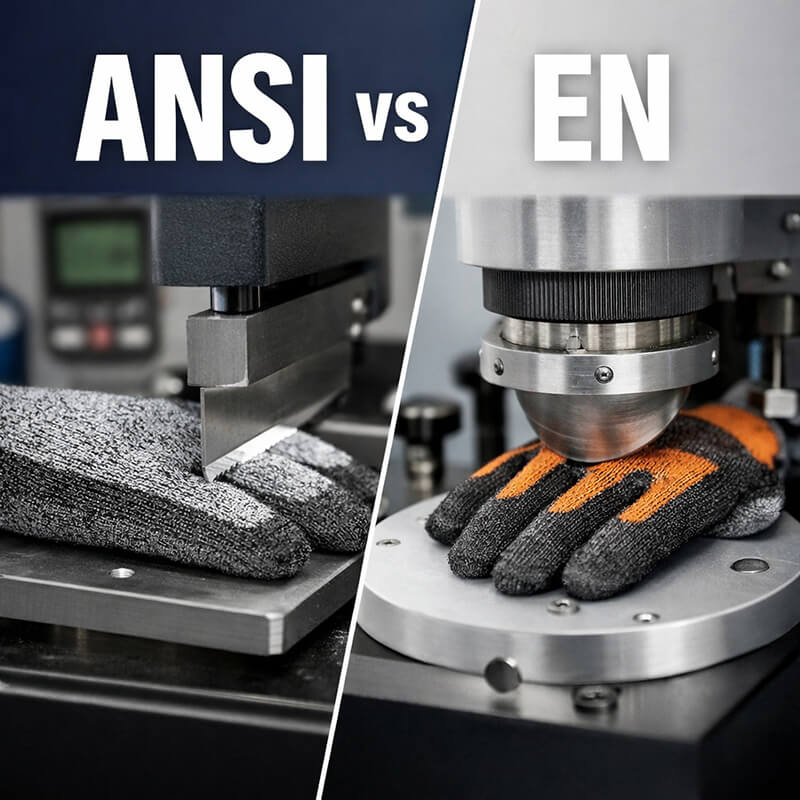
If you’ve ever compared safety gloves under ANSI and EN standards, you may have noticed something confusing:
the same pair of gloves, tested for the same protection, can receive very different ratings.
Is one standard stricter than the other?
Is one result more “accurate”?
Or is something else going on?
The short answer is this: ANSI and EN are not measuring protection in the same way, even when the glove itself doesn’t change.
Understanding this difference can help buyers avoid misjudging glove performance—and avoid costly purchasing mistakes.
1. ANSI and EN Start from Different Philosophies
Although both standards aim to improve worker safety, their design logic is different.
-
ANSI (American National Standards Institute) focuses on
👉 quantifying performance ranges
👉 fine distinctions between protection levels -
EN (European Standards) focuses on
👉 minimum compliance thresholds
👉 pass/fail style classification
This means ANSI tends to separate performance into more levels, while EN groups results into broader categories.
2. Different Test Methods, Not Just Different Labels
Even when testing the same protection type, ANSI and EN often use different equipment and procedures.
Example: Cut Resistance
-
ANSI (A1–A9)
-
Uses the TDM-100 test
-
Measures force in grams needed to cut the material
-
Produces a continuous, scalable result
-
-
EN 388 (ISO 13997)
-
Uses a similar straight-blade method
-
Groups results into Level A–F
-
Focuses on whether a glove meets a defined performance band
-
👉 Result:
A glove rated ANSI A4 may appear as EN Level C or D, even though the material hasn’t changed at all.
3. EN Results Can Look “Lower” Than ANSI—Here’s Why
Buyers often assume that a lower EN level means weaker protection.
That’s not always true.
EN standards:
-
Stop testing once a level requirement is met
-
Do not emphasize “how far above” the requirement the glove performs
ANSI standards:
-
Continue measuring performance across a wider range
-
Highlight incremental improvements
So a glove that far exceeds EN Level C may still only display “C,” while ANSI reveals the extra margin.
4. Abrasion, Tear, and Puncture: Same Story, Different Logic
This difference applies beyond cut resistance:
-
Abrasion
-
EN focuses on cycle thresholds
-
ANSI may reflect performance trends more clearly
-
-
Tear & puncture
-
EN emphasizes compliance
-
ANSI emphasizes comparison
-
Neither is wrong—they simply answer different questions.
5. Which Standard Should Buyers Trust?
The real question is not which standard is better, but:
👉 Which standard matches your application and market?
-
For North America: ANSI is often more familiar and preferred
-
For Europe: EN compliance is mandatory
-
For global sourcing: understanding both avoids false comparisons
The most common mistake we see is buyers comparing ANSI and EN numbers as if they were directly convertible. They aren’t.
6. What This Means for PPE Buyers
When evaluating safety gloves:
-
Don’t assume higher numbers always mean better protection
-
Don’t dismiss EN results because they “look lower”
-
Ask how the glove is used in real working conditions, not just how it scores on paper
At CHEAMYPPE, we believe PPE performance should be understood—not misunderstood by labels.
Conclusion
ANSI and EN are two different languages describing the same product.
When you translate one directly into the other, the meaning gets distorted.
Understanding the logic behind the standards helps buyers make safer, smarter, and more cost-effective decisions—which is exactly what PPE should support.