Skip to content
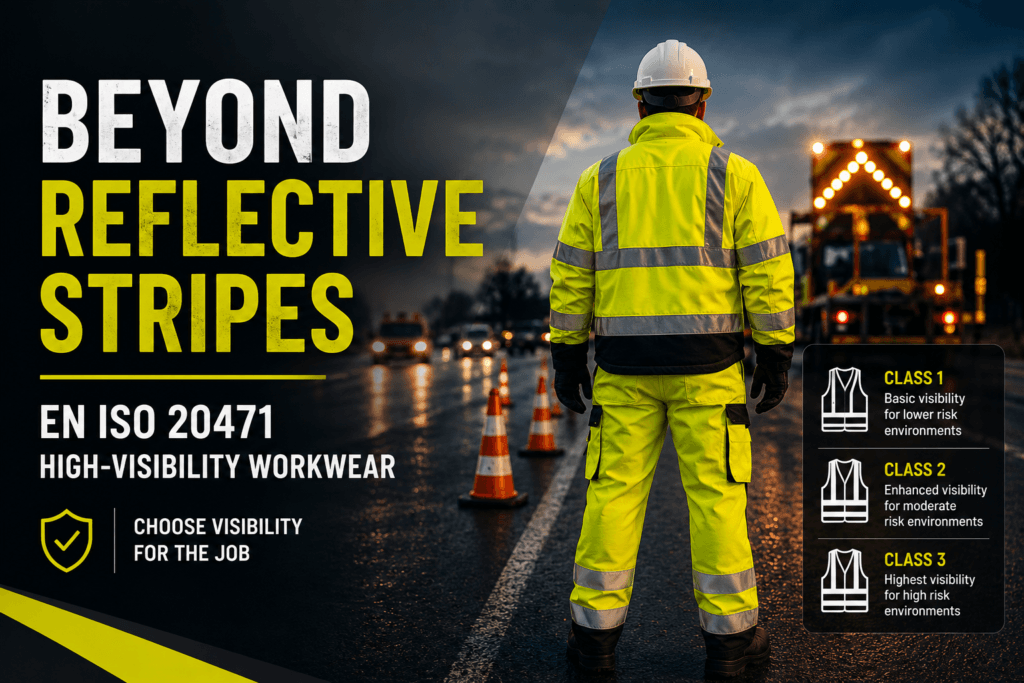
A high-visibility vest may look simple: fluorescent fabric, reflective stripes, and a few pockets.
But when that vest becomes part of a worker’s PPE, the real question is not:
“Does it look bright enough?”
The better question is:
“Will this garment make the worker sufficiently conspicuous in the environment where it is actually being used?”
This is where EN ISO 20471 becomes important.
EN ISO 20471 is widely used for high-visibility clothing designed to visually signal the presence of the wearer. The standard addresses the performance of fluorescent and retroreflective materials, as well as the minimum visible areas and placement of those materials. Its purpose is to improve the wearer’s conspicuity when viewed by vehicle or machinery operators in daylight and when illuminated by headlights in darkness.
For PPE buyers, however, understanding the standard should go beyond memorizing Class 1, Class 2, and Class 3.
The real challenge is choosing a garment whose visibility, design, protection, comfort, and intended working environment work together.
Why “High Visibility” Is More Than a Bright Color
Imagine two workers standing beside a busy road.
One is wearing a fluorescent yellow jacket with reflective elements.
The other is wearing an ordinary dark work jacket.
During daylight, the first worker is likely to stand out much more clearly against the surrounding environment.
At night, however, the situation changes.
Fluorescent fabric is designed primarily to create conspicuity under daylight conditions. Retroreflective material performs a different function: it helps return incident light toward its source, making the wearer more noticeable when illuminated by vehicle headlights.
This is why EN ISO 20471 evaluates more than color.
It considers:
- Fluorescent background material
- Retroreflective material
- Material performance
- Minimum visible areas
- Placement and garment design
- Overall visibility classification
The objective is not simply to make clothing brighter.
It is to make the wearer easier to recognize.
The First Question Should Be: Where Will the Garment Be Used?
Many PPE purchasing decisions begin with the product:
“We need 500 high-visibility vests.”
A better starting point is the workplace.
Ask:
Where will these workers be standing, walking, or working?
For example, the visibility requirements for a warehouse worker may be very different from those for a road maintenance worker.
Consider these environments:
Warehouse and Logistics
Workers may operate around:
- Forklifts
- Loading bays
- Delivery vehicles
- Pallet trucks
- Warehouse traffic
Visibility can be particularly important where workers and vehicles share the same space.
Construction Sites
Workers may be exposed to:
- Excavators
- Cranes
- Trucks
- Mobile machinery
- Changing site layouts
Here, the ability to identify a worker quickly can become particularly important.
Road Construction and Maintenance
Workers may operate close to:
- Moving vehicles
- High-speed traffic
- Temporary traffic routes
- Nighttime operations
- Poor weather
These conditions can create a much greater visibility challenge.
Utilities and Infrastructure
Electricity, telecommunications, rail, road, and municipal workers may move between different environments during the same working day.
Their workwear may therefore need to combine visibility with additional protection, weather resistance, or durability.
The same “hi-vis jacket” can serve very different purposes depending on the risk environment.
EN ISO 20471 Class 1, 2 and 3: Think in Terms of Visibility
EN ISO 20471 defines three clothing classes based on minimum visible areas of the relevant materials.
Under the current ISO 20471:2013 requirements, the minimum areas are:
| Classification | Background Material | Retroreflective Material |
|---|---|---|
| Class 1 | 0.14 m² | 0.10 m² |
| Class 2 | 0.50 m² | 0.13 m² |
| Class 3 | 0.80 m² | 0.20 m² |
The standard determines the clothing class according to the relevant visible material area. Class 3 provides the highest level of conspicuity among the three classes.
But there is an important point that is often overlooked:
Higher class does not simply mean “better PPE.”
The appropriate class should be selected according to the risk and working conditions.
A Class 3 garment may provide significantly more visible coverage, but that does not mean every warehouse worker needs a heavy Class 3 winter jacket.
The correct question is:
What level of conspicuity does this particular working environment require?
Why Class 3 Is About More Than More Reflective Tape
It is easy to assume that Class 3 simply means adding more reflective strips.
That is not how the standard works.
Class 3 garments must meet the applicable minimum material areas and design requirements. The standard also includes specific requirements concerning torso coverage and reflective elements on sleeves or full-length trouser legs.
This is why garment design matters.
For example, a professional Class 3 solution may be:
- A Class 3 high-visibility jacket
- A high-visibility jacket and trouser combination
- A coverall designed to achieve the required classification
The final design needs to be assessed as a complete protective clothing solution rather than simply by counting reflective bands.
The Overlooked Issue: 360° Visibility
A worker is not a two-dimensional object.
Vehicles can approach from:
- The front
- The rear
- The side
- An angle
Therefore, visibility should not be considered only from the front.
EN ISO 20471 includes design requirements intended to support visibility around the wearer. The arrangement of fluorescent and retroreflective materials is therefore an important part of garment design.
This matters particularly for:
- Road workers
- Construction workers
- Traffic personnel
- Logistics workers
- Railway personnel
- Airport ground workers
- Utility workers
For these applications, a garment that looks impressive from the front may not necessarily provide the same visual signal from every direction.
Good high-visibility design is about making the worker recognizable as a person—not merely making one part of the garment reflective.
What Happens When You Add a Company Logo?
Customization is one of the most common requirements in B2B workwear.
A customer may want:
- Company logo
- Brand name
- Employee identification
- Department information
- Contact details
- Custom colors
But there is a potential problem.
Large logos, labels, lettering, or other design elements should not compromise the minimum visible material areas required for the garment classification.
This means customization should be considered during product design, not after the garment has already been finalized.
For example, instead of simply placing a large logo across a fluorescent panel, a better approach may be to:
- Identify the required visible areas.
- Determine the logo position.
- Select an appropriate printing or embroidery method.
- Check the resulting garment design.
- Confirm the applicable documentation and certification requirements.
For large-volume PPE projects, this can prevent expensive redesigns later.
The Garment Should Not Be Selected in Isolation
Visibility is only one part of workplace protection.
A road worker may need:
High visibility + rain protection + thermal protection
A welding worker may require:
High visibility + flame resistance + heat protection
An electrical worker may require:
High visibility + arc protection + flame resistance
A cold-weather logistics worker may need:
High visibility + insulation + wind/rain protection
This is why PPE selection should begin with the risk profile, rather than with a single standard.
EN ISO 20471 can form one part of a broader PPE specification.
Depending on the application, a high-visibility garment may also need to meet other applicable requirements, such as standards for rain protection, heat and flame protection, or electrical hazards.
The right PPE is not the garment with the longest list of standards. It is the garment whose combination of protections matches the actual job.
EN ISO 20471 and Rainwear: A Practical Example
Outdoor workers often face two problems at the same time:
They need to stay visible, and they need to stay dry.
A high-visibility rain jacket may therefore need to combine visibility requirements with requirements for protection against rain.
For a buyer, this changes the purchasing question from:
“Do you have an EN ISO 20471 jacket?”
to:
“Do you have a high-visibility rain jacket with the required visibility classification and the appropriate weather-protection performance for our working conditions?”
That is a much more useful procurement question.
Why Comfort Matters in High-Visibility PPE
Visibility is only useful if workers actually wear the garment correctly.
A theoretically excellent garment can become ineffective as a practical PPE solution if it is:
- Too hot
- Too heavy
- Too restrictive
- Poorly sized
- Difficult to layer
- Uncomfortable during long shifts
This is especially relevant for:
- Summer construction work
- Tropical climates
- Long logistics shifts
- Outdoor maintenance
- Physically demanding jobs
For procurement teams, visibility and wearability should therefore be considered together.
A breathable Class 2 vest may be more practical for one workplace, while a Class 3 jacket-and-trouser system may be more appropriate for another.
The objective is not to maximize the specification.
The objective is to provide the right protection for the real working environment.
Maintenance Can Affect Visibility
A high-visibility garment is not a “buy once and forget” item.
The condition of the garment matters.
Dirt, contamination, wear, improper washing, damage, and prolonged exposure to environmental conditions can affect the appearance and performance of protective materials.
The ISO standard itself notes that real-world conspicuity can be influenced by factors such as use, dirt, solar exposure, care, cleaning, repair, and storage.
For this reason, employers should establish procedures for:
- Regular garment inspection
- Correct washing
- Damage assessment
- Replacement
- Proper storage
A faded, heavily contaminated, or damaged garment should not simply remain in service because its label originally stated a particular EN ISO 20471 classification.
A Better Way to Buy EN ISO 20471 Workwear
For distributors, contractors, and industrial procurement teams, we recommend evaluating high-visibility workwear through five questions.
1. What is the working environment?
Identify vehicles, machinery, traffic, lighting, weather, and other visibility hazards.
2. What visibility class is required?
Determine whether Class 1, Class 2, or Class 3 is appropriate based on the workplace risk assessment and applicable requirements.
3. What additional protection is needed?
Consider rain, cold, heat, flame, electrical hazards, chemicals, or other workplace risks.
4. Will the garment be customized?
If logos, colors, labels, or other modifications are required, review the design before production.
5. What documentation is required?
Depending on the market and product, buyers may need relevant conformity documentation, test reports, technical information, user instructions, and certification records.
This approach is much more reliable than choosing a garment simply because it “looks like a safety vest.”
A Note on the Current EN ISO 20471 Standard
As of August 2026, ISO 20471:2013 remains the current published ISO edition, with Amendment 1:2016. ISO states that the standard is being revised and that ISO/DIS 20471 is under development.
For companies purchasing PPE for the European market, it is therefore important to check the applicable current European edition and the conformity requirements relevant to the product and destination market when placing an order.
This is particularly important for long-term contracts, new product development, and large OEM/ODM projects.
CHEAMY’s Approach to High-Visibility PPE
At CHEAMY PPE, we believe high-visibility workwear should be developed around the worker and the working environment—not around a checklist of specifications.
We help customers source and customize solutions such as:
- High-visibility safety vests
- Hi-vis jackets
- High-visibility trousers
- Hi-vis coveralls
- High-visibility rainwear
- High-visibility workwear sets
- Customized industrial workwear
For B2B projects, we can also support requirements such as:
- Custom colors
- Logo printing
- Custom specifications
- OEM/ODM development
- Different garment configurations
- Product documentation
Our approach is simple:
Understand the application → define the protection → select the right garment → confirm the requirements → develop the right solution.
Because PPE should not only be visible.
It should be appropriate, comfortable, practical, and suitable for the job.
Final Takeaway: Don’t Buy “Hi-Vis”—Buy the Right Visibility Solution
EN ISO 20471 gives PPE professionals a framework for evaluating high-visibility clothing.
But the standard itself is only the beginning.
When selecting workwear, look beyond:
“Is it fluorescent?”
and beyond:
“Does it have reflective tape?”
Instead, ask:
Where will the worker be?
What will they be exposed to?
How will they be seen?
What additional protection do they need?
Will they actually be comfortable wearing it throughout the shift?
That is the difference between simply purchasing high-visibility clothing and building a practical PPE solution.
At CHEAMY, we believe in Safety Meets Comfort—because effective PPE should protect workers while fitting naturally into the way they work.