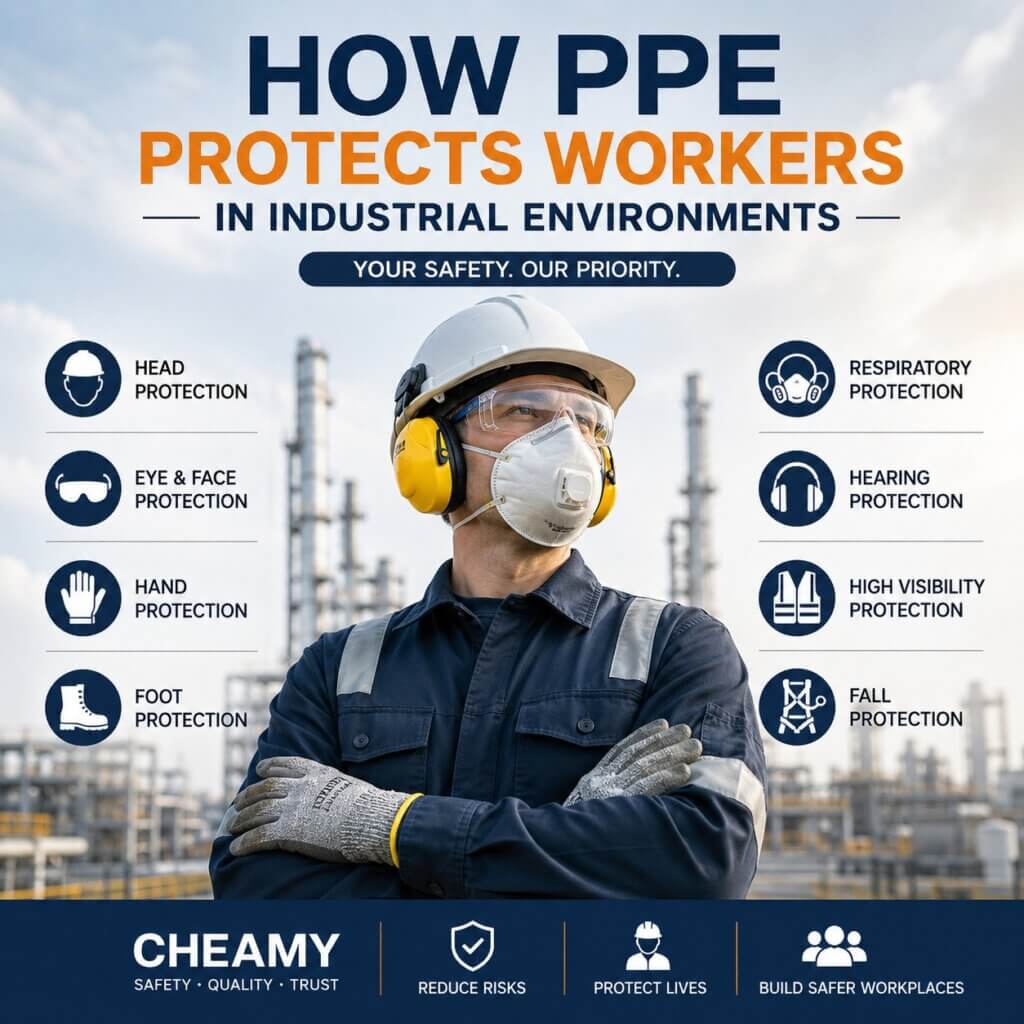
Personal Protective Equipment (PPE) plays a critical role in reducing workplace injuries and preventing exposure to hazards in industrial environments. While engineering controls and safety procedures aim to reduce risks at the source, PPE provides the final physical barrier between workers and danger.
Understanding how PPE works helps companies design better safety systems and ensure workers are properly protected.
1. Protection Against Physical Hazards
Industrial workplaces often involve moving machinery, heavy objects, and sharp materials.
How PPE helps:
- Safety helmets protect against falling objects and head impact
- Safety gloves reduce cuts, abrasions, and crushing injuries
- Safety footwear prevents foot injuries from heavy loads or punctures
✔ PPE absorbs or blocks direct physical force
✔ Reduces severity of accidental injuries
2. Protection from Chemical Exposure
Chemical industries and maintenance operations expose workers to corrosive liquids, vapors, and toxic substances.
How PPE helps:
- Chemical-resistant gloves prevent skin contact
- Protective suits block chemical splashes
- Respirators filter harmful vapors and gases
- Goggles and face shields protect eyes from splashes
✔ PPE creates a sealed barrier against hazardous substances
✔ Prevents skin absorption and inhalation risks
3. Protection from Thermal and Fire Hazards
High-temperature environments such as welding, oil and gas, and metal processing present burn and fire risks.
How PPE helps:
- Flame-resistant (FR) clothing resists ignition and slows burn spread
- Welding helmets protect from UV/IR radiation
- Heat-resistant gloves protect hands from hot surfaces
- Safety boots reduce heat and molten splash injuries
✔ PPE delays heat transfer to the body
✔ Reduces severity of burn injuries
4. Protection from Respiratory Hazards
Dust, fumes, gases, and airborne particles are common in industrial environments.
How PPE helps:
- Dust masks filter particulate matter
- Respirators remove harmful gases and vapors
- PAPR systems provide filtered airflow in high-risk zones
✔ PPE prevents inhalation of harmful substances
✔ Protects long-term lung health
5. Protection from Noise Exposure
Factories, construction sites, and heavy machinery generate high noise levels.
How PPE helps:
- Earplugs reduce sound entering the ear canal
- Earmuffs block external noise exposure
- Combined systems offer higher noise reduction
✔ PPE prevents hearing loss from prolonged exposure
✔ Maintains long-term auditory health
6. Protection from Visibility and Traffic Hazards
In logistics, construction, and roadside environments, visibility is critical.
How PPE helps:
- High-visibility clothing improves worker detection
- Reflective strips increase visibility in low light
- LED accessories enhance nighttime safety
✔ PPE reduces accident risk involving vehicles or machinery
✔ Improves situational awareness
7. Protection from Fall Hazards
Working at height introduces serious life-threatening risks.
How PPE helps:
- Harness systems prevent falls from height
- Lanyards absorb shock during sudden falls
- Anchoring systems secure workers to stable points
✔ PPE prevents fatal fall injuries
✔ Provides controlled fall arrest system
8. PPE as the Final Layer of Defense
Industrial safety follows a hierarchy:
- Eliminate hazards
- Engineering controls
- Administrative controls
- PPE (last line of defense)
Even when other controls fail, PPE remains essential for protecting workers from direct exposure.
✔ PPE does not remove hazards—it reduces their impact
✔ Essential for all high-risk industries
CHEAMY PPE Industrial Protection Solutions
CHEAMY PPE provides complete industrial PPE solutions designed to protect workers across all hazard categories, including:
- Head-to-toe protection systems for industrial environments
- Chemical, mechanical, thermal, and respiratory PPE
- High-visibility and fall protection equipment
- Customized PPE solutions for different industries and risk levels
We focus on delivering practical protection that works in real industrial conditions.
Conclusion
PPE protects workers by creating a physical barrier against industrial hazards such as impact, chemicals, heat, noise, and airborne contaminants. While it is the last line of defense, it is one of the most critical components of any workplace safety system.
A well-designed PPE program ensures that workers remain protected, productive, and confident in even the most hazardous environments.