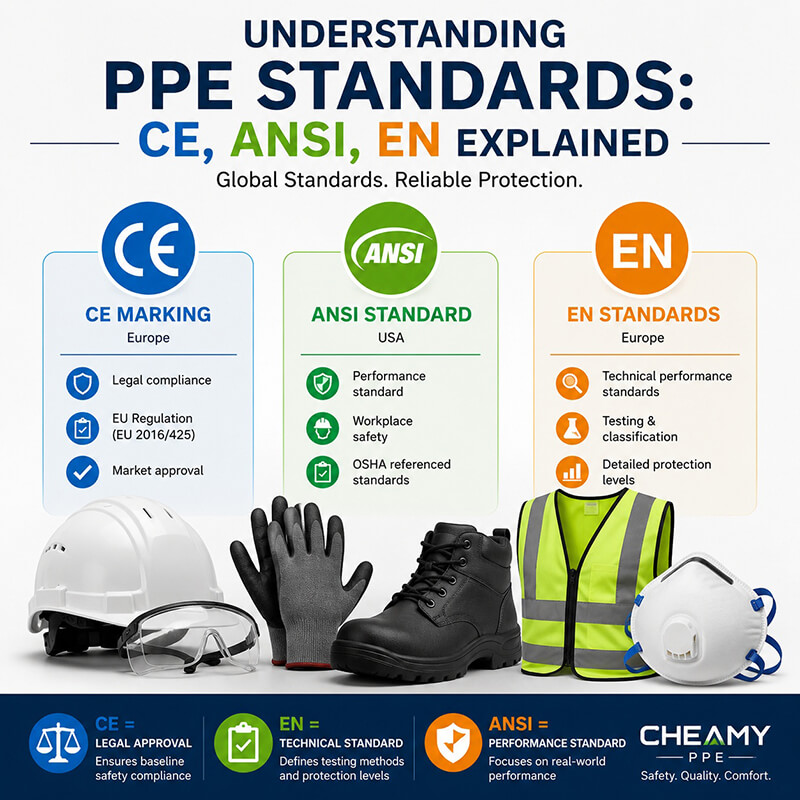
When selecting Personal Protective Equipment (PPE), one of the most important factors is compliance with recognized safety standards. These standards ensure that PPE products meet minimum safety, performance, and quality requirements.
Among the most widely used standards globally are CE, ANSI, and EN. Understanding them helps companies choose reliable and compliant PPE for industrial use.
1. What is CE Marking?
CE (Conformité Européenne) marking indicates that a product complies with European Union safety, health, and environmental protection requirements.
Key points:
- Mandatory for PPE sold in the European Economic Area (EEA)
- Indicates compliance with relevant EU regulations (PPE Regulation EU 2016/425)
- Ensures product has passed required safety assessments
Applies to:
- Safety helmets
- Gloves
- Protective clothing
- Safety footwear
- Respiratory protection
✔ CE is a legal requirement in Europe
✔ It confirms baseline safety compliance
2. What is ANSI Standard?
ANSI (American National Standards Institute) develops safety performance standards widely used in the United States.
Key points:
- Focuses on performance testing and product safety
- Commonly used in industrial and construction PPE
- Often referenced in OSHA workplace safety requirements
Examples:
- ANSI Z87.1 → Eye and face protection
- ANSI Z89.1 → Industrial head protection
- ANSI/ISEA standards → High-visibility clothing
✔ ANSI focuses on real-world performance testing
✔ Widely used in U.S. workplace safety regulations
3. What are EN Standards?
EN (European Norms) are technical standards used across Europe for PPE performance classification.
Key points:
- Define detailed testing methods and protection levels
- Often used together with CE marking
- Provide specific performance categories
Examples:
- EN 388 → Mechanical risks (cut, abrasion, tear, puncture)
- EN 374 → Chemical protection gloves
- EN 166 → Eye protection
- EN ISO 20345 → Safety footwear
- EN 11612 → Heat and flame protection
✔ EN standards define detailed protection levels
✔ Widely used in global industrial PPE markets
4. Key Differences Between CE, ANSI, and EN
| Standard | Region | Purpose | Focus |
|---|---|---|---|
| CE | Europe | Legal compliance | Market approval |
| EN | Europe | Technical performance | Testing & classification |
| ANSI | USA | Performance standard | Workplace safety |
✔ CE = legal approval
✔ EN = technical testing standard
✔ ANSI = performance-based U.S. standard
5. Why PPE Standards Matter in Industry
Using certified PPE ensures:
- Worker safety under real conditions
- Compliance with legal and site requirements
- Reliable performance under stress
- Reduced risk of accidents and liability
✔ Non-certified PPE may fail under hazardous conditions
✔ Standards ensure consistency and trust
6. CHEAMY PPE Compliance Solutions
CHEAMY PPE provides PPE products compliant with major international standards, including CE, EN, and ANSI requirements.
Our solutions include:
- Certified head-to-toe industrial PPE systems
- Standard-compliant products for global markets
- Customized PPE based on project regulations
- Bulk supply for contractors and industrial projects
We ensure every product meets practical safety requirements for real working environments.
Conclusion
CE, ANSI, and EN standards form the foundation of global PPE safety compliance. Understanding these standards helps businesses choose reliable protective equipment and ensure workers are properly protected in all industrial environments.
A certified PPE system is not just about compliance—it is about trust, safety, and performance.