Skip to content
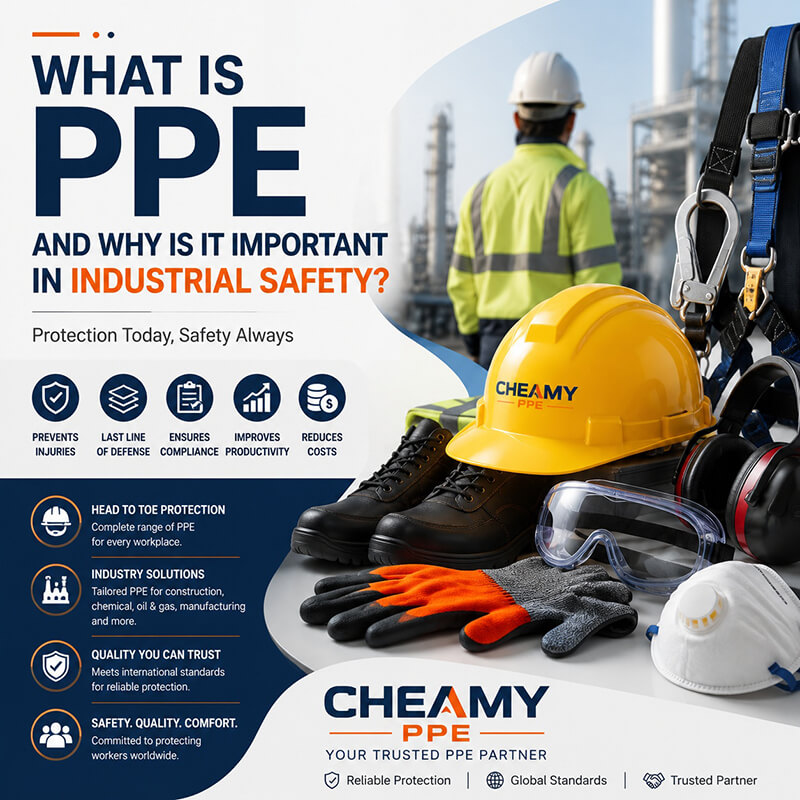
Personal Protective Equipment (PPE) refers to specialized clothing and equipment designed to protect workers from workplace hazards that could cause injury or illness. In industrial environments, PPE acts as the last line of defense when engineering controls and administrative measures are not enough to eliminate risks.
From construction sites to chemical plants, PPE is essential for ensuring worker safety, compliance, and operational continuity.
1. What is PPE?
PPE includes any wearable or portable equipment used to reduce exposure to hazards.
Common PPE categories:
- Head protection (helmets, bump caps)
- Eye and face protection (safety glasses, goggles, face shields)
- Hand protection (gloves for cut, chemical, or heat resistance)
- Body protection (high-visibility clothing, FR suits, chemical coveralls)
- Foot protection (safety boots, anti-slip shoes)
- Respiratory protection (masks, respirators, PAPR systems)
- Hearing protection (earplugs, earmuffs)
- Fall protection (harness systems, lanyards)
✔ PPE is not optional in high-risk industries
✔ It is tailored based on specific job hazards
2. Why PPE Is Important in Industrial Safety
Industrial workplaces contain multiple hazards that can cause serious injuries if not properly controlled.
(1) Prevents Workplace Injuries
PPE protects workers from:
- Falling objects and impact injuries
- Chemical burns and exposure
- Respiratory hazards and toxic gases
- Noise-induced hearing loss
- Electrical and thermal injuries
✔ Reduces both minor and severe accidents
(2) Acts as the Last Line of Defense
Safety follows a hierarchy:
- Eliminate hazards
- Engineering controls
- Administrative controls
- PPE (final protection layer)
Even when other controls fail, PPE provides critical protection.
(3) Ensures Legal and Safety Compliance
Most industries are required to follow strict safety regulations and standards.
Examples include:
- OSHA regulations (U.S.)
- EN and ISO standards (global industrial PPE standards)
- Site-specific safety protocols
✔ Non-compliance can lead to fines or shutdowns
(4) Improves Productivity and Confidence
When workers feel protected, they perform tasks more efficiently and confidently.
- Reduces downtime from injuries
- Improves workforce morale
- Supports stable operations in high-risk environments
✔ Safe workers are more productive workers
(5) Reduces Long-Term Costs
Investing in PPE helps avoid:
- Medical expenses
- Compensation claims
- Equipment damage from accidents
- Operational delays
✔ Prevention is always cheaper than recovery
3. PPE in Different Industrial Environments
- Construction → helmets, boots, fall protection
- Chemical industry → respirators, chemical suits, gloves
- Oil & gas → FR clothing, anti-static PPE, gas protection
- Manufacturing → eye protection, gloves, safety footwear
- Logistics → hi-vis clothing, safety shoes, hearing protection
Each industry requires a tailored PPE system based on risk levels.
CHEAMY PPE Industrial Safety Solutions
CHEAMY PPE provides complete PPE solutions for industrial safety, including:
- Full head-to-toe PPE systems
- Industry-specific protective equipment packages
- Bulk supply for contractors and large projects
- Customized PPE based on risk assessments
- Standard-compliant safety products for global use
We focus on practical, reliable protection that supports real industrial working conditions.
Conclusion
PPE is a critical component of industrial safety, protecting workers from unavoidable hazards and serving as the final barrier against injury. Its importance goes beyond compliance—it directly impacts safety, productivity, and operational efficiency.
A well-designed PPE system ensures that every worker is properly protected, no matter the industry or risk level.