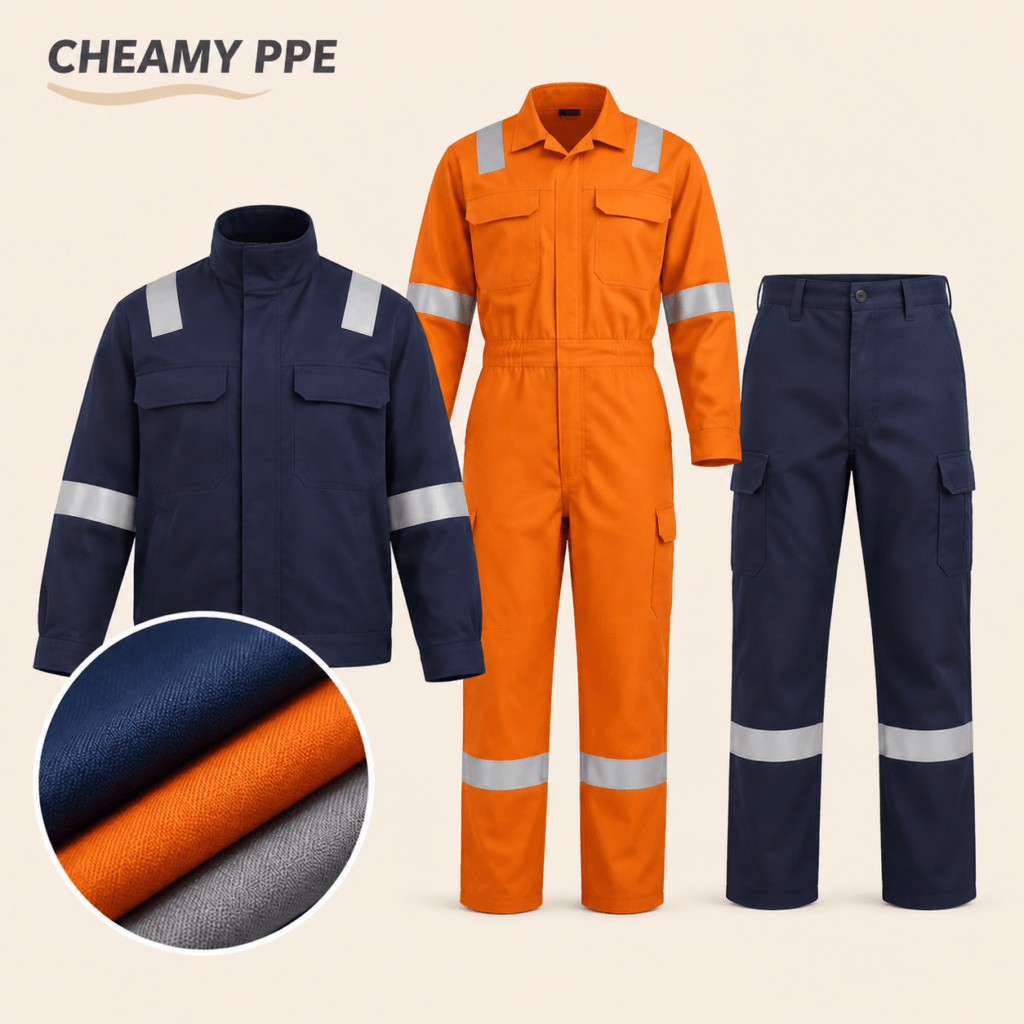
Sourcing flame-resistant (FR) clothing from China can offer international buyers access to a wide range of fabrics, garment styles, customization options, and competitive pricing. However, when purchasing protective workwear designed to meet EN ISO 11612, price should never be the only consideration.
The quality of the fabric, certification documents, garment construction, supplier reliability, and consistency of mass production all play an important role in ensuring that the clothing meets the required protection standards.
For importers, distributors, and industrial procurement teams, choosing the right supplier requires more than simply comparing quotations.
This guide explains the key factors to consider when sourcing EN ISO 11612 flame-resistant clothing from China, from defining product requirements to verifying documentation and controlling production quality.
1. Define Your EN ISO 11612 Protection Requirements
Before contacting suppliers, buyers should identify the specific protection requirements for their intended applications.
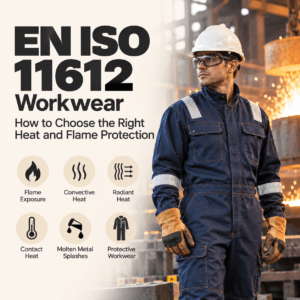
EN ISO 11612 specifies minimum performance requirements for clothing designed to protect the body, excluding the hands, against heat and flame. Depending on the working environment, different types of thermal hazards may need to be considered.
The standard uses several performance codes:
- A1/A2: Limited flame spread through surface ignition and edge ignition.
- B: Protection against convective heat.
- C: Protection against radiant heat.
- D: Protection against molten aluminium splashes.
- E: Protection against molten iron splashes.
- F: Protection against contact heat.
The performance levels vary depending on the test category. For example, B1–B3 represent different levels of convective heat protection, while C1–C4 indicate different levels of radiant heat protection.
Not every garment needs to meet every performance category. The required combination should be determined by the actual workplace hazards and the buyer’s technical specifications.
Before requesting quotations, prepare a clear list of the required protection codes, garment types, and applicable standards.
2. Choose a Supplier with Relevant FR Workwear Experience
Not every workwear supplier has the experience and resources needed to handle flame-resistant clothing.
When evaluating potential suppliers in China, buyers should consider:
Product experience
Check whether the supplier regularly handles flame-resistant jackets, trousers, coveralls, shirts, or complete FR workwear sets.
Technical knowledge
A reliable supplier should understand the differences between flame-resistant fabrics, fabric treatments, garment construction, and the relevant testing requirements.
Supply chain capabilities
Ask whether the supplier can coordinate suitable fabric mills, garment factories, testing laboratories, and quality inspection services.
Customization capabilities
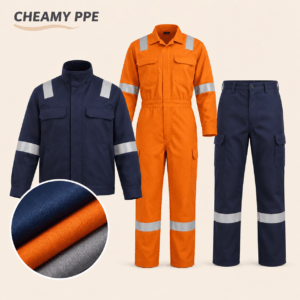
For distributors and industrial buyers, customization may include garment colors, fabric weights, reflective tape, embroidery, printing, sizing, and private labeling.
A supplier with relevant product experience and an established supply chain can help buyers coordinate these requirements more efficiently.
3. Check Fabric Composition and Flame-Resistant Performance
Fabric selection is one of the most important decisions when sourcing FR clothing.
Different materials offer different combinations of flame resistance, durability, comfort, and cost.
Common fabric options include:
- Inherent flame-resistant fabrics: Made from fibers with flame-resistant properties built into their chemical structure.
- Treated flame-resistant fabrics: Conventional fibers treated with flame-retardant chemicals to achieve the required flame-resistant performance.
- Blended fabrics: Combinations of different fibers designed to balance protection, strength, comfort, and cost.
When reviewing fabric specifications, buyers should request information about:
- Fiber composition and fabric weight (GSM).
- Flame-resistant performance and relevant test reports.
- Shrinkage and dimensional stability.
- Colorfastness and resistance to repeated washing.
- Fabric durability and tear strength.
- Applicable care and maintenance instructions.
It is also important to understand whether the flame-resistant properties are inherent or treatment-based. For treated fabrics, buyers should pay particular attention to the durability of the flame-resistant performance after repeated laundering.
Do not rely solely on a fabric specification sheet or a supplier’s statement that the material is flame-resistant. Request relevant test reports and verify that the tested material corresponds to the fabric used in the finished garment.
4. Verify Certificates and Testing Documents
Certification is a critical part of purchasing EN ISO 11612 flame-resistant clothing.
Buyers should request and carefully review the following documents:
EU Type-Examination Certificate
For applicable PPE placed on the European market, this certificate demonstrates that the product type has undergone the relevant conformity assessment by a notified body.
Test Reports
Test reports should identify the tested product or material, applicable standards, test methods, and achieved performance levels.
EU Declaration of Conformity
This document declares that the PPE complies with the applicable requirements of Regulation (EU) 2016/425.
Product Technical Information
This may include fabric specifications, product descriptions, performance classifications, care instructions, and user information.
When checking these documents, pay attention to:
- Whether the certificate identifies the same manufacturer and product model.
- Whether the standard edition and performance codes match the buyer’s requirements.
- Whether the certificate and test reports are valid and verifiable.
- Whether the tested fabric and garment construction match the products being offered.
A certificate from one garment or fabric should not automatically be assumed to cover every product supplied by the same company.
For European market requirements, buyers should also check the applicable conformity assessment and CE marking obligations under Regulation (EU) 2016/425.
5. Evaluate Garment Design and Construction
Even when the fabric meets the required performance levels, garment construction remains essential.
Poorly designed garments may compromise protection, durability, and user comfort.
When reviewing samples, buyers should pay attention to:
Seams and stitching
Check seam strength, stitching density, and construction quality.
Fasteners and closures
Zippers, buttons, snaps, and other accessories should be suitable for the intended protective application.
Pockets and openings
Their design and positioning should not compromise the garment’s protective function.
Reflective materials
For workwear intended for environments with limited visibility, reflective materials may be required. Buyers should confirm their compatibility with the intended heat and flame protection requirements.
Fit and coverage
The garment should provide appropriate coverage and allow sufficient freedom of movement during work.
Depending on the application, buyers may also need to consider additional PPE, such as protective gloves, safety footwear, helmets, and face protection.
6. Request Samples Before Placing Bulk Orders
Sample evaluation is an important step before confirming a large order.
A sample allows buyers to assess the actual product rather than relying entirely on photographs or technical descriptions.
We recommend checking the following:
- Fabric composition, weight, and overall feel.
- Color consistency and workmanship.
- Stitching, seams, zippers, and accessories.
- Size measurements and fit.
- Labels, markings, and care instructions.
- Consistency with the agreed technical specifications.
If laboratory testing is required, buyers should ensure that the sample submitted for testing represents the actual production material and garment construction.
Once the sample is approved, its specifications should be documented and used as the reference for mass production.
Any subsequent changes to fabric composition, suppliers, accessories, or garment construction should be reviewed before implementation, as they may affect product conformity.
7. Confirm Production Capacity and Quality Control
After sample approval, buyers should evaluate whether the supplier can maintain consistent quality throughout mass production.
Before placing an order, clarify the following:
| Item | What to Confirm |
|---|---|
| Production lead time | Estimated time required for bulk production |
| Minimum order quantity | MOQ for each style, color, and size |
| Fabric availability | Whether the approved fabric is available for the order |
| Size distribution | Quantity required for each size |
| Customization | Logo, labels, colors, and packaging |
| Quality inspection | Inspection procedures and acceptance criteria |
| Packaging | Individual packaging, cartons, and labeling |
For larger orders, consider arranging pre-production sample approval and pre-shipment inspection.
Quality checks should cover fabric specifications, measurements, workmanship, labels, accessories, and packaging.
Maintaining consistency between the approved sample and the finished bulk order is particularly important for protective clothing.
8. Compare Quotations Beyond the Unit Price
When sourcing from China, buyers may receive significantly different quotations for seemingly similar FR clothing.
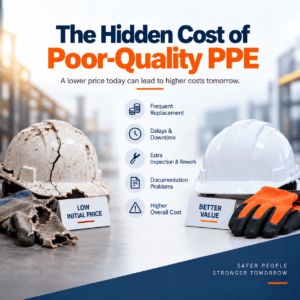
However, a lower price does not necessarily mean better purchasing value.
Before comparing quotations, make sure suppliers are quoting on the same basis:
- Identical fabric composition and GSM.
- The same EN ISO 11612 performance requirements.
- Equivalent garment designs and accessories.
- The same size range and quantity.
- Comparable certification and testing arrangements.
- Consistent packaging and delivery terms.
Also clarify whether the quotation includes customization, labels, testing fees, and other additional costs.
A transparent quotation makes it easier to compare suppliers and avoid unexpected expenses during production.
9. Consider the Latest Standard Updates
Standards and regulatory requirements may change over time, so buyers should pay attention to the edition referenced in certificates and technical documentation.
ISO 11612:2015 is the published edition currently listed by ISO. However, ISO/FDIS 11612, the fourth edition, has entered the final approval stage and is intended to replace the 2015 edition.
Before placing an order, buyers should confirm which edition is required by their market, project specifications, or end customer.
Do not assume that an existing certificate automatically covers a future revised edition. Any transition should be checked with the relevant certification body and supplier.
10. Work with a Reliable PPE Sourcing Partner
Finding the right EN ISO 11612 flame-resistant clothing supplier involves more than identifying a competitive factory price.
International buyers need to coordinate product specifications, fabric selection, certification documents, sample approval, production quality, and shipment arrangements.
Working with an experienced PPE sourcing partner can simplify communication and help buyers manage these different requirements through one coordinated process.
At CHEAMY PPE, we focus on providing PPE products and sourcing support for international buyers. Our product range includes flame-resistant workwear, protective coveralls, high-visibility clothing, safety gloves, respiratory protection, and other industrial safety equipment.
We understand that different markets and industries have different purchasing requirements. From product selection and technical specifications to customization and order coordination, we aim to help customers find suitable PPE solutions for their businesses.
Final Thoughts
Sourcing EN ISO 11612 flame-resistant clothing from China requires careful evaluation of both product performance and supplier capabilities.
Before placing an order, buyers should clearly define their protection requirements, verify certificates and test reports, evaluate fabric quality, approve samples, and establish clear quality control procedures.
A well-planned sourcing process helps reduce purchasing risks, improve product consistency, and build reliable long-term supply relationships.
Looking for EN ISO 11612 flame-resistant clothing or other industrial PPE products?
Contact CHEAMY PPE to discuss your product requirements, customization needs, and sourcing inquiries.