Skip to content
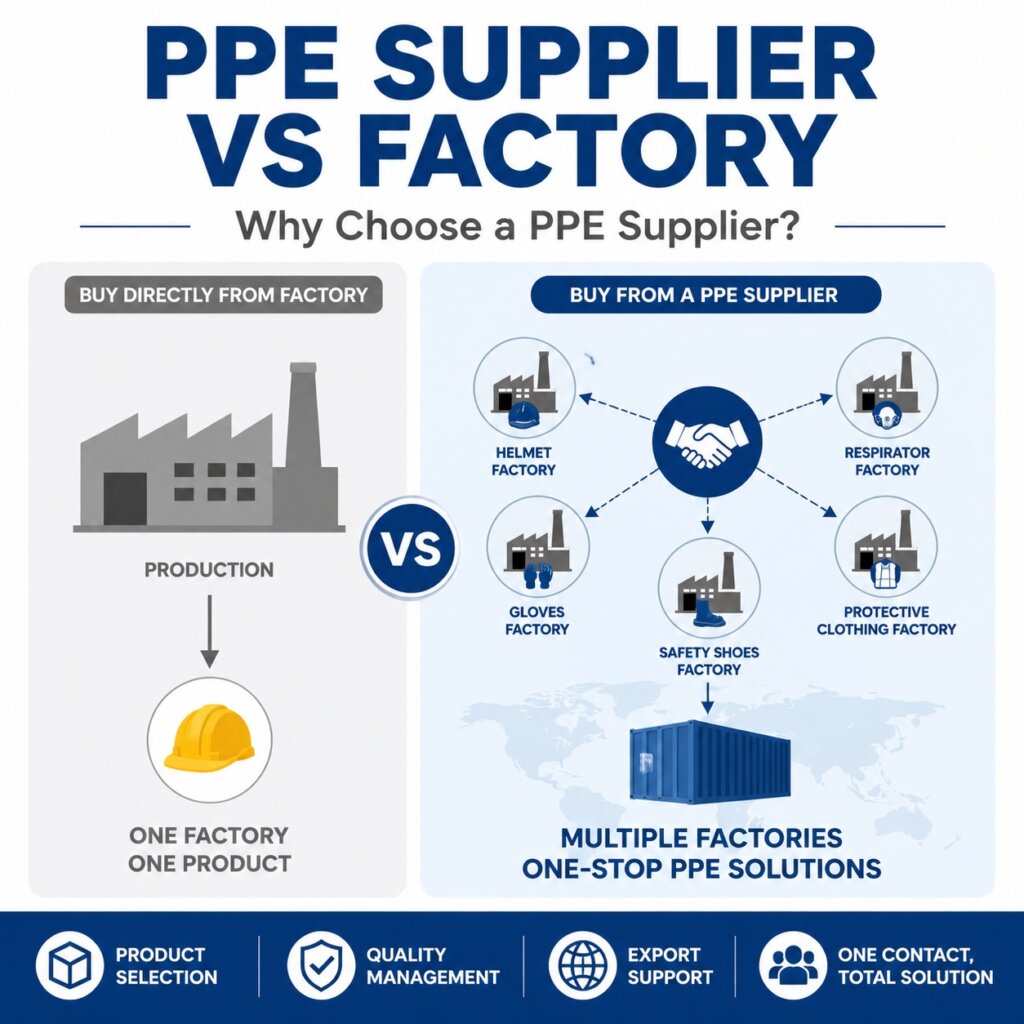
When sourcing Personal Protective Equipment (PPE), many buyers assume purchasing directly from a factory is always the most cost-effective option. While factories play a critical role in manufacturing PPE, international procurement involves much more than production.
For importers, distributors, contractors, and industrial buyers, working with an experienced PPE sourcing partner often provides greater flexibility, lower risk, and better overall value.
This article explains the differences between a PPE supplier vs factory and why partnering with a professional supplier can make your procurement process more efficient.
Factory vs PPE Supplier: What’s the Difference?
Although the terms are sometimes used interchangeably, factories and suppliers serve different purposes.
| Factory | PPE Supplier |
|---|---|
| Manufactures products | Sources products from multiple qualified factories |
| Usually specializes in one product category | Offers a complete PPE product range |
| Focuses on production efficiency | Focuses on customer solutions |
| Limited sourcing capability | Flexible sourcing and product matching |
| Handles manufacturing | Handles procurement, quality management, logistics, and export support |
A factory manufactures products.
A PPE supplier manages the entire purchasing process.
Factories Are Experts in Manufacturing
Factories are designed to produce products efficiently.
A glove factory produces gloves.
A helmet factory produces helmets.
A safety shoe factory produces footwear.
Most factories specialize in one or two product categories because manufacturing equipment, certifications, and production processes differ significantly.
If your project only requires one product in large quantities, purchasing directly from the manufacturer may be appropriate.
However, most industrial buyers require much more than a single PPE item.
Modern PPE Procurement Requires Multiple Product Categories
A construction project rarely needs only safety helmets.
It may also require:
- Safety gloves
- Safety glasses
- Reflective vests
- Safety shoes
- Respiratory protection
- Hearing protection
- Fall protection
- Protective clothing
Buying each product from a different factory means dealing with multiple suppliers, separate negotiations, different payment terms, various production schedules, and independent shipments.
This increases workload and procurement complexity.
A PPE Supplier Connects Multiple Qualified Factories
One of the biggest advantages of working with a PPE supplier is access to an established manufacturing network.
Instead of relying on a single factory, a supplier cooperates with multiple specialized manufacturers.
For example:
- Factory A produces cut-resistant gloves.
- Factory B manufactures safety helmets.
- Factory C specializes in respirators.
- Factory D produces safety footwear.
The supplier selects the most suitable factory for each product based on quality, certification, delivery time, and customer requirements.
This allows buyers to source the best products without managing numerous factory relationships.
Wider Product Selection
Factories naturally recommend the products they manufacture.
A supplier, however, evaluates products from multiple manufacturers to recommend the most suitable solution.
This gives buyers access to:
- Different protection levels
- Various certifications
- Multiple material options
- Budget-friendly alternatives
- Premium product selections
- Customized OEM solutions
Rather than being limited to one production line, customers benefit from a much broader range of PPE options.
Better Quality Management
Choosing a factory does not automatically guarantee consistent quality.
Professional PPE suppliers establish strict quality management systems across their manufacturing partners.
Typical quality management includes:
- Factory qualification
- Supplier audits
- Raw material verification
- Production monitoring
- Pre-shipment inspection
- Packaging inspection
- Documentation verification
By overseeing every stage of the supply chain, suppliers help reduce quality risks before products reach customers.
Easier Export Support
International trade involves more than manufacturing products.
Export procedures require experience with documentation, logistics, compliance, and customs requirements.
Professional PPE suppliers typically assist with:
- Commercial invoices
- Packing lists
- Certificates of Origin
- Product certifications
- Inspection reports
- Shipping coordination
- Container loading
- Customs documentation
For overseas buyers, this support can significantly reduce delays and administrative workload.
More Flexible Order Quantities
Factories often require relatively high minimum order quantities (MOQs) to maintain production efficiency.
A PPE supplier can often provide greater flexibility by:
- Combining products from different factories
- Consolidating shipments
- Supporting mixed orders
- Helping buyers test new products with smaller quantities
- Offering scalable purchasing plans as demand grows
This flexibility is especially valuable for distributors, project contractors, and businesses expanding into new markets.
One Contact Instead of Many
Managing multiple factories means communicating with several sales teams, tracking different production schedules, and coordinating separate shipments.
Working with a PPE supplier simplifies communication.
Instead of contacting:
- Helmet factory
- Glove factory
- Footwear factory
- Respirator factory
You communicate with one sourcing partner who manages everything on your behalf.
This saves time and improves procurement efficiency.
Better Supply Chain Stability
Unexpected issues can occur in manufacturing, including:
- Production delays
- Raw material shortages
- Capacity constraints
- Equipment maintenance
- Shipping disruptions
If a supplier works with multiple qualified factories, alternative production resources may already be available.
This helps minimize delays and maintain supply continuity.
Is Buying Directly from a Factory Ever Better?
Direct factory purchasing may be suitable when:
- You only need one PPE product.
- Order quantities are very large.
- You already have a quality inspection team.
- You have experience managing international procurement.
- You are comfortable handling logistics and export documentation independently.
For many businesses, however, procurement involves multiple products, ongoing orders, and international logistics. In these situations, a professional PPE supplier often provides greater efficiency and lower operational risk.
Why Many International Buyers Prefer a PPE Sourcing Partner
Experienced PPE suppliers do much more than source products.
They help buyers:
- Identify the right products for different industries
- Select reliable manufacturing partners
- Manage quality throughout production
- Coordinate multi-product orders
- Consolidate shipments
- Prepare export documentation
- Reduce sourcing risks
- Improve procurement efficiency
Rather than acting as a middleman, a professional supplier serves as an extension of the buyer’s procurement team.
Conclusion
When comparing a PPE supplier vs factory, the right choice depends on your purchasing needs.
Factories excel at manufacturing individual products. PPE suppliers excel at managing the complete sourcing process—from selecting specialized manufacturers and ensuring quality to coordinating logistics and supporting international trade.
For organizations purchasing multiple PPE categories or importing products from overseas, partnering with an experienced PPE sourcing partner can simplify procurement, reduce risks, and provide access to a wider range of certified safety solutions.
FAQ
Is buying directly from a factory always cheaper?
Not necessarily. While the unit price may be lower, managing multiple factories, inspections, logistics, and export documentation can increase the overall procurement cost.
Why work with a PPE supplier?
A PPE supplier offers access to multiple qualified manufacturers, broader product selection, quality management, shipment consolidation, and export support, making international sourcing more efficient.
Can a PPE supplier provide OEM or private label services?
Yes. Many PPE suppliers coordinate OEM and private label projects with specialized manufacturing partners, helping customers customize products, packaging, and branding.
Who should choose a PPE supplier?
Importers, distributors, contractors, wholesalers, and businesses purchasing multiple PPE categories can benefit from the expertise and supply chain management offered by a professional PPE sourcing partner.