Choosing chemical protective clothing is not simply a matter of checking whether a garment meets a particular EN standard. Different chemicals can react differently with the same protective material, and a fabric that performs well against one chemical may offer limited protection against another.
For PPE buyers, distributors, and safety managers, chemical resistance test reports provide important information about how protective clothing materials perform under specific test conditions. However, understanding the results requires more than looking at a pass mark or a single test value.
This guide explains how to read chemical resistance test reports, which key results to check, and what to consider before selecting chemical protective clothing for industrial applications.
1. Why Chemical Resistance Test Reports Matter
Chemical protective clothing is designed to reduce workers’ exposure to hazardous substances. However, no single material provides universal protection against every chemical.
The actual protection depends on several factors, including:
- The type of chemical being handled
- Chemical concentration and temperature
- Duration and frequency of exposure
- Contact conditions, such as splashes, sprays, or continuous contact
- Protective material and garment construction
- Seams, closures, and other garment components
A chemical resistance test report helps buyers evaluate whether a material has been tested against the chemicals relevant to their applications.
For procurement teams, reviewing these reports can also help compare different materials, verify supplier claims, and identify whether additional testing is required.
2. Identify the Chemical and Test Conditions
Before reviewing the test results, check exactly what chemical was used during testing.
A report should provide sufficient information to identify the test substance and the conditions under which the test was conducted.
Pay attention to the following details:
Chemical name: Confirm that the tested substance matches the chemical used in your workplace. Similar chemical names do not necessarily mean identical chemical resistance.
Concentration: Chemical resistance can vary significantly with concentration. A material tested against a diluted solution should not automatically be considered suitable for a more concentrated solution.
Temperature: Higher temperatures may affect chemical permeation and material performance. Check whether the test temperature is relevant to the actual working environment.
Test duration: The exposure period is important when interpreting the results. A material tested for a limited period has not necessarily demonstrated protection for longer exposure.
Physical condition: Check whether the chemical was tested as a liquid or gas, and whether the test conditions represent the intended application.
A test result is meaningful only when its conditions are relevant to the actual chemical exposure scenario.
3. Understand the Three Important Chemical Resistance Properties
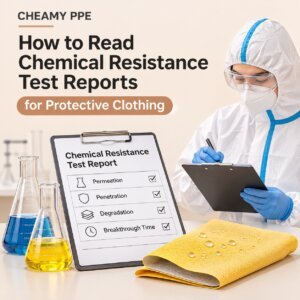
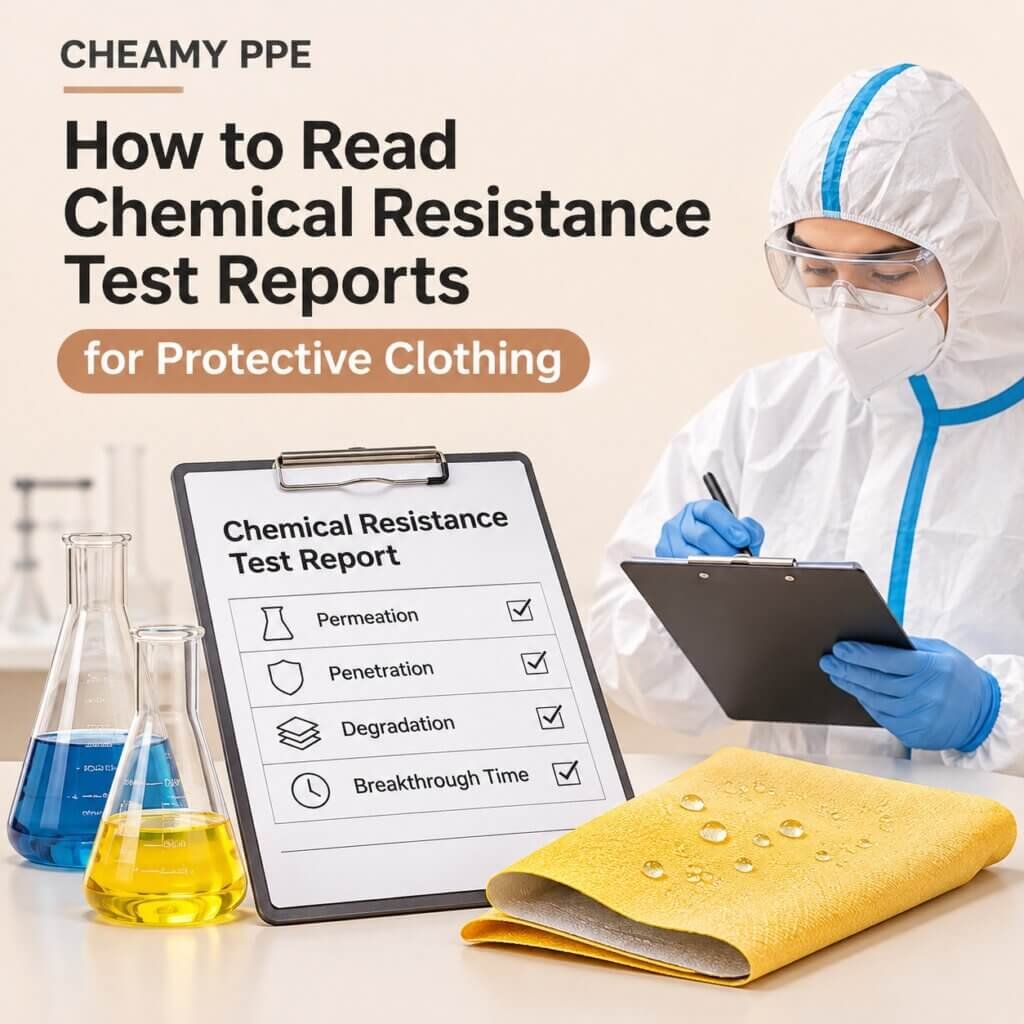
When reviewing chemical protective clothing test reports, three important properties are worth understanding: permeation, penetration, and degradation.
Although these terms are sometimes used interchangeably in general discussions, they describe different forms of material performance.
3.1 Chemical Permeation
Permeation occurs when a chemical passes through a protective material at the molecular level.
The process generally involves three stages:
- Absorption of the chemical into the outer surface of the material.
- Diffusion of the chemical through the material.
- Desorption of the chemical from the inner surface.
Permeation testing helps determine how quickly a chemical can pass through the material under specified test conditions.
One important result is breakthrough time.
Breakthrough time indicates the time taken for the chemical to reach a defined detection or reporting threshold on the inside of the tested material. The exact definition and threshold depend on the test method.
A longer breakthrough time may indicate better resistance under the tested conditions. However, it should not be interpreted as a guaranteed safe working time.
3.2 Chemical Penetration
Penetration refers to the movement of a chemical through openings or physical defects in a protective material or garment.
Examples include:
- Small holes or defects
- Openings around seams
- Gaps between garment components
- Inadequately sealed closures
Unlike permeation, penetration does not involve the chemical passing through the material at a molecular level.
For chemical protective clothing, penetration resistance is particularly important when workers may encounter liquid splashes or sprays.
3.3 Chemical Degradation
Degradation occurs when a chemical changes the physical or mechanical properties of a protective material.
Possible signs include:
- Swelling
- Softening
- Hardening
- Discoloration
- Cracking
- Loss of flexibility
- Reduced mechanical strength
A material may show a relatively long permeation breakthrough time but still experience significant degradation.
Therefore, buyers should not evaluate chemical resistance based on permeation results alone. The material must also maintain its physical integrity under the relevant exposure conditions.
4. How to Interpret Breakthrough Time and Permeation Rate
Breakthrough time and permeation rate are two important values that may appear in chemical permeation test reports.
Breakthrough Time
Breakthrough time indicates when the chemical reaches the specified detection threshold on the inner side of the test specimen.
Depending on the test method and reporting system, results may be expressed in minutes or hours.
When comparing reports, check:
- Whether the same test method was used
- Whether the same breakthrough definition was applied
- Whether the chemical concentration and temperature were identical
- Whether the reported value is an actual measured result or a test-duration limit
For example, a report stating that breakthrough was not detected during a 60-minute test does not necessarily mean that the material will resist the chemical indefinitely.
It means that breakthrough was not detected within the specified test period and under the stated conditions.
Permeation Rate
Permeation rate describes how quickly a chemical passes through the tested material.
It is generally expressed as the amount of chemical passing through a unit area of material over a specified period.
A lower permeation rate may indicate better resistance under comparable test conditions.
However, results should only be compared when the test methods, chemicals, concentrations, temperatures, and reporting criteria are sufficiently consistent.
5. Check the Test Standard and Method
The test standard is another important part of a chemical resistance report.
Different standards cover different aspects of protective clothing performance. Buyers should identify what the test actually evaluates instead of assuming that all chemical resistance tests provide the same information.
Some relevant standards include:
| Standard | Main purpose |
|---|---|
| EN 16523-1 | Determination of material resistance to permeation by liquid chemicals under continuous contact |
| EN 16523-2 | Determination of material resistance to permeation by gaseous chemicals |
| EN ISO 6529 | Test methods for resistance of protective clothing materials to permeation by liquids and gases |
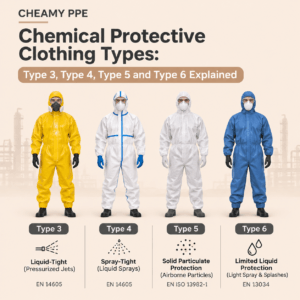
| EN 14605 | Performance requirements for liquid-tight and spray-tight chemical protective clothing |
| EN 13034 | Performance requirements for Type 6 protective clothing against limited liquid chemical exposure |
| EN ISO 13982-1 | Performance requirements for Type 5 protective clothing against airborne solid particulates |
It is important to distinguish between material testing standards and garment performance standards.
For example, EN 16523-1 is used to evaluate chemical permeation through materials. EN 14605 and EN 13034 specify requirements for particular types of chemical protective clothing.
A material test result alone does not automatically establish that a complete garment meets the requirements of a particular protective clothing type.
Always check the applicable standard edition and the product’s supporting conformity documentation.
6. Evaluate the Test Specimen and Material Construction
Another important detail is the material actually tested.
Chemical protective clothing may use different fabric structures and material combinations, such as:
- PVC-coated fabrics
- Rubber-coated fabrics
- Polyethylene-based materials
- Multilayer barrier materials
- Chemical-resistant laminated fabrics
A test report may cover only a particular material, coating, or fabric construction.
Before applying the result to a finished garment, confirm whether the tested specimen is identical to the material used in the product you intend to purchase.
Also consider the garment’s construction, including:
Seams: Stitching, taped seams, and welded seams may provide different levels of liquid protection.
Zippers and closures: These components can create potential exposure points if they are not adequately protected.
Cuffs and openings: The design should help reduce the risk of chemical entry during the intended application.
Material thickness: Thickness can influence material performance, but a thicker material is not automatically more resistant to every chemical.
A fabric test report should not be treated as proof that every component of the finished garment provides the same level of protection.
7. Common Mistakes When Reviewing Chemical Resistance Reports
Even experienced PPE buyers can misinterpret chemical resistance test results. The following mistakes should be avoided.
Mistake 1: Assuming One Material Protects Against All Chemicals
Chemical resistance is substance-specific. A material suitable for one acid may not provide adequate protection against another acid, alkali, solvent, or chemical mixture.
Always check the test data for the actual chemical involved.
Mistake 2: Treating Breakthrough Time as Safe Working Time
Breakthrough time is a laboratory test result, not a recommended period for workers to wear protective clothing.
Actual use conditions may differ from laboratory conditions. Follow the manufacturer’s instructions and workplace risk assessment when determining replacement and use procedures.
Mistake 3: Ignoring Chemical Concentration and Temperature
Test results obtained under one set of conditions should not automatically be applied to different concentrations or temperatures.
Make sure the test conditions are relevant to the intended workplace.
Mistake 4: Checking Permeation but Ignoring Degradation
A material may resist chemical permeation while still experiencing swelling, cracking, or other physical changes.
Review all available performance results rather than relying on a single figure.
Mistake 5: Assuming a Material Test Certifies the Complete Garment
A material test report does not necessarily demonstrate that the finished garment meets all applicable requirements.
Check the product documentation, garment classification, and relevant conformity information separately.
8. A Practical Checklist for PPE Buyers
When requesting or reviewing chemical resistance test reports from suppliers, use the following checklist.
| What to check | Questions to ask |
|---|---|
| Chemical identity | Was the actual workplace chemical tested? |
| Concentration | Does the tested concentration match the intended application? |
| Temperature | Is the test temperature relevant to working conditions? |
| Test standard | Which test method and standard edition were used? |
| Breakthrough time | What was the reported breakthrough time and detection threshold? |
| Permeation rate | Is the reported rate available and clearly explained? |
| Penetration | Was resistance to liquid penetration evaluated where relevant? |
| Degradation | Were physical changes to the material assessed? |
| Test specimen | Is the tested material identical to the product material? |
| Garment construction | Are seams, closures, and other components suitable for the intended exposure? |
| Product documentation | Is there supporting documentation for the complete garment? |
If any important information is missing, ask the supplier or manufacturer for clarification before making a purchasing decision.
9. How to Choose Chemical Protective Clothing Based on Test Results
After reviewing the report, the next step is to determine whether the tested material is appropriate for the intended application.
A practical selection process includes:
Step 1: Identify the workplace hazards.
Determine the chemical substances, concentrations, temperatures, exposure methods, and expected contact duration.
Step 2: Define the required protection.
Establish whether workers may face liquid splashes, pressurized liquid jets, sprays, or airborne solid particles.
Step 3: Review chemical-specific test data.
Check permeation, penetration, and degradation results for the actual chemicals involved.
Step 4: Evaluate the complete garment.
Consider the material, seams, closures, design, and compatibility with other PPE.
Step 5: Confirm product documentation.
Review the relevant standards, product specifications, instructions for use, and conformity documents.
The final selection should be based on a workplace risk assessment and the manufacturer’s guidance, not on a single test value.
10. Final Thoughts
Chemical resistance test reports are essential tools for evaluating protective clothing materials, but their results must be interpreted carefully.
For PPE buyers, the most important points are to identify the tested chemical, understand the test conditions, distinguish permeation from penetration and degradation, and confirm that the tested material corresponds to the finished garment.
At CHEAMY PPE, we believe that effective protection should balance safety, quality, and comfort. When sourcing chemical protective clothing, requesting relevant test reports and reviewing product documentation can help buyers make more informed decisions and select suitable protection for different industrial applications.
Need help selecting chemical protective clothing?
Contact CHEAMY PPE to discuss your application requirements, material options, and chemical protection needs.