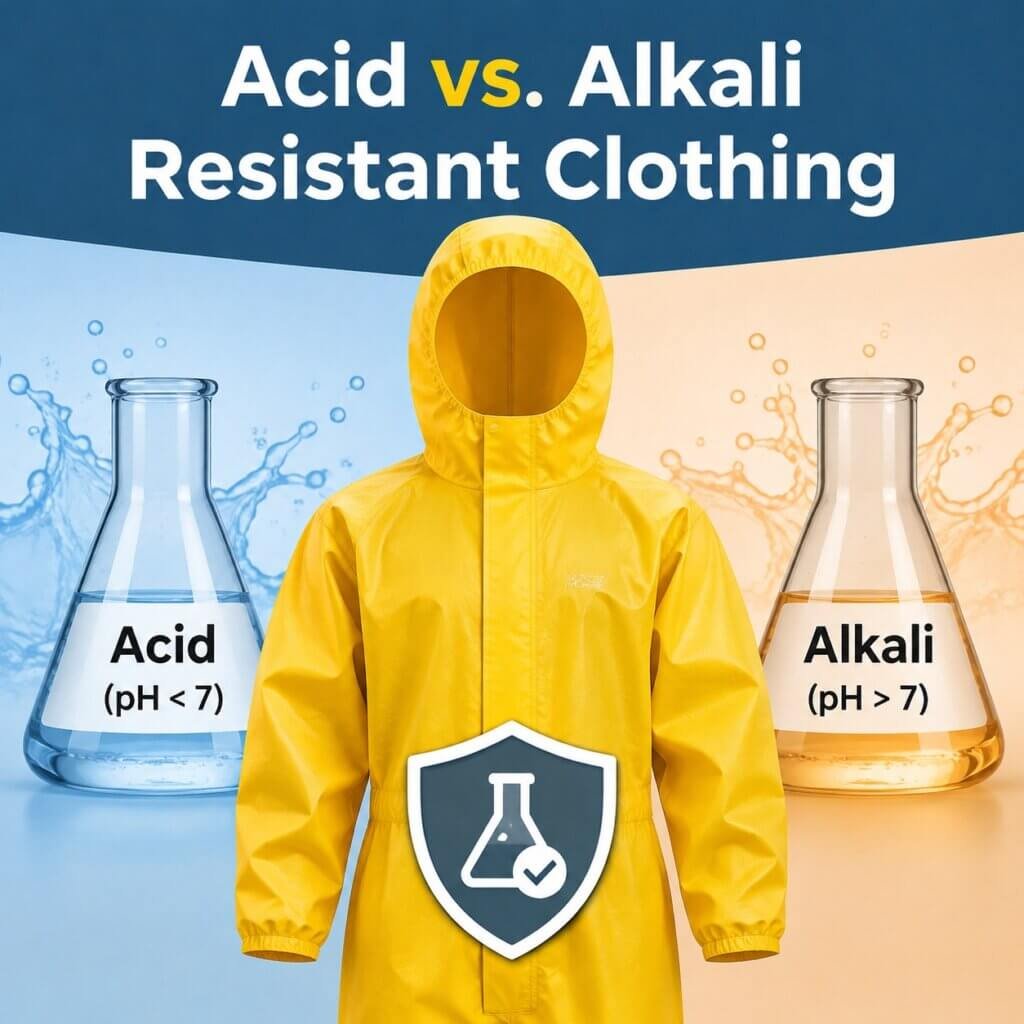
In chemical processing plants, metal treatment facilities, wastewater treatment plants, and industrial manufacturing environments, workers may be exposed to acids, alkalis, and other hazardous chemical substances. Selecting suitable protective clothing is essential for reducing the risk of chemical contact and skin injuries.
However, acid-resistant clothing and alkali-resistant clothing are not necessarily interchangeable. A material that performs well against a particular acid may offer limited protection against certain alkaline chemicals. The difference becomes even more important when chemical concentration, temperature, exposure duration, and working conditions change.
For professional PPE buyers, understanding chemical compatibility is an important part of selecting the right protective garments. Simply choosing clothing labeled “acid resistant” or “chemical resistant” is not enough. Buyers need to understand how materials behave when exposed to specific chemicals and how to evaluate the available test data.
In this guide, we explore the differences between acid and alkali resistant clothing, compare common protective materials, explain chemical resistance testing, and discuss the factors buyers should consider when sourcing chemical protective workwear.
1. Acid vs. Alkali: What Are the Differences?
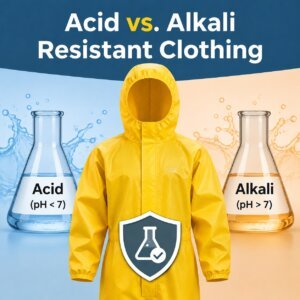
Acids and alkalis are two major categories of chemicals commonly encountered in industrial environments. Both can cause serious skin injuries, but their chemical properties and interactions with protective materials are different.
1.1 What Are Acids?
Acids are substances that donate hydrogen ions in aqueous solutions. Their pH is generally below 7.
Common industrial acids include:
- Sulfuric acid
- Hydrochloric acid
- Nitric acid
- Phosphoric acid
- Acetic acid
- Hydrofluoric acid
These substances are used in chemical manufacturing, metal processing, battery production, industrial cleaning, and other applications.
Different acids can have significantly different chemical properties. Some are strongly corrosive, while others may present additional hazards such as toxicity or specific reactions with certain materials.
For example, sulfuric acid is widely used in industrial processing and battery applications. Hydrochloric acid is commonly used for metal cleaning and surface treatment. Nitric acid is used in chemical production and metal processing.
These examples illustrate why buyers should identify the exact chemical rather than relying on the general term “acid.”
1.2 What Are Alkalis?
Alkalis are water-soluble bases that produce hydroxide ions in aqueous solutions. Their pH is generally above 7.
Common industrial alkalis include:
- Sodium hydroxide
- Potassium hydroxide
- Calcium hydroxide
- Ammonium hydroxide
Alkaline chemicals are widely used in cleaning, wastewater treatment, metal processing, food manufacturing, and chemical production.
Strong alkalis such as sodium hydroxide and potassium hydroxide can cause severe chemical burns. Their effects may not always be immediately obvious, making appropriate protective equipment and safe handling procedures particularly important.
1.3 Why Is the Difference Important for Protective Clothing?
Acids and alkalis do not interact with every protective material in the same way.
A material that provides acceptable resistance to one acidic solution may not provide sufficient protection against a concentrated alkaline solution. Similarly, a material suitable for one acid may perform poorly against another acid.
Chemical compatibility depends on several factors:
- Chemical identity and formulation
- Concentration
- Temperature
- Contact duration
- Material composition
- Material thickness
- Garment construction
For this reason, buyers should not assume that acid-resistant clothing automatically provides adequate alkali protection, or that a general chemical-resistant garment is suitable for every industrial chemical.
The correct approach is to match the protective material to the actual chemical exposure conditions.
2. Why Chemical Compatibility Matters in Protective Clothing
Chemical protective clothing is designed to reduce the risk of hazardous substances reaching the wearer’s skin. However, no single material provides universal protection against every chemical.
When a chemical comes into contact with a protective garment, three important processes should be considered: penetration, permeation, and degradation.
2.1 Chemical Penetration
Penetration occurs when a chemical passes through openings, defects, seams, or other imperfections in a material or garment.
Potential weak points include:
- Damaged fabric surfaces
- Poorly sealed seams
- Openings around cuffs and collars
- Defective zippers and closures
- Inadequate connections between garment components
For example, a chemical-resistant fabric may provide a suitable barrier, but an inadequately designed seam could allow liquid to enter the garment.
This is why buyers should evaluate the complete garment rather than examining only the main fabric.
2.2 Chemical Permeation
Permeation occurs when a chemical moves through a material at the molecular level.
Unlike penetration, permeation does not necessarily involve visible holes or physical damage.
A garment may appear completely intact while a chemical gradually passes through its protective material.
Permeation testing helps evaluate how quickly a specific chemical passes through a material under defined laboratory conditions.
Important test results may include:
- Standardized breakthrough time
- Permeation rate
- Cumulative permeation
- Observations of material changes
These results help buyers compare materials and assess their suitability for specified exposure conditions.
However, laboratory breakthrough time should not automatically be treated as a safe working time. Actual workplace conditions, safety factors, exposure patterns, and garment design must also be considered.
2.3 Chemical Degradation
Degradation occurs when chemical exposure changes the physical or chemical properties of a protective material.
Possible signs include:
- Swelling
- Softening
- Cracking
- Discoloration
- Loss of flexibility
- Changes in material strength
- Surface damage or delamination
A degraded material may no longer provide its intended level of protection.
Importantly, degradation and permeation are not the same. A material can experience chemical permeation without obvious visible damage, while another material may show significant degradation after exposure.
Buyers should therefore review both chemical compatibility information and the physical condition of the protective garment.
3. How Different Materials Respond to Acids and Alkalis
Material selection is one of the most important considerations when purchasing acid and alkali resistant clothing.
Different materials have different chemical resistance characteristics, flexibility, durability, and comfort properties. Their performance also depends on manufacturing formulation and garment construction.
3.1 PVC (Polyvinyl Chloride)
PVC is widely used in industrial protective clothing, including chemical-resistant aprons, jackets, trousers, and coveralls.
Potential advantages include:
- Resistance to selected acids and alkalis
- Good liquid barrier properties
- Availability in different thicknesses
- Easy-to-clean surfaces
- Flexible options for garment design
- Suitability for certain industrial splash protection applications
PVC protective clothing may be considered for chemical handling, industrial cleaning, electroplating, and selected wastewater treatment operations.
However, PVC formulations vary. Plasticizers, additives, coating processes, and material construction can influence performance.
Certain organic solvents and other chemicals may be incompatible with particular PVC formulations. Therefore, buyers should request compatibility information for the exact chemical involved.
3.2 Natural Rubber
Natural rubber is valued for its elasticity and flexibility. It is used in various protective products and can provide resistance to selected dilute acids and alkalis.
Potential advantages include:
- Good flexibility
- Elasticity
- Comfortable movement in suitable designs
- Resistance to selected aqueous chemicals
However, natural rubber has limitations. Its performance against oils, organic solvents, oxidizing chemicals, and other substances varies.
Natural rubber can also be affected by environmental conditions and aging.
Buyers should verify the exact rubber formulation and its intended chemical applications rather than treating natural rubber as a universal chemical barrier.
3.3 Neoprene (Chloroprene Rubber)
Neoprene is a synthetic rubber used in certain chemical protective products.
Depending on its formulation, it may provide resistance to a range of acids, alkalis, oils, and other industrial substances.
Potential advantages include:
- Flexibility
- Resistance to selected chemicals
- Good mechanical properties
- Suitability for certain industrial protective applications
Its performance is chemical-specific. Some strong oxidizing chemicals, solvents, and other substances may be incompatible with particular neoprene formulations.
The material should be evaluated using relevant test results for the intended chemical.
3.4 Nitrile Rubber
Nitrile rubber is commonly used in chemical-resistant gloves and other protective products.
It is known for useful resistance to selected oils, fuels, and chemicals, but its performance against acids and alkalis depends on the specific formulation and exposure conditions.
Nitrile should not automatically be selected for every acid or alkali application.
Buyers should also distinguish between nitrile used in gloves, nitrile coatings, and nitrile-based garment materials. Different constructions may have different performance characteristics.
3.5 Chemical-Resistant Coated Fabrics
Some protective garments use a textile base with a chemical-resistant polymer coating.
The textile base provides mechanical support, while the coating forms the intended liquid barrier.
Depending on the coating formulation and construction, these materials may offer:
- Flexibility
- Different thickness and weight options
- Mechanical strength
- Resistance to selected chemical liquids
- Suitability for different garment designs
However, coating damage, seam construction, and the performance of the complete material assembly must be considered.
A coating that performs well on a flat laboratory specimen does not automatically establish the performance of the finished garment.
3.6 Specialized Chemical Barrier Materials
For demanding chemical exposure conditions, specialized barrier materials may be required.
Certain multilayer polymer materials are designed to provide protection against a wider range of hazardous chemicals than conventional coated fabrics.
These materials may be considered for applications involving more challenging chemical hazards, depending on the product’s tested performance.
However, even specialized chemical barrier materials have limitations. Their suitability must be verified against the exact chemicals, concentrations, temperatures, and exposure durations involved.
3.7 Material Comparison for Buyers
| Material | Potential advantages | Important considerations |
|---|---|---|
| PVC | Liquid barrier properties and resistance to selected acids and alkalis | Formulation and chemical compatibility must be checked |
| Natural rubber | Flexibility and resistance to certain aqueous chemicals | Limited compatibility with some oils, solvents, and other chemicals |
| Neoprene | Flexibility and resistance to selected industrial chemicals | Performance varies with formulation and chemical |
| Nitrile rubber | Useful resistance to selected oils and chemicals | Not universally suitable for strong acids or alkalis |
| Coated fabrics | Combines textile support with a protective coating | Coating integrity and seam performance are important |
| Specialized barrier materials | Designed for demanding chemical protection applications | Requires product-specific compatibility data |
There is no universal best material for all acid and alkali applications.
Buyers should select the material with verified performance for the actual chemical exposure, not simply the thickest, most expensive, or most commonly advertised option.
4. How Chemical Concentration and Temperature Affect Protection
Even when a material is compatible with a particular chemical, its protective performance may change under different exposure conditions.
4.1 Chemical Concentration
The concentration of a chemical can significantly affect its interaction with protective materials.
A material that performs adequately against a dilute solution may not provide sufficient protection against a concentrated solution of the same chemical.
For example, buyers evaluating protective clothing for sulfuric acid should not assume that test results for a low-concentration solution automatically apply to concentrated sulfuric acid.
The same principle applies to alkaline solutions such as sodium hydroxide.
Chemical concentration should always be included when requesting material compatibility information.
4.2 Temperature
Temperature can influence chemical reactions and the behavior of protective materials.
Higher temperatures may increase chemical permeation rates, accelerate material degradation, or change the flexibility and mechanical properties of certain materials.
Therefore, chemical compatibility information obtained under one test temperature should not automatically be applied to significantly different working conditions.
For example, a garment tested at normal laboratory temperature may not provide the same performance when exposed to a hot chemical solution.
4.3 Contact Duration
The length of time a chemical remains in contact with a protective garment is another important factor.
A brief splash and prolonged contact may produce very different outcomes.
Buyers should consider whether workers face:
- Occasional small splashes
- Repeated liquid contact
- Continuous chemical exposure
- Extended contact during maintenance
- Potential immersion or pooling of chemicals
The longer a material remains in contact with a chemical, the more important permeation and degradation data become.
4.4 Chemical Mixtures
Industrial chemicals are not always used as pure substances.
Mixtures may contain several ingredients that interact differently with protective materials.
A mixture can sometimes behave more aggressively than its individual components because of interactions between ingredients.
For example, compatibility information for a single acid should not automatically be applied to a cleaning solution containing several acids, surfactants, and solvents.
When evaluating protective clothing for mixtures, buyers should consider the complete formulation and seek appropriate compatibility information.
4.5 Mechanical Stress During Use
Chemical protective clothing is also exposed to movement, bending, stretching, and friction during normal work.
These conditions can affect seams, coatings, closures, and material integrity.
A material that performs well under static laboratory conditions may experience different stresses during actual use.
Buyers should therefore consider the garment’s design and mechanical durability alongside its chemical resistance.
5. Understanding Chemical Resistance Test Results
For professional PPE buyers, test reports are essential when evaluating chemical-resistant materials.
However, different tests measure different properties. Understanding their purpose helps avoid incorrect conclusions.
5.1 Liquid Penetration and Repellency Testing
ISO 6530:2005 specifies a test method for measuring penetration, absorption, and repellency indices of protective clothing materials against liquid chemicals, mainly chemicals of low volatility.
The test helps evaluate how a material responds to limited liquid contact under specified conditions.
It can provide useful information when assessing materials intended for certain splash exposure applications.
However, this test does not establish universal chemical resistance or replace permeation testing where molecular-level chemical passage is a concern.
5.2 Chemical Permeation Testing
ISO 6529 specifies laboratory methods for evaluating the resistance of protective clothing materials to permeation by liquid and gaseous chemicals.
Important results include:
Breakthrough time: The measured time until chemical permeation is detected according to the test method and detection criteria.
Permeation rate: The amount of chemical passing through a unit area of material over a defined period.
Cumulative permeation: The total amount of chemical that has passed through the tested material during the measurement period.
These results help compare material performance under defined laboratory conditions.
A longer breakthrough time may indicate better barrier performance for the tested chemical and conditions. However, it does not mean that the garment can safely be worn for that entire period in the workplace.
5.3 Chemical Degradation Assessment
Chemical degradation assessment examines changes in a material after exposure to a specific chemical.
Depending on the test method, observations may include:
- Changes in appearance
- Swelling or shrinkage
- Cracking
- Softening
- Loss of strength
- Changes in flexibility
These observations help buyers understand whether a material may deteriorate during chemical contact.
5.4 Why Test Conditions Matter
When reviewing a test report, buyers should check:
- Chemical identity
- Chemical concentration
- Test temperature
- Test duration
- Material identification
- Material thickness
- Test method and edition
- Reported breakthrough time and permeation rate
- Observed material degradation
A test report for one material formulation should not automatically be treated as applicable to another product made from a similar-looking material.
Likewise, a test conducted against one concentration should not be used as proof of performance against every concentration.
5.5 Material Tests vs. Finished Garment Performance
One important distinction is the difference between testing a material specimen and evaluating a complete protective garment.
Material testing can provide information about chemical penetration, permeation, or degradation.
However, a complete garment also includes:
- Seams
- Closures
- Zippers
- Cuffs
- Hoods
- Interfaces with gloves and boots
- Connections between different garment components
These features can affect the protection offered by the complete product.
Buyers should therefore review both material performance and the applicable finished-garment conformity documentation.
6. Types of Acid and Alkali Resistant Protective Clothing
Different garment designs are available depending on the exposure conditions and the level of body coverage required.
6.1 Chemical-Resistant Aprons
Chemical-resistant aprons provide additional protection for the front of the body during selected tasks.
They may be used in:
- Chemical preparation
- Industrial cleaning
- Laboratory work
- Chemical transfer operations
- Food and industrial processing
Aprons can be practical where the main exposure risk is localized to the front of the body.
However, they do not provide full-body protection and should not be used where the risk assessment requires more extensive coverage.
6.2 Chemical-Resistant Jackets and Trousers
Separate jackets and trousers may be used in certain industrial applications.
They can provide flexibility and may be more convenient for tasks requiring frequent movement.
Buyers should pay attention to the connection between the jacket and trousers, as well as the protection of the waist, cuffs, and other potential exposure points.
6.3 Chemical-Resistant Coveralls
Coveralls provide broader body coverage and are available in different materials and protection designs.
Depending on their tested performance, they may be used for selected splash, spray, or more demanding liquid chemical applications.
Important features include:
- Hood design
- Front closures
- Elasticated or adjustable cuffs
- Seam construction
- Boot and glove interfaces
- Overall fit and mobility
The garment type and protection level should match the actual chemical exposure.
6.4 Full Chemical Protective Suits
Full chemical protective suits are designed for more demanding applications where greater body coverage is required.
Some designs can be integrated with compatible gloves, boots, respiratory protective equipment, and other PPE components.
The complete ensemble should be evaluated for the intended application. A protective suit alone does not automatically provide adequate respiratory, hand, or foot protection.
7. Which Chemical Protective Clothing Standards Should Buyers Understand?
When purchasing acid and alkali resistant clothing, buyers should understand the standards relevant to the intended exposure.
7.1 EN 14605: Liquid-Tight and Spray-Tight Clothing
EN 14605 specifies performance requirements for certain reusable and limited-use chemical protective clothing.
It covers:
- Type 3: Clothing with liquid-tight connections between different parts of the garment.
- Type 4: Clothing with spray-tight connections between different parts of the garment.
- Type PB [3] and PB [4]: Partial-body protective clothing providing the corresponding specified protection.
Type 3 clothing is intended for protection against strong, directional liquid jets.
Type 4 clothing is intended for protection against liquid spray exposure.
Buyers should select the appropriate garment type based on the exposure conditions and relevant risk assessment.
7.2 EN 13034: Limited Protection Against Liquid Chemicals
EN 13034 specifies requirements for Type 6 chemical protective clothing and certain partial-body protective garments.
Type 6 clothing provides limited protection against light spray and minor splashes of liquid chemicals under specified test conditions.
It should not be treated as equivalent to Type 3 or Type 4 clothing.
7.3 EN 14325: Testing and Classification of Chemical Protective Clothing Materials
EN 14325 provides test methods and performance classification requirements for materials, seams, joins, and assemblages used in chemical protective clothing.
It supports the evaluation of material and component performance.
However, it should not be confused with a standalone finished-garment product standard.
7.4 ISO 6530: Liquid Penetration and Repellency
ISO 6530:2005 specifies a method for measuring penetration, absorption, and repellency indices of protective clothing materials against liquid chemicals, mainly chemicals of low volatility.
It is relevant when evaluating material performance against limited liquid exposure.
7.5 ISO 6529: Chemical Permeation Testing
ISO 6529 specifies methods for evaluating chemical permeation through protective clothing materials.
It provides information such as breakthrough time, permeation rate, and cumulative permeation under defined laboratory conditions.
Buyers should check the current edition and the specific test method referenced in the product documentation.
7.6 How Should Buyers Select the Appropriate Standard?
| Exposure condition | Relevant standard to consider |
|---|---|
| Strong directional liquid jets | EN 14605 Type 3 |
| Liquid spray exposure | EN 14605 Type 4 |
| Limited spray and minor splashes | EN 13034 Type 6 |
| Liquid penetration and repellency testing | ISO 6530 |
| Chemical permeation testing | ISO 6529 |
| Material and component performance classification | EN 14325 |
These standards address different aspects of chemical protection. No single standard automatically confirms suitability for every acid or alkali.
The required protection should be established through workplace risk assessment and verified product documentation.
8. How to Select Protective Clothing for Different Chemical Applications
The right protective clothing depends on the chemicals handled and the way workers may be exposed.
8.1 Chemical Manufacturing
Chemical manufacturing facilities may handle concentrated acids, alkalis, solvents, and mixtures.
Buyers should identify the exact chemicals used in each process and determine whether workers face occasional splashes, spray exposure, or continuous contact.
Material compatibility and complete garment performance should be reviewed before selecting protective clothing.
8.2 Electroplating and Metal Surface Treatment
Electroplating and metal treatment operations may involve acidic cleaning solutions, alkaline degreasing agents, and other chemical baths.
Workers may require protective aprons, jackets, trousers, or full-body suits depending on the task.
Special attention should be given to the chemical composition, temperature, and potential for splashes during tank operations.
8.3 Wastewater Treatment
Wastewater treatment facilities may use acids and alkalis for pH adjustment, cleaning, and chemical processing.
The chemicals and concentrations can vary between facilities.
Protective clothing should be selected according to the substances handled, exposure frequency, and potential contact conditions.
8.4 Industrial Cleaning
Industrial cleaning may involve acidic descaling agents, alkaline detergents, and mixed cleaning formulations.
Buyers should obtain the chemical formulation and review its compatibility with the proposed garment material.
A garment suitable for one cleaning solution may not be suitable for another.
8.5 Laboratories and Chemical Preparation
Laboratory workers may handle relatively small quantities of concentrated chemicals.
Even small quantities can present serious hazards depending on the chemical.
Protective clothing should be selected according to the laboratory risk assessment, chemical handling procedures, and other required PPE.
9. How to Choose the Right Acid and Alkali Resistant Clothing
For buyers and procurement teams, the following selection process can help organize product evaluation.
Step 1: Identify the Chemicals
Obtain the chemical names, concentrations, mixtures, and available Safety Data Sheets.
Avoid relying only on general descriptions such as “acid solution” or “industrial cleaning chemical.”
Step 2: Evaluate the Exposure Conditions
Determine whether workers may encounter:
- Occasional splashes
- Repeated liquid contact
- Low-pressure sprays
- Strong directional jets
- Continuous contact
- Chemical immersion
The exposure conditions influence the required garment design and protection level.
Step 3: Define Material Requirements
Use relevant compatibility information to identify suitable materials.
Consider the chemical, concentration, temperature, contact duration, material thickness, and test conditions.
Step 4: Select the Appropriate Garment Design
Determine whether an apron, jacket and trousers, coverall, or full protective suit is appropriate.
Consider body coverage, movement, and interfaces with gloves and boots.
Step 5: Verify Test Reports and Product Documentation
Request the relevant chemical resistance data, material test reports, and applicable product conformity documentation.
Confirm that the documents match the exact product being offered.
Step 6: Evaluate Samples and Workmanship
Where appropriate, review samples for material quality, stitching, closures, fit, and construction.
Sample inspection is useful for evaluating workmanship, but visual inspection cannot replace chemical compatibility testing.
Step 7: Confirm Maintenance and Replacement Requirements
Review instructions for cleaning, storage, inspection, repair, and replacement.
Make sure the end user understands the garment’s limitations and conditions for removal from service.
10. Common Mistakes When Selecting Acid and Alkali Resistant Clothing
Mistake 1: Assuming One Material Resists All Acids and Alkalis
Different chemicals interact differently with protective materials.
A material suitable for one acidic solution may not provide adequate protection against another acid or a strong alkaline solution.
Always verify compatibility for the actual chemical.
Mistake 2: Choosing Products Based Only on Material Thickness
A thicker material is not automatically more chemically resistant.
Thickness may influence permeation performance, but the chemical formulation and material properties are also important.
Test results are more useful than thickness alone.
Mistake 3: Confusing Waterproof Clothing with Chemical Protective Clothing
A waterproof garment may prevent water from passing through but may not provide sufficient protection against hazardous chemical liquids.
Water resistance and chemical resistance are different performance considerations.
Mistake 4: Ignoring Chemical Concentration and Temperature
Test results obtained under one set of conditions may not apply to more concentrated or hotter chemicals.
Buyers should provide realistic operating conditions when requesting compatibility information.
Mistake 5: Checking Only the Main Fabric
Seams, closures, cuffs, collars, and connections between components can create potential weak points.
The complete garment should be evaluated for the intended application.
Mistake 6: Ignoring Permeation and Degradation Data
A garment may appear undamaged while chemicals gradually permeate its material.
Similarly, chemical degradation may reduce material performance even when the original garment specification appears suitable.
Buyers should review the relevant test results and follow manufacturer instructions for inspection and replacement.
Mistake 7: Assuming a Standard Number Guarantees Universal Protection
A garment meeting a particular chemical protective clothing standard is not automatically suitable for every chemical.
Standards define specific performance requirements and test conditions. Chemical compatibility must still be evaluated for the intended application.
11. Maintenance, Inspection, and Replacement of Chemical Protective Clothing
Selecting the right garment is only the beginning. Proper maintenance and inspection are also important for maintaining the intended protective performance.
11.1 Inspect Before Use
Before each use, workers should follow the manufacturer’s inspection instructions.
Depending on the garment, checks may include:
- Cuts, holes, and tears
- Cracked or damaged coatings
- Discoloration or swelling
- Damaged seams
- Defective zippers and closures
- Deteriorated cuffs and connections
Any suspected damage should be evaluated before the garment is used.
11.2 Follow Cleaning Instructions
Chemical residues may remain on garment surfaces after use.
Cleaning should follow the manufacturer’s instructions and workplace decontamination procedures.
Do not assume that ordinary washing methods are suitable for every chemical protective garment.
11.3 Store Correctly
Protective clothing should be stored according to the manufacturer’s recommendations.
Avoid conditions that may accelerate material aging, such as unsuitable temperatures, direct sunlight, excessive humidity, or contact with incompatible substances.
11.4 Know When to Replace the Garment
A garment should be removed from service when it is damaged, visibly degraded, contaminated beyond approved decontamination procedures, or otherwise no longer suitable for its intended use.
Replacement decisions should follow the manufacturer’s guidance and workplace safety procedures.
Chemical protective clothing should never be reused simply because it looks clean or undamaged.
12. What Should Buyers Check When Sourcing from a PPE Supplier in China?
For international buyers, sourcing acid and alkali resistant clothing involves more than comparing prices and product photographs.
A reliable purchasing process should include clear specifications, relevant technical documentation, and communication about the intended application.
12.1 Provide Clear Chemical Information
When requesting a quotation, provide the chemical names, concentrations, operating temperatures, and expected exposure conditions whenever available.
This information helps the supplier understand the application and identify which product information needs to be reviewed.
12.2 Request Product-Specific Technical Documents
Ask for relevant product specifications, chemical compatibility information, test reports, and applicable conformity documents.
Verify that the documentation relates to the exact product model and material construction being offered.
12.3 Confirm Material and Garment Construction
Clarify the material type, thickness, coating, seam construction, closures, and garment design.
Do not rely on general product descriptions without supporting technical information.
12.4 Evaluate Samples Before Bulk Orders
Where appropriate, request samples to evaluate workmanship, fit, material appearance, and design details.
Agree on the final product specifications before confirming bulk production.
12.5 Discuss Customization Requirements
Depending on the product and available options, buyers may request:
- Custom colors
- Different garment sizes
- Logo printing
- Private labels
- Special packaging
- Design adjustments
Any changes to the tested material or garment construction should be reviewed to ensure that they do not invalidate relevant performance evidence or conformity claims.
12.6 Establish Quality and Inspection Requirements
Before placing an order, confirm the approved specifications, inspection arrangements, packaging requirements, and documentation to be supplied.
Clear purchasing records help reduce misunderstandings and support consistency in repeat orders.
Frequently Asked Questions
1. Is acid-resistant clothing also alkali-resistant?
Not necessarily. Acid and alkali resistance depend on the chemical composition of the protective material and the specific chemical exposure. Buyers should verify compatibility with both the acid and alkaline substances involved.
2. Which material is best for acid and alkali resistant clothing?
There is no universal best material. PVC, natural rubber, neoprene, nitrile, coated fabrics, and specialized barrier materials have different chemical compatibility characteristics. The correct choice depends on the exact chemical, concentration, temperature, and exposure duration.
3. Can PVC clothing protect against strong acids?
Some PVC formulations provide resistance to selected acids, but performance depends on the exact chemical, concentration, temperature, material thickness, and exposure conditions. Relevant test data should be reviewed before selecting a garment.
4. What is the difference between chemical penetration and permeation?
Penetration occurs when chemicals pass through openings, seams, or imperfections. Permeation occurs when chemicals move through a material at the molecular level. Both are important when evaluating chemical protective clothing.
5. What does EN 14605 Type 3 mean?
EN 14605 Type 3 relates to liquid-tight chemical protective clothing with liquid-tight connections between different garment components. It is intended for specified liquid jet exposure conditions.
6. What does EN 13034 Type 6 mean?
EN 13034 Type 6 relates to chemical protective clothing offering limited protection against liquid chemicals, such as light spray and minor splashes under specified test conditions. It is not equivalent to Type 3 or Type 4 protection.
7. How can buyers verify chemical resistance?
Request relevant test reports and compatibility information for the exact chemical, concentration, temperature, and material construction. Review permeation, penetration, and degradation results as applicable.
8. Can chemical protective clothing be reused?
Some garments are designed for repeated use, while others are intended for limited use. Reuse depends on the product design, exposure history, cleaning instructions, inspection results, and manufacturer’s recommendations.
9. Do chemical-resistant garments replace chemical-resistant gloves and boots?
No. Protective clothing is only one part of a complete PPE system. Workers may also require compatible gloves, boots, eye protection, face protection, and respiratory equipment depending on the workplace hazards.
Conclusion
Acid and alkali resistant clothing must be selected according to the specific chemical hazards and exposure conditions involved.
Although PVC, rubber, coated fabrics, and specialized barrier materials are used in chemical protective clothing, their performance varies depending on formulation, chemical concentration, temperature, contact duration, and garment construction.
For professional buyers, the most reliable approach is to identify the exact chemicals, review relevant compatibility data, verify protective clothing requirements, and evaluate the complete garment rather than relying on general material descriptions.
Understanding these differences helps buyers make better-informed purchasing decisions and select chemical protective clothing that is more appropriate for their industrial applications.
Sourcing Acid and Alkali Resistant Clothing with CHEAMY PPE
Selecting suitable acid and alkali resistant clothing requires clear product specifications, relevant technical documentation, and an understanding of the intended working environment.
As a PPE supplier in China, CHEAMY PPE supports international buyers in sourcing protective clothing and other personal protective equipment according to their specifications and purchasing requirements.
Whether you are sourcing chemical-resistant coveralls, protective aprons, or other industrial safety equipment, CHEAMY PPE can help coordinate product selection and customization discussions based on your requirements.
Our focus is to help buyers consider safety, quality, and comfort when evaluating protective equipment for industrial applications.
Contact CHEAMY PPE to discuss your acid and alkali resistant clothing sourcing requirements.