Chemical exposure is a serious workplace hazard in industries such as chemical processing, manufacturing, pharmaceuticals, laboratories, and industrial maintenance. Choosing the right chemical protective clothing (CPC) is essential for reducing the risk of skin contact with hazardous substances.
However, not all chemical protective suits provide the same level of protection. Under European PPE standards, chemical protective clothing is classified into different types according to the nature and level of exposure they are designed to protect against.
Among these classifications, Type 3, Type 4, Type 5, and Type 6 are commonly used for different industrial applications.
Understanding their differences can help safety managers, PPE distributors, and procurement professionals select suitable protective clothing for specific workplace hazards.
1. What Are the Types of Chemical Protective Clothing?
Chemical protective clothing is classified according to its protective performance against different forms of chemical exposure.
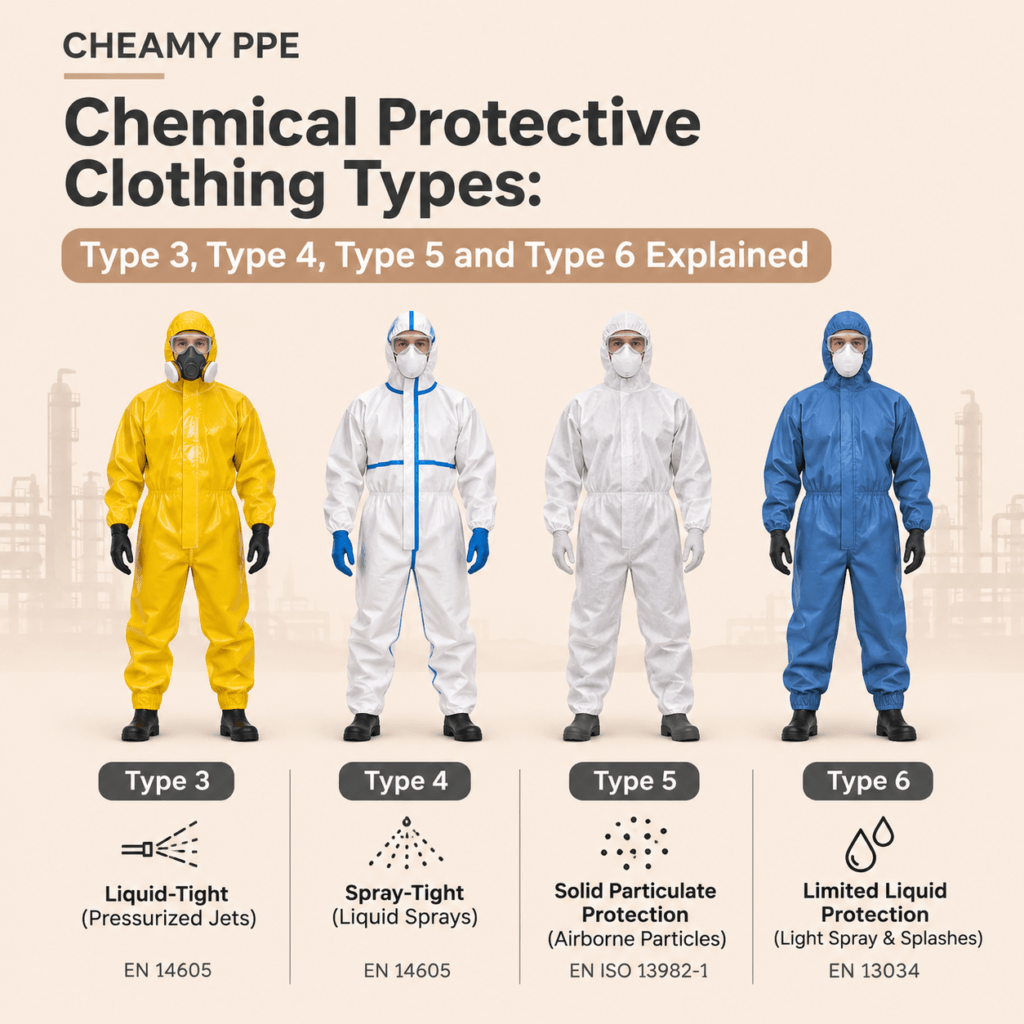
The main European standards associated with Types 3–6 are:
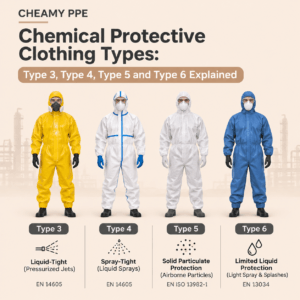
- Type 3: EN 14605 – Liquid-tight protective clothing.
- Type 4: EN 14605 – Spray-tight protective clothing.
- Type 5: EN ISO 13982-1 – Protective clothing against airborne solid particulates.
- Type 6: EN 13034 – Clothing offering limited protection against liquid chemicals.
Each type addresses a different exposure scenario. These classifications should not be understood as a simple ranking from low to high protection because they cover different hazards.
2. Type 3 Chemical Protective Clothing: Liquid-Tight Protection
Type 3 chemical protective clothing is designed to protect against liquid chemicals delivered in the form of pressurized jets.
It is commonly used in workplaces where workers may face direct liquid chemical exposure, including situations involving directional splashes or pressurized chemical release.
Applicable Standard: EN 14605
Key Characteristics
- Liquid-tight connections between garment components.
- Designed to withstand pressurized liquid jets under the applicable test conditions.
- Seams and closures are important parts of the overall protective design.
- Suitable chemical resistance must be verified for the specific chemical involved.
Typical Applications
- Chemical processing facilities.
- Industrial chemical transfer operations.
- Maintenance involving pressurized chemical lines.
- Certain chemical cleaning and handling tasks.
What Should Buyers Consider?
When sourcing Type 3 chemical protective suits, buyers should pay attention to:
- Chemical resistance of the garment material.
- Seam construction and sealing quality.
- Zipper and closure protection.
- Compatibility with gloves, boots, and respiratory protection.
- Product certification and test documentation.
A Type 3 classification does not mean the garment resists every chemical. Chemical-specific permeation data must still be reviewed.
3. Type 4 Chemical Protective Clothing: Spray-Tight Protection
Type 4 chemical protective clothing is designed to protect against liquid chemicals in the form of sprays or liquid aerosols.
Compared with Type 3, Type 4 clothing is intended for spray exposure rather than pressurized liquid jets.
Applicable Standard: EN 14605
Key Characteristics
- Spray-tight garment connections.
- Protection against liquid spray exposure under standardized test conditions.
- Sealed seams and suitable garment construction.
- Designed for applications where liquid spray is a potential workplace hazard.
Typical Applications
- Industrial spray cleaning.
- Chemical spraying operations.
- Certain agricultural chemical applications.
- Manufacturing processes involving liquid chemical aerosols.
What Should Buyers Consider?
Before selecting Type 4 protective clothing, consider:
- Whether the workplace involves continuous spraying or occasional exposure.
- The chemical’s concentration and temperature.
- The fabric’s resistance to the specific substance.
- Seam and closure performance.
- Whether additional face, hand, and foot protection is required.
Type 4 garments should not automatically be considered suitable for pressurized liquid jets. That exposure scenario requires evaluation against Type 3 requirements.
4. Type 5 Chemical Protective Clothing: Protection Against Airborne Solid Particles
Type 5 chemical protective clothing is designed to protect the full body against hazardous airborne solid particulates.
Unlike Types 3 and 4, which address liquid exposure, Type 5 focuses on solid particles suspended in the air.
Applicable Standard: EN ISO 13982-1
Key Characteristics
- Designed for full-body protection against airborne solid particles.
- Evaluates particle penetration through the garment.
- Garment design, closures, and fit are important for reducing inward leakage.
- Commonly manufactured using lightweight, particle-resistant materials.
Typical Applications
- Industrial powder handling.
- Pharmaceutical manufacturing.
- Certain dust-intensive manufacturing processes.
- Asbestos-related work where the selected garment and complete PPE system meet the applicable requirements.
- Industrial environments involving hazardous dry particles.
What Should Buyers Consider?
When selecting Type 5 clothing, buyers should evaluate:
- The particle hazard and its toxicity.
- Fabric filtration and garment penetration performance.
- Total inward leakage test results.
- Hood, cuff, ankle, and closure design.
- Compatibility with respiratory protective equipment.
Important: Type 5 clothing is intended for airborne solid particulates. It does not automatically provide protection against liquid chemicals, gases, or chemical vapors.
Respiratory protection must also be selected separately according to the workplace risk assessment.
5. Type 6 Chemical Protective Clothing: Limited Protection Against Liquid Chemicals
Type 6 chemical protective clothing provides limited protection against small quantities of liquid chemical spray, mist, and occasional low-volume splashes.
It is generally used in workplaces where the risk of liquid chemical exposure is relatively limited and workers can take appropriate action if contamination occurs.
Applicable Standard: EN 13034
Key Characteristics
- Limited protective performance against liquid chemicals.
- Designed for light spray and occasional low-volume splashes.
- Often available in lightweight and flexible garment designs.
- May be suitable for tasks requiring greater freedom of movement.
Typical Applications
- General industrial maintenance.
- Certain laboratory support tasks.
- Light chemical handling.
- Industrial cleaning involving limited splash exposure.
- Tasks where occasional minor chemical splashes may occur.
What Should Buyers Consider?
When purchasing Type 6 clothing, consider:
- Whether the actual exposure is limited to light spray or occasional small splashes.
- Chemical compatibility of the garment material.
- Fabric penetration and repellency performance.
- Garment coverage and fit.
- Whether the workplace requires a higher level of protection.
Type 6 clothing should not be used as a substitute for Type 3 or Type 4 garments where pressurized jets or significant liquid spray exposure are foreseeable.
6. Type 3 vs. Type 4 vs. Type 5 vs. Type 6: Key Differences
The following table summarizes the main differences between the four classifications.
| Classification | Main Protection | Applicable Standard | Typical Exposure |
|---|---|---|---|
| Type 3 | Liquid-tight | EN 14605 | Pressurized liquid jets |
| Type 4 | Spray-tight | EN 14605 | Liquid sprays and aerosols |
| Type 5 | Solid particulate protection | EN ISO 13982-1 | Airborne solid particles |
| Type 6 | Limited liquid protection | EN 13034 | Light spray and occasional small splashes |
Which Type Should You Choose?
The correct selection depends on the actual workplace exposure:
- Type 3: When pressurized liquid chemical jets are a foreseeable hazard.
- Type 4: When workers may be exposed to liquid chemical sprays.
- Type 5: When protection against hazardous airborne solid particles is required.
- Type 6: When exposure is limited to light spray or occasional low-volume splashes.
It is important to remember that these classifications address different exposure scenarios. A Type 5 garment, for example, is not necessarily more or less protective than a Type 4 garment; they are designed for different hazards.
Some protective garments may carry multiple Type classifications if they meet the relevant requirements.
7. How to Choose the Right Chemical Protective Clothing
Selecting chemical protective clothing requires more than checking the Type number on a product label.
Procurement professionals and safety managers should consider several factors before placing an order.
1. Identify the Chemical Hazard
Start by identifying the chemical, its concentration, temperature, and physical state.
Consult the Safety Data Sheet (SDS) and workplace risk assessment to understand the potential exposure routes.
2. Evaluate the Exposure Scenario
Determine whether workers may encounter:
- Pressurized liquid jets.
- Liquid sprays or aerosols.
- Airborne solid particles.
- Occasional low-volume splashes.
The expected exposure scenario helps determine which protective clothing classification should be considered.
3. Check Chemical Permeation and Penetration Data
A garment’s Type classification does not establish its resistance to every chemical.
Buyers should review chemical-specific test results, including permeation, penetration, and degradation data where applicable.
Consider the chemical concentration, temperature, and expected contact duration when evaluating suitability.
4. Check Garment Construction
Pay attention to:
- Fabric composition and thickness.
- Seam construction.
- Zipper and closure design.
- Hood, cuffs, and ankle coverage.
- Compatibility with other PPE.
The complete garment design matters, not just the fabric itself.
5. Verify Certification and Documentation
Request the relevant documentation from the supplier, including:
- CE marking where applicable.
- EU Declaration of Conformity.
- Relevant test reports.
- Product technical specifications.
- Manufacturer’s instructions for use.
Always verify that the certification and documentation apply to the actual product being supplied.
8. Why the Right Chemical Protective Clothing Matters
Selecting unsuitable chemical protective clothing can increase the risk of worker exposure and workplace contamination.
The right garment should match the actual hazard while allowing workers to perform their tasks safely and comfortably.
For PPE distributors, importers, and industrial procurement teams, understanding the differences between Types 3, 4, 5, and 6 also makes it easier to compare products, evaluate supplier documentation, and select suitable solutions for different customers.
9. Looking for Chemical Protective Clothing for Your Business?
At CHEAMY PPE, we understand that different industrial environments require different protective solutions.
We provide chemical protective clothing options for various workplace applications, with product specifications and protection requirements to be evaluated according to the intended use.
Whether you are sourcing Type 3 liquid-tight suits, Type 4 spray-tight garments, Type 5 particulate protective coveralls, or Type 6 limited-splash clothing, our team can help you review product requirements and identify suitable options.
Contact CHEAMY PPE to discuss your chemical protective clothing requirements and request product information.
CHEAMY PPE — Safety Meets Comfort: PPE You’ll Want to Wear.