Protecting workers from head injuries is one of the most important responsibilities in any industrial workplace. Construction sites, manufacturing facilities, utilities, mining operations, and oil & gas projects all expose workers to hazards such as falling objects, impacts, and electrical risks.
Choosing a certified safety helmet is essential, but many buyers are unsure what the ANSI Z89.1 helmet standard actually means.
What is the difference between Type I and Type II helmets? When should you choose Class G, Class E, or Class C? And how does ANSI compare with other international hard hat standards?
This guide explains the ANSI Z89.1 hard hat standard and helps you select the right industrial safety helmet for your workplace.
What Is ANSI Z89.1?
ANSI Z89.1 is the American National Standard for Industrial Head Protection.
Published by the American National Standards Institute (ANSI), this standard establishes the performance and testing requirements for industrial safety helmets used in workplaces across North America.
Helmets certified to ANSI Z89.1 are tested for:
- Impact protection
- Penetration resistance
- Electrical insulation (where applicable)
- Flame resistance
- Retention system performance
ANSI Z89.1 certified helmets are widely used in:
- Construction
- Manufacturing
- Utilities
- Oil & Gas
- Mining
- Infrastructure projects
- Warehousing
Why Is ANSI Z89.1 Important?
Not every workplace has the same head protection requirements.
For example:
A warehouse employee may only need protection against falling objects, while an electrician working on high-voltage equipment requires additional electrical insulation.
ANSI Z89.1 helps employers select the correct helmet based on workplace hazards while ensuring consistent product quality and regulatory compliance.
Benefits include:
- Better worker protection
- Compliance with safety regulations
- Easier product comparison
- Reduced workplace injuries
- Greater purchasing confidence
Understanding ANSI Z89.1 Helmet Types
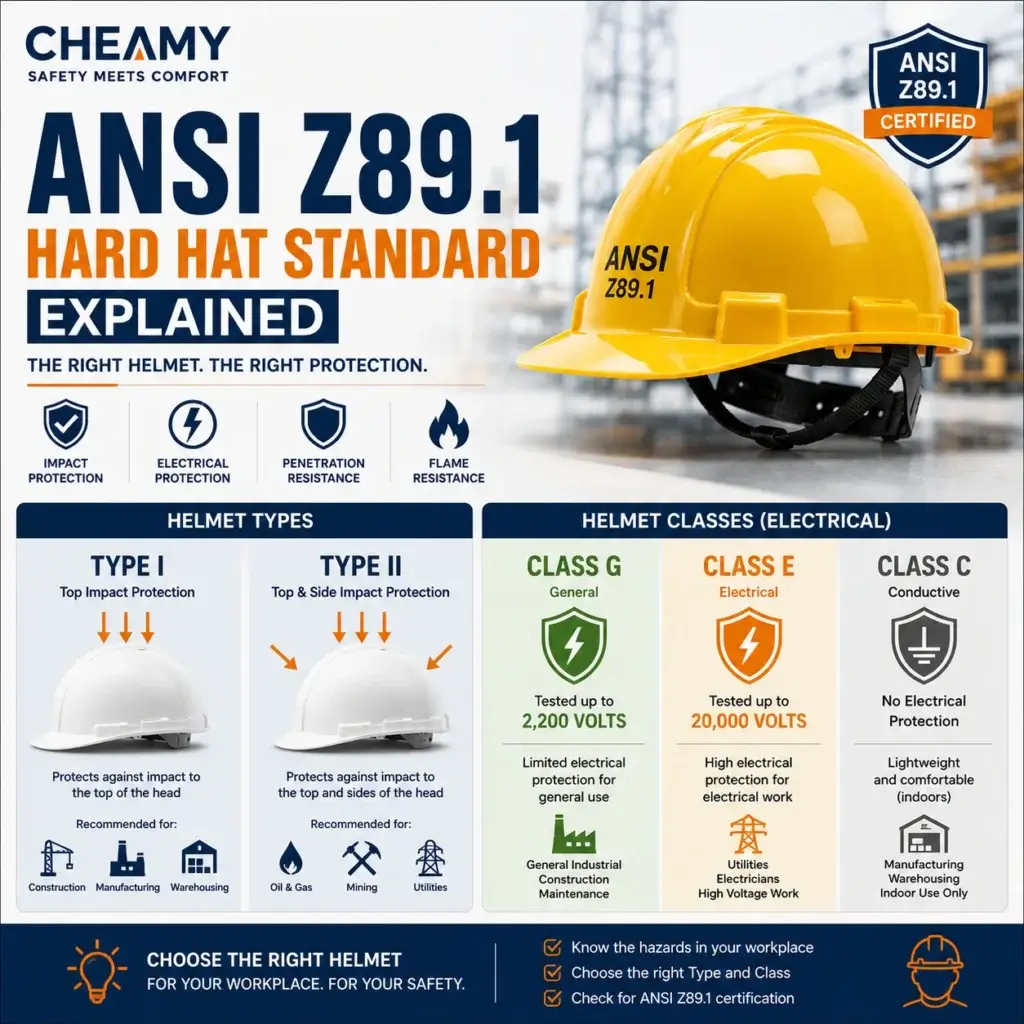
ANSI divides industrial safety helmets into two impact protection categories.
Type I Hard Hats
Type I helmets protect against impacts to the top of the head.
Typical hazards include:
- Falling tools
- Falling construction materials
- Overhead objects
Suitable industries:
- Construction
- Warehousing
- Manufacturing
- Logistics
Type I helmets are the most common choice for general industrial applications.
Type II Hard Hats
Type II helmets provide protection against impacts to both the top and sides of the head.
Additional protection helps reduce injuries caused by:
- Side impacts
- Swinging objects
- Lateral collisions
Recommended for:
- Oil & Gas
- Utilities
- Mining
- Heavy construction
- Confined space work
Type II helmets generally include enhanced energy-absorbing liners for improved side-impact performance.
Understanding ANSI Helmet Classes
In addition to helmet type, ANSI Z89.1 classifies helmets according to their electrical performance.
Class G – General
Class G helmets provide limited electrical protection.
Features:
- Tested up to 2,200 volts
- General industrial use
- Good impact protection
Typical applications:
- Construction
- Manufacturing
- Warehousing
- General maintenance
Class E – Electrical
Class E helmets provide the highest level of electrical insulation.
Features:
- Tested up to 20,000 volts
- Designed for electrical work
- Excellent dielectric performance
Recommended for:
- Utility workers
- Electricians
- Power generation
- High-voltage maintenance
Class C – Conductive
Class C helmets do not provide electrical insulation.
Their advantages include:
- Lightweight construction
- Improved ventilation
- Enhanced comfort
Suitable for:
- Manufacturing
- Warehousing
- Indoor industrial work
Class C helmets should never be used where electrical hazards are present.
ANSI Helmet Classification Overview
| Classification | Protection | Recommended Applications |
|---|---|---|
| Type I | Top impact | Construction, warehouses, manufacturing |
| Type II | Top & side impact | Utilities, mining, oil & gas |
| Class G | General electrical protection | General industrial work |
| Class E | High-voltage electrical protection | Electrical & utility work |
| Class C | No electrical protection | Indoor work without electrical hazards |
How to Choose the Right ANSI Z89.1 Helmet
Before purchasing a safety helmet, evaluate the following factors.
Workplace Hazards
Identify whether workers are exposed to:
- Falling objects
- Side impacts
- Electrical hazards
- High temperatures
- Outdoor environments
Helmet Type
Choose:
Type I
For standard overhead impact protection.
Type II
For environments with both top and side impact risks.
Helmet Class
Choose:
Class G
General industrial applications.
Class E
Electrical and utility work.
Class C
Lightweight comfort where electrical protection is unnecessary.
Comfort and Fit
Workers may wear helmets throughout the day.
Look for features such as:
- Ratchet suspension
- Adjustable headband
- Sweatband
- Lightweight shell
- Ventilation (where appropriate)
Comfort encourages consistent PPE use.
Common Industries Using ANSI Z89.1 Helmets
Construction
Recommended:
- Type I
- Class G
Manufacturing
Recommended:
- Type I
- Class G or C
Electrical Utilities
Recommended:
- Type I or II
- Class E
Oil & Gas
Recommended:
- Type II
- Class E
Mining
Recommended:
- Type II
- Class G or E
Common Buying Mistakes
Avoid these common mistakes:
- Buying helmets based only on price
- Ignoring ANSI certification
- Choosing the wrong helmet class
- Using Class C helmets around electrical hazards
- Continuing to use helmets after significant impacts
- Failing to replace aging helmets
Proper helmet selection and maintenance are essential for long-term worker safety.
Why Choose CHEAMY Safety Helmets?
CHEAMY offers a complete range of industrial safety helmets designed for demanding workplaces worldwide.
Our head protection solutions include:
- ANSI Z89.1 Safety Helmets
- EN 397 Safety Helmets
- HDPE Helmets
- ABS Helmets
- Fiberglass Hard Hats
- Ratchet Suspension Helmets
- Custom Logo & OEM Services
Designed for comfort, durability, and international compliance, CHEAMY helmets help protect workers across construction, manufacturing, utilities, mining, and industrial operations.
Safety Meets Comfort — Trusted Head Protection for Every Industry.
Conclusion
Understanding the ANSI Z89.1 helmet standard is essential for selecting the right hard hat.
By comparing Type I and Type II helmets and choosing the correct Class G, Class E, or Class C protection, employers can improve workplace safety, reduce head injuries, and meet North American safety requirements.
Choosing a certified hard hat is not just about compliance—it’s about protecting workers every day.