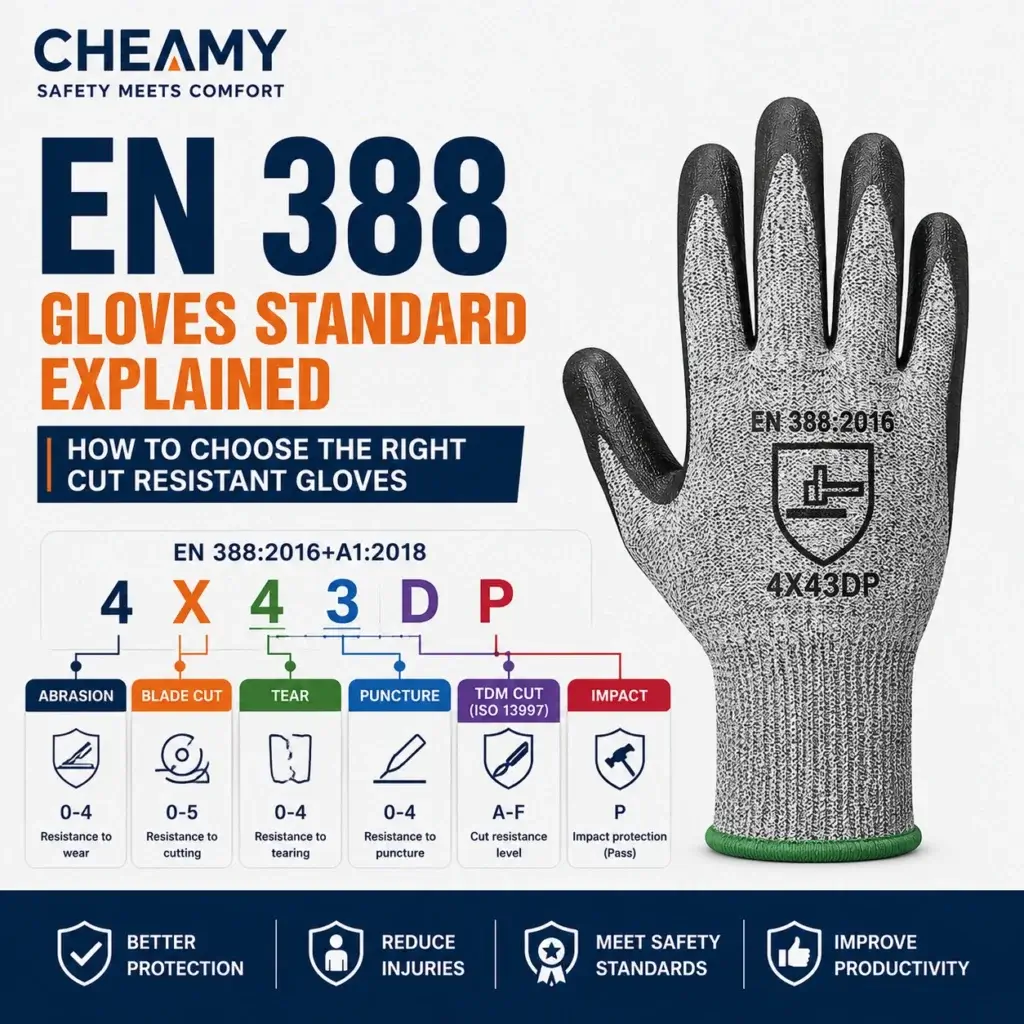
Protective gloves are one of the most widely used types of Personal Protective Equipment (PPE) in industrial workplaces. Workers in manufacturing, construction, logistics, metal fabrication, automotive, and warehousing rely on safety gloves every day to reduce the risk of cuts, abrasions, punctures, and impact injuries.
However, not all safety gloves provide the same level of protection.
One of the most important standards for evaluating mechanical protection gloves is EN 388. Understanding this standard helps buyers choose the right gloves for specific workplace hazards while ensuring compliance with international safety requirements.
In this guide, we’ll explain what the EN 388 gloves standard means, how to read EN 388 ratings, and how to select the best cut resistant gloves for your workplace.
What Is EN 388?
EN 388 is the European standard for protective gloves designed to protect against mechanical risks.
It evaluates glove performance through a series of laboratory tests that measure resistance to:
- Abrasion
- Blade cuts
- Tears
- Punctures
- Straight blade cut (TDM test)
- Impact protection (optional)
Gloves certified under EN 388 are widely used across Europe and many international markets for industrial applications.
Why Is EN 388 Important?
Different jobs expose workers to different mechanical hazards.
For example:
- Construction workers handle rough materials.
- Glass workers face severe cut hazards.
- Warehouse employees encounter abrasion risks.
- Automotive workers require excellent grip and dexterity.
EN 388 allows employers and buyers to compare gloves objectively and select the appropriate protection level.
Benefits include:
- Improved worker safety
- Reduced hand injuries
- Easier product comparison
- Compliance with workplace regulations
- Better purchasing decisions
Understanding the EN 388 Rating
Modern EN 388 markings typically appear as:
EN 388:2016+A1:2018
followed by a performance code such as:
4X43DP
Each character represents a different performance test.
| Test | Rating Range | Protection |
|---|---|---|
| Abrasion Resistance | 0–4 | Surface wear |
| Coup Blade Cut Resistance | 0–5 (or X) | Circular blade cut |
| Tear Resistance | 0–4 | Resistance to tearing |
| Puncture Resistance | 0–4 | Sharp object penetration |
| TDM Cut Resistance | A–F | High cut protection |
| Impact Protection | P (Optional) | Back-of-hand impact |
Abrasion Resistance
Abrasion resistance measures how well glove materials withstand rubbing and surface wear.
Performance levels:
| Level | Durability |
|---|---|
| 1 | Basic |
| 2 | Moderate |
| 3 | Good |
| 4 | Excellent |
Recommended for:
- Material handling
- Warehousing
- Construction
Higher abrasion resistance generally means a longer glove service life.
Blade Cut Resistance
The Coup Test evaluates resistance to cutting using a rotating circular blade.
Ratings:
0–5
If the test is unsuitable because the material dulls the blade quickly, the result may be marked as X, and the TDM Cut Test becomes the primary cut rating.
Tear Resistance
This test measures the force required to tear the glove material.
Higher tear resistance is beneficial when handling:
- Metal sheets
- Glass
- Timber
- Heavy equipment
Ratings range from Level 0 to Level 4.
Puncture Resistance
Puncture resistance measures protection against sharp objects such as:
- Nails
- Wire
- Metal fragments
- Splinters
Ratings:
Level 0–4
Higher ratings indicate better resistance.
TDM Cut Resistance (ISO 13997)
The TDM test provides a more accurate measurement for highly cut-resistant materials.
Performance levels:
| Rating | Cut Resistance |
|---|---|
| A | Lowest |
| B | Low |
| C | Medium |
| D | High |
| E | Very High |
| F | Maximum |
Workers handling sharp metal, glass, or blades should prioritize gloves with D, E, or F ratings.
Impact Protection
Some EN 388 gloves include an additional P marking.
This indicates the glove has passed impact testing on the back of the hand.
Impact gloves are commonly used in:
- Oil & Gas
- Mining
- Heavy construction
- Mechanical maintenance
How to Read an EN 388 Marking
Example:
EN 388:2016 4X43DP
This means:
- 4 – Excellent abrasion resistance
- X – Coup cut test not applicable
- 4 – High tear resistance
- 3 – Good puncture resistance
- D – High TDM cut resistance
- P – Impact protection certified
Understanding this code makes it easier to compare different glove models.
Choosing the Right EN 388 Gloves
The correct glove depends on workplace hazards.
Manufacturing
Recommended:
- Cut Resistant Gloves
- EN 388 Level C–D
Construction
Recommended:
- Impact Gloves
- Abrasion-resistant gloves
Glass Industry
Recommended:
- High cut-resistant gloves
- EN 388 Level E–F
Logistics & Warehousing
Recommended:
- Abrasion-resistant gloves
- Medium cut protection
Automotive Industry
Recommended:
- Lightweight cut resistant gloves
- Excellent grip and dexterity
Common Buying Mistakes
Avoid these common mistakes:
- Buying gloves based only on price
- Ignoring EN 388 ratings
- Selecting the wrong cut protection level
- Using one glove for every application
- Wearing damaged gloves
Proper glove selection improves both safety and productivity.
Why Choose CHEAMY Safety Gloves?
CHEAMY offers a complete range of industrial hand protection solutions designed to meet international safety standards.
Our product range includes:
- Cut Resistant Gloves
- Nitrile-Coated Gloves
- Impact Gloves
- Chemical Resistant Gloves
- General Work Gloves
All CHEAMY gloves are engineered for durability, comfort, and reliable protection in demanding industrial environments.
Whether you work in construction, manufacturing, logistics, metalworking, or automotive industries, CHEAMY provides dependable hand protection solutions to keep your workforce safe.
Safety Meets Comfort — Reliable Hand Protection for Every Job.
Conclusion
The EN 388 gloves standard provides a reliable way to evaluate mechanical protection gloves and compare their performance.
By understanding abrasion, cut, tear, puncture, TDM, and impact ratings, buyers can confidently choose the right cut resistant gloves for their specific workplace hazards.
Investing in certified EN 388 gloves not only protects workers but also improves compliance, productivity, and long-term operational safety.