Skip to content
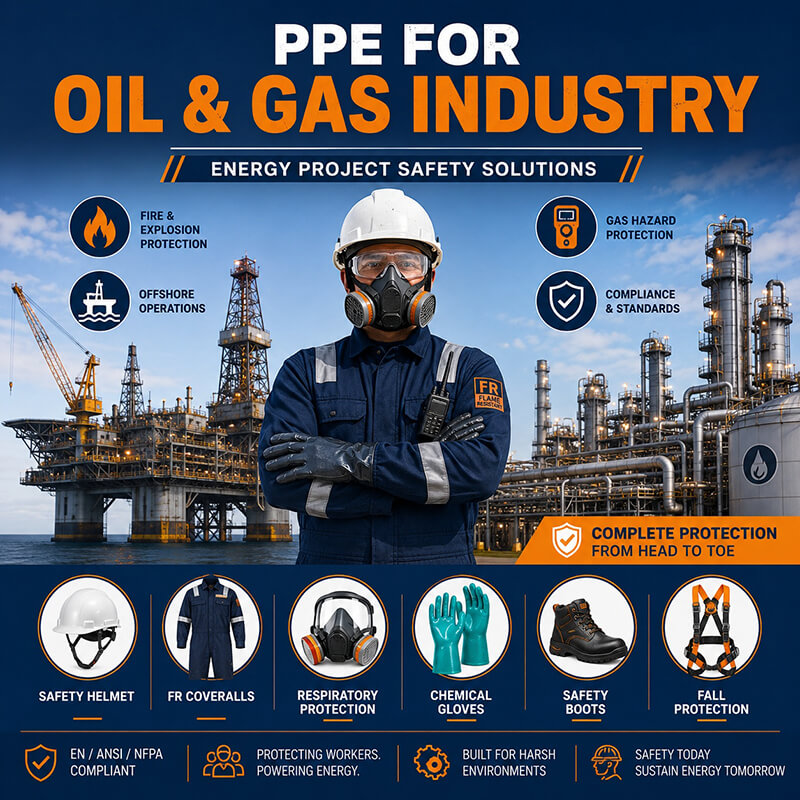
The oil and gas industry is one of the highest-risk industrial environments, involving fire hazards, explosive atmospheres, toxic gases, high-pressure systems, offshore operations, and extreme weather conditions. Workers are often exposed to multiple hazards at the same time, which makes a complete and properly selected PPE system essential.
A single protective item is never enough—effective safety in energy projects depends on a full PPE solution from head to toe.
1. Head, Face, and Eye Protection
Oil and gas sites often include drilling rigs, pipelines, refineries, and offshore platforms where falling objects, chemical splashes, and flash fire risks are common.
Required PPE:
- Industrial safety helmet (impact-resistant, often with chin strap for offshore use)
- Face shield for chemical handling or grinding operations
- Safety goggles (anti-fog, chemical splash resistant)
- Arc/flash-rated face protection in electrical zones
Key requirements:
- Flame-resistant shell materials in high-risk areas
- Compatibility with hearing protection and respirators
- Strong resistance to impact and heat exposure
2. Flame-Resistant (FR) Body Protection
Fire and flash hazards are among the most critical risks in oil and gas environments.
Required PPE:
- FR coveralls (inherent or treated flame-resistant fabrics)
- Arc-rated clothing (for electrical and maintenance work)
- FR jackets and trousers for offshore cold conditions
- Anti-static workwear (to reduce ignition risk in explosive atmospheres)
Important standards:
- EN ISO 11612 (heat and flame protection)
- NFPA 2112 (flash fire protection)
- IEC 61482 (arc flash protection)
3. Hand Protection
Workers frequently handle pipelines, chemicals, sharp tools, and heavy equipment.
Required PPE:
- Oil-resistant and chemical-resistant gloves (nitrile, neoprene)
- Cut-resistant gloves for mechanical work
- Impact-resistant gloves for heavy handling tasks
- Thermal gloves for hot surfaces or offshore cold environments
Key requirements:
- Anti-static properties in explosive zones
- Grip performance for wet and oily surfaces
- Durability under harsh chemical exposure
4. Respiratory Protection
Oil and gas environments may contain hydrogen sulfide (H₂S), hydrocarbons, vapor fumes, and confined-space oxygen deficiency risks.
Required PPE:
- Half-mask respirators with multi-gas cartridges
- Full-face respirators for combined eye and respiratory protection
- Powered Air-Purifying Respirators (PAPR) for long-duration tasks
- Supplied-air respirators (SAR) for confined space entry
Critical consideration:
- H₂S detection protocols must always be combined with PPE use
- Proper fit testing is mandatory for effective protection
5. Foot Protection
Oil rigs, refineries, and pipelines often have slippery, wet, and chemically contaminated surfaces.
Required PPE:
- Anti-static safety boots
- Oil- and chemical-resistant soles
- Steel toe or composite toe protection
- Slip-resistant and puncture-resistant design
- Waterproof construction for offshore environments
In offshore operations, boots must also withstand saltwater corrosion.
6. Hearing Protection
Noise levels in drilling and refining operations are often extremely high.
Required PPE:
- Earplugs (disposable or reusable)
- Earmuffs for long-duration exposure
- Helmet-mounted hearing protection systems for integrated use
Noise control is essential in compliance with occupational exposure limits above 85 dB.
7. Fall Protection and Specialized PPE
Many oil and gas tasks involve working at height or in confined spaces.
Required PPE:
- Full-body harness systems
- Lanyards with shock absorbers
- Lifelines and anchorage systems
- Gas detectors for confined space entry
- Thermal protective clothing for offshore cold wind exposure
8. Compliance and Industry Standards
Oil and gas PPE must meet strict international standards, including:
- API standards (American Petroleum Institute guidelines)
- EN ISO 11611 / 11612 (protective clothing)
- NFPA 2112 (fire protection)
- ANSI Z87.1 (eye protection)
- EN 20345 (safety footwear)
- IEC 60079 (explosive atmospheres)
Compliance ensures both worker safety and operational approval in high-risk zones.
9. CHEAMY PPE Energy Industry Solutions
CHEAMY PPE provides complete PPE solutions for oil and gas and energy-related industries, including:
- Flame-resistant and arc-rated protective clothing
- Chemical and oil-resistant gloves
- Respiratory protection systems for toxic gas environments
- Head-to-toe safety solutions for offshore and onshore operations
- Customized PPE combinations based on site-specific risk assessments
We focus on delivering practical, field-ready protection designed for real energy industry conditions.
Conclusion
Oil and gas operations require one of the most comprehensive PPE systems across all industries. From flame resistance to gas protection and fall safety, every layer plays a critical role in preventing accidents and ensuring operational continuity.
A properly designed PPE program is not just a compliance requirement—it is a fundamental part of energy project safety management.