Skip to content
Purchasing Personal Protective Equipment (PPE) internationally requires more than simply comparing prices. The right PPE products must meet safety requirements, comply with relevant standards, maintain consistent quality, and arrive with complete documentation.
Whether you are sourcing safety helmets, protective gloves, respirators, workwear, safety shoes, or other industrial safety products, having a clear procurement checklist can help reduce risks and avoid costly mistakes.
This PPE buying checklist provides a practical guide for international buyers before placing an order with a PPE supplier.
1. Define Your PPE Product Requirements
Before contacting a supplier, clearly define what type of protection your workers need.
A detailed product specification should include:
- Product category and application
- Material requirements
- Protection level
- Size range
- Color options
- Design requirements
- Working environment
- User quantity
For example:
A chemical-resistant glove used in a laboratory requires different protection performance compared with a cut-resistant glove used in metal fabrication.
Important questions to ask:
- What hazards will the PPE protect against?
- Is the PPE for daily use or special working conditions?
- Are there specific customer or project requirements?
- Does the product need customization?
Clear requirements help suppliers recommend suitable solutions and avoid selecting products that do not match the actual application.
2. Confirm Applicable PPE Standards
Safety standards are one of the most important factors when purchasing PPE internationally.
Different countries and industries may require different certifications and compliance standards.
Common PPE standards include:
Head Protection
- EN 397 – Industrial safety helmets
- ANSI Z89.1 – Industrial head protection
Hand Protection
- EN ISO 21420 – General requirements for protective gloves
- EN 388 – Mechanical risks
- EN ISO 374 – Chemical protection
Respiratory Protection
- EN 149 – Filtering half masks (FFP1, FFP2, FFP3)
- EN 136 – Full face masks
Protective Clothing
- EN ISO 13688 – General requirements for protective clothing
- EN ISO 20471 – High-visibility clothing
- IEC 61482 – Arc flash protective clothing
Before ordering, confirm:
- Which standards are required?
- Is the certificate valid?
- Does the certificate match the exact product model?
Choosing PPE without verifying standards may create compliance problems during inspection or workplace use.
3. Verify Certificates and Compliance Documents
Certificates provide evidence that PPE products have passed required tests.
Before cooperation, international buyers should request:
- CE certificates (for European markets)
- Test reports
- Declaration of Conformity
- Product technical sheets
- Quality inspection reports
However, certificates should always be carefully checked.
Pay attention to:
- Certificate issuer
- Testing laboratory
- Product model
- Applicable standards
- Validity period
A reliable PPE supplier should be able to provide clear and traceable documentation.
4. Request Samples Before Bulk Orders
Samples are an essential step before large-scale purchasing.
A sample evaluation allows buyers to check:
- Product appearance
- Material quality
- Comfort
- Size accuracy
- Functionality
- Packaging quality
For customized PPE products, samples are especially important to confirm:
- Logo printing
- Color matching
- Labels
- Packaging design
- Product specifications
A professional supplier should support sample approval before mass production.
5. Check MOQ (Minimum Order Quantity)
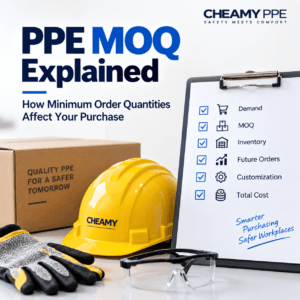
MOQ is an important consideration when sourcing PPE internationally.
Before placing an order, confirm:
- Minimum order quantity per product
- Minimum quantity for customized products
- Price differences between quantities
- Production lead time
For standard PPE items, some suppliers may accept smaller quantities from stock.
For OEM products, higher MOQ is usually required because of:
- Customized materials
- Special colors
- Packaging production
- Mold or tooling requirements
Understanding MOQ helps buyers plan purchasing budgets and inventory levels.
6. Confirm Packaging Requirements
Proper packaging protects PPE products during transportation and storage.
Before production, confirm:
- Individual packaging
- Inner carton quantity
- Master carton quantity
- Carton dimensions
- Gross and net weight
- Pallet requirements
- Shipping marks
For international shipments, packaging information is also important for:
- Container loading calculation
- Freight quotation
- Customs clearance
A good PPE supplier should provide complete packing details before shipment.
7. Prepare Complete Shipping Documents
International PPE procurement requires accurate shipping documents.
Common documents include:
Commercial Documents
- Proforma Invoice (PI)
- Commercial Invoice (CI)
- Packing List (PL)
Shipping Documents
- Bill of Lading (B/L)
- Certificate of Origin (if required)
Compliance Documents
- Certificates
- Test reports
- Inspection documents
Depending on the destination country, additional documents may be required, such as:
- ECTN certificate
- Import permits
- Special declarations
Confirm document requirements early to avoid customs delays.
8. Evaluate Your PPE Supplier
Selecting the right supplier is as important as selecting the right product.
Before cooperation, evaluate:
Product Capability
- Product range
- Customization ability
- Technical support
Quality Management
- Quality inspection process
- Production control
- Pre-shipment inspection
Export Experience
- International shipping experience
- Familiarity with destination markets
- Documentation capability
Communication
- Response speed
- Professional recommendations
- Problem-solving ability
A reliable PPE partner should not only provide products but also help buyers manage the entire sourcing process.
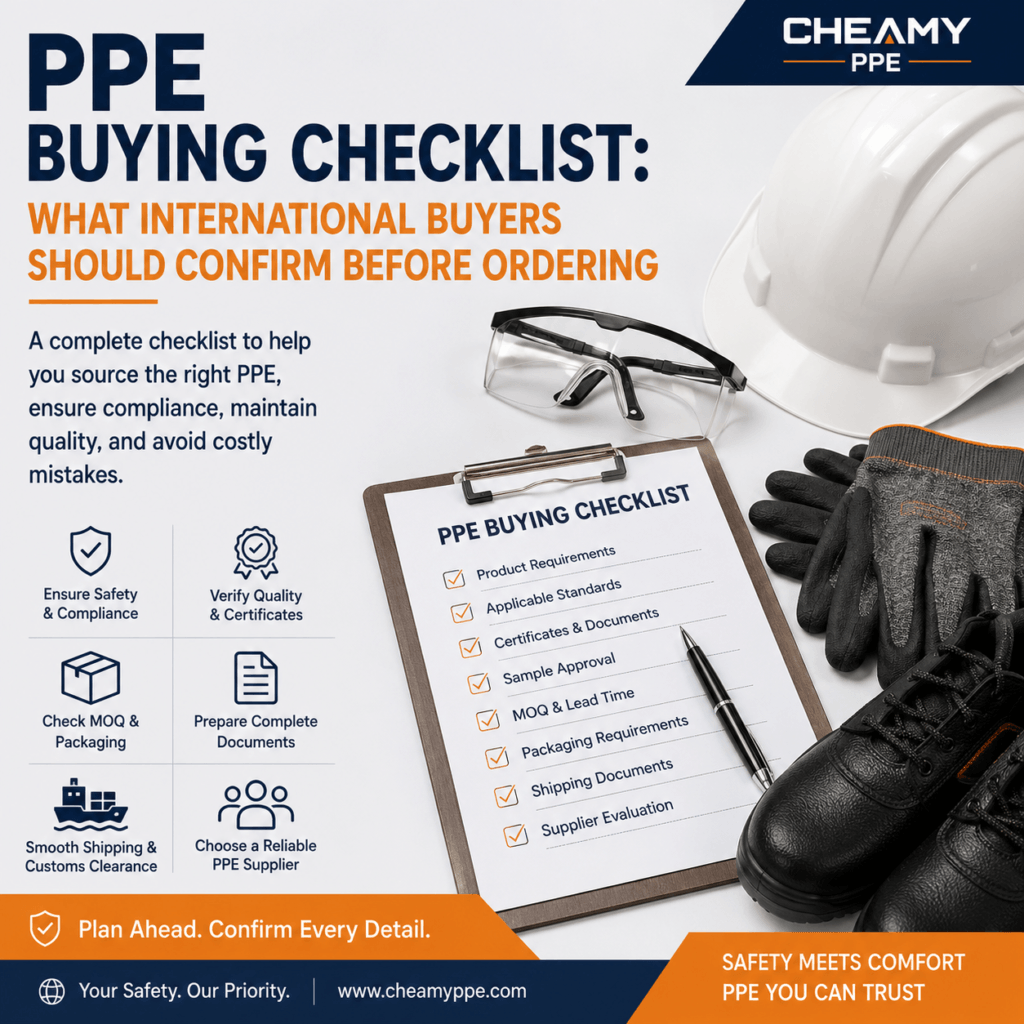
Final PPE Procurement Checklist
Before confirming your PPE order, make sure you have checked:
☐ Product specifications confirmed
☐ Required standards identified
☐ Certificates verified
☐ Samples approved
☐ MOQ accepted
☐ Packaging confirmed
☐ Shipping documents prepared
☐ Supplier capability evaluated
A successful PPE purchase depends on more than price. By following a complete PPE buying checklist, international buyers can reduce procurement risks, improve product quality, and build long-term cooperation with reliable PPE suppliers.
At CHEAMY PPE, we support global buyers with product sourcing, quality coordination, documentation support, and customized PPE solutions — helping customers purchase safety equipment with greater confidence and efficiency.