Skip to content
When purchasing chemical protective clothing, one of the most common questions is:
“Should we choose EN 13034 or EN 14605?”
At first glance, the answer may seem simple.
EN 13034 is often associated with Type 6, while EN 14605 is associated with Type 3 and Type 4 chemical protective clothing.
But the real difference is not simply the number printed on the garment.
It is about how the chemical reaches the worker, how much exposure may occur, how the garment is constructed, and what level of protection the application actually requires.
EN 13034:2005+A1:2009 covers chemical protective clothing offering limited protective performance against liquid chemicals, including Type 6 full-body clothing and Type PB[6] partial-body protection. EN 14605:2005+A1:2009 covers Type 3 liquid-tight and Type 4 spray-tight clothing, as well as partial-body Types PB[3] and PB[4].
So instead of asking:
“Which standard is better?”
a better question is:
“What kind of liquid chemical exposure does the worker actually face?”
That is the starting point for selecting the right chemical protective clothing.
EN 13034 vs EN 14605 at a Glance
Before looking at the details, here is the basic distinction:
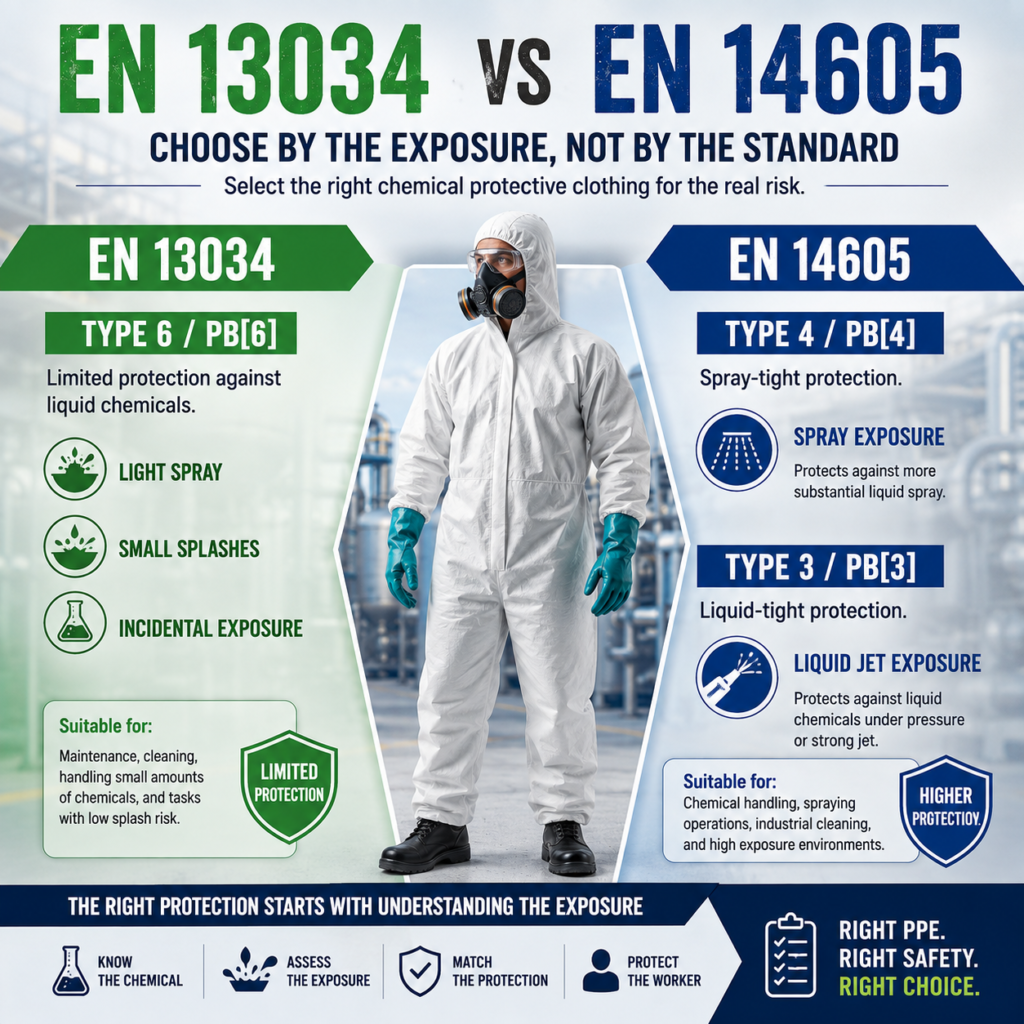
| Standard | Main Clothing Type | Main Protection Concept | Typical Exposure |
|---|---|---|---|
| EN 13034 | Type 6 / PB[6] | Limited protection against liquid chemicals | Light spray, small splashes, incidental exposure |
| EN 14605 | Type 4 / PB[4] | Spray-tight protection | More substantial spray exposure |
| EN 14605 | Type 3 / PB[3] | Liquid-tight protection | Liquid chemicals under pressure / stronger jet exposure |
BSI identifies Type 6 as clothing offering limited protection against liquid chemicals, while EN 14605 covers Type 3 liquid-tight and Type 4 spray-tight clothing.
This distinction gives us an important rule:
The standard should follow the exposure scenario—not the other way around.
What Is EN 13034?
EN 13034 is the standard for protective clothing offering limited protective performance against liquid chemicals.
It covers:
- Type 6 full-body chemical protective clothing
- Type PB[6] partial-body chemical protective clothing
Examples of partial-body garments can include items such as:
- Chemical-resistant aprons
- Jackets
- Trousers
- Sleeves
- Other garments designed to protect specific areas
The standard is intended for situations where the worker may experience relatively limited liquid chemical exposure rather than continuous or high-intensity chemical contact.
What Does “Limited Protection” Mean?
It does not mean:
“The garment provides no chemical protection.”
It means that the garment is designed and tested for a particular level of liquid chemical exposure.
A Type 6 garment is generally intended for situations involving things such as:
- Small splashes
- Light spray
- Accidental liquid contact
- Incidental chemical contamination
For example, a worker may need protection while performing routine maintenance where occasional low-volume chemical splashes are possible.
The garment is not intended to function like a fully liquid-tight chemical suit.
What Is EN 14605?
EN 14605 addresses protective clothing against liquid chemicals where a higher degree of liquid protection is required.
It covers:
Type 3 — Liquid-Tight Clothing
Type 3 clothing is designed with liquid-tight connections between the different parts of the garment.
It may include:
- One-piece coveralls
- Two-piece suits
- Hoods
- Integrated or connected components
- Other configurations designed to maintain liquid-tight connections
BSI describes Type 3 as full-body clothing with liquid-tight connections between garment components and, where applicable, liquid-tight connections to components such as hoods, gloves, boots, visors, or respiratory protective equipment.
Type 4 — Spray-Tight Clothing
Type 4 clothing is designed for spray-tight protection.
It is intended for environments where the wearer may encounter a more significant spray exposure than the low-level exposure addressed by Type 6 clothing.
BSI describes Type 4 as full-body clothing with spray-tight connections between different parts of the clothing.
The Easiest Way to Understand Type 6, Type 4 and Type 3
Instead of memorizing standard numbers, imagine three different workplaces.
Scenario 1: Occasional Small Splash
A maintenance worker opens a container and there is a possibility of a small amount of chemical liquid splashing onto the garment.
The exposure is:
Limited + incidental + low volume
A Type 6 solution may be appropriate, subject to the specific chemical and risk assessment.
Scenario 2: Continuous or Significant Spray
A worker performs a process involving chemical spraying.
The exposure is:
More extensive + repeated spray + greater coverage requirement
A Type 4 garment may be more appropriate.
Scenario 3: Liquid Chemical Jet or Pressure Exposure
A worker operates in an environment where liquid chemicals could reach the garment with greater force or through a directed jet.
The exposure is:
More aggressive + liquid-tight protection required
A Type 3 solution may be appropriate.
The key difference is therefore:
Type 6 → Limited liquid exposure
Type 4 → Spray exposure
Type 3 → Liquid-tight protection
This is much more useful than simply thinking:
Type 3 > Type 4 > Type 6
because the classifications describe different protection concepts, not just a simple quality ranking.
Type 6 Does Not Mean “Cheap Type 4”
This is an important purchasing distinction.
A Type 6 garment should not be viewed as an inferior version of Type 4 clothing.
The two garments are designed for different exposure scenarios.
For a worker facing occasional small splashes, selecting a heavier and more restrictive garment than necessary may create unnecessary cost and discomfort.
On the other hand, using Type 6 clothing in a workplace with significant spray exposure may provide an inappropriate level of protection.
The goal is not:
Maximum protection at any cost.
The goal is:
Appropriate protection for the actual exposure.
That is a much better PPE procurement principle.
Why the Garment Connections Matter
One of the biggest differences between ordinary workwear and chemical protective clothing is the importance of connections and seams.
Imagine a chemical-resistant fabric.
The fabric may resist liquid penetration.
But what happens at:
- The zipper?
- The sleeve connection?
- The hood?
- The ankle?
- The front closure?
- The seam?
- The interface with gloves or boots?
Chemical protection is not determined by fabric alone.
This is particularly important for EN 14605 because Type 3 and Type 4 classifications specifically address the protective performance of the garment’s connections.
For buyers, this means:
Do not evaluate chemical protective clothing by fabric performance alone.
The complete garment design matters.
Why Type 3 and Type 4 Need Different Designs
The difference becomes easier to understand when we consider how liquid moves.
Type 4: Spray
A spray consists of many small droplets moving toward the worker.
The garment therefore needs to prevent the spray from penetrating the protective clothing and its relevant connections.
Type 3: Liquid Jet
A liquid jet delivers a more concentrated flow of liquid.
The garment therefore needs a higher level of liquid-tight protection.
This difference affects:
- Garment construction
- Closures
- Seams
- Connections
- Hood design
- Interfaces with other PPE
The more demanding the exposure, the more important the complete garment architecture becomes.
Don’t Confuse Penetration With Permeation
This is one of the most important technical distinctions when buying chemical PPE.
Penetration
Penetration refers to a chemical liquid physically passing through openings, seams, closures, or the material structure.
Think:
Liquid getting through the garment.
Permeation
Permeation is different.
A chemical can potentially pass through a material at the molecular level even when there is no visible hole or opening.
Think:
Chemical molecules passing through the material.
Therefore:
A garment can resist liquid penetration but still require separate evaluation for chemical permeation.
Chemical permeation is chemical-specific and depends on factors such as:
- Chemical identity
- Concentration
- Temperature
- Exposure time
- Material construction
The current ISO 6529:2026 provides laboratory methods for determining resistance of protective clothing materials to permeation by liquids and gases. It also emphasizes that such material tests do not by themselves address the complete garment design or all interfaces.
This is why PPE buyers should not ask only:
“Is this suit EN 13034 or EN 14605?”
They should also ask:
“Has the material been evaluated against the specific chemical we will use?”
Why Chemical Name Matters
Suppose a customer says:
“We need chemical-resistant coveralls.”
That is not enough information for a professional PPE specification.
“Chemical” can mean:
- Acid
- Alkali
- Solvent
- Cleaning agent
- Pesticide
- Oil-based chemical
- Industrial process chemical
- Pharmaceutical chemical
- Other substances
Different chemicals can behave very differently when they contact protective materials.
Therefore, a good PPE supplier should ask for information such as:
Chemical name
Concentration
Temperature
Exposure method
Expected exposure duration
Application process
Only then can the appropriate material and garment configuration be evaluated.
Type 3 vs Type 4: Which One Should You Choose?
This is one of the most common procurement questions.
A simplified decision approach is:
Choose Type 4 when:
The primary concern is spray exposure and the workplace does not require the stronger liquid-tight performance associated with Type 3.
Potential examples can include certain:
- Chemical spraying operations
- Industrial cleaning processes
- Coating operations
- Process maintenance tasks
Consider Type 3 when:
The worker may be exposed to liquid chemicals under stronger or directed conditions, where liquid-tight connections are required.
Potential examples can include certain:
- Chemical transfer operations
- Industrial process maintenance
- High-exposure chemical handling
- Emergency response scenarios
The exact classification should always be based on the workplace risk assessment and the garment’s tested application.
What About Type PB[3], PB[4] and PB[6]?
Not every worker needs a full-body chemical suit.
Sometimes only one part of the body requires protection.
For example:
- Chemical apron
- Protective jacket
- Sleeves
- Trousers
- Hood
The standards therefore include partial-body classifications:
- PB[6] under EN 13034
- PB[4] under EN 14605
- PB[3] under EN 14605
BSI notes that EN 14605 covers partial-body garments such as laboratory coats, jackets, trousers, aprons, sleeves, and hoods, while partial-body Type PB[6] clothing falls under EN 13034.
This can be useful where full-body protection would be unnecessary or impractical.
Why Comfort Still Matters in Chemical PPE
Chemical protective clothing can become hot, restrictive, or uncomfortable.
That creates a practical problem.
If workers are required to wear protective clothing for long periods, they need garments that allow appropriate:
- Movement
- Visibility
- Ventilation
- Sizing
- Layering
- Work positioning
A garment that is technically suitable but impractical for the job can create poor PPE compliance.
This is why procurement should consider:
Protection + Mobility + Comfort + Duration of Use
rather than protection alone.
The most protective garment on paper is not necessarily the best solution for every task.
EN 13034 vs EN 14605: A Procurement Comparison
| Question | EN 13034 | EN 14605 |
|---|---|---|
| Main focus | Limited liquid chemical protection | Higher liquid/spray protection |
| Full-body type | Type 6 | Type 3 / Type 4 |
| Partial-body type | PB[6] | PB[3] / PB[4] |
| Typical exposure | Limited spray / small splashes | Spray or liquid-tight exposure |
| Garment connections | Requirements appropriate to limited protection | Critical to spray-tight or liquid-tight performance |
| Best starting point | Incidental chemical exposure | More substantial liquid chemical exposure |
BSI’s classification identifies Type 6 as limited protection, Type 4 as spray-tight, and Type 3 as liquid-tight.
Common Mistakes When Buying Chemical Protective Clothing
Mistake 1: Choosing the Highest Type Automatically
A higher classification is not automatically the best solution.
The exposure scenario should determine the appropriate type.
Mistake 2: Looking Only at the Fabric
The garment’s:
- Seams
- Closures
- Connections
- Hood
- Interfaces
can be just as important as the material.
Mistake 3: Ignoring the Chemical
A garment classification does not mean it provides universal protection against every chemical.
Chemical-specific performance should be reviewed.
Mistake 4: Confusing Penetration With Permeation
Passing a spray test does not automatically answer every question about chemical permeation.
These are different performance characteristics.
Mistake 5: Treating “Chemical Resistant” as a Complete Specification
A product description saying “chemical resistant” is not enough for professional PPE procurement.
Ask:
Which standard?
Which type?
Which chemical?
Which test results?
Which garment configuration?
Mistake 6: Adding Customization Without Checking the Garment
OEM customers often request:
- Logos
- Labels
- Reflective strips
- Custom colors
- Additional pockets
- Different closures
For chemical protective clothing, modifications should be evaluated carefully because they can affect garment construction and protective performance.
A Better Way to Write Your Chemical PPE RFQ
Instead of:
“Please quote chemical-resistant coveralls.”
A more useful RFQ could say:
Application: Chemical plant maintenance
Chemical: [Chemical name]
Concentration: [Concentration]
Exposure: Spray / splash / jet
Required clothing type: Type 6 / Type 4 / Type 3
Garment: Coverall
Additional protection: Flame resistance / antistatic / high visibility
Customization: Company logo
Quantity: 1,000 pcs
Documentation: Test reports and conformity documents required
This gives the supplier a much clearer technical starting point.
It also helps avoid purchasing the wrong type of garment simply because it has the phrase “chemical protective” in its product description.
Chemical Protection Often Requires More Than One Standard
In many industrial environments, chemical exposure is not the only hazard.
A worker may face:
Chemical splash + Flame
or:
Chemical exposure + Electrostatic discharge
or:
Chemical exposure + High visibility
or:
Chemical exposure + Infective agents
Depending on the application, protective clothing may therefore need to meet several applicable requirements.
For example:
- EN 13034 / EN 14605 → Liquid chemical protection
- EN ISO 11612 → Heat and flame
- EN 1149-5 → Electrostatic properties
- EN ISO 20471 → High visibility
- EN 14126 → Infective agents, where applicable
The correct combination depends on the risk assessment and intended use.
The Better Question Is Not “Which Standard Is Better?”
This is the key message of this article.
When buyers compare EN 13034 and EN 14605, they sometimes ask:
“Which one offers better protection?”
But that is not the most useful question.
Instead ask:
“What form of chemical exposure are we trying to control?”
Then consider:
Small incidental splash?
→ Type 6 may be appropriate.
Spray exposure?
→ Type 4 may be appropriate.
Liquid-tight exposure?
→ Type 3 may be appropriate.
Only part of the body exposed?
→ Consider the applicable PB classification.
Specific chemical contact for extended periods?
→ Review chemical-specific permeation data as well.
This approach creates a much more rational PPE selection process.
How CHEAMY Helps Buyers Select Chemical Protective Workwear
At CHEAMY PPE, we believe chemical protective clothing should be selected around the exposure scenario, not simply around a standard number.
We can support B2B customers with chemical protective solutions such as:
- Type 6 chemical protective coveralls
- Type 4 chemical protective clothing
- Type 3 chemical protective clothing
- Partial-body chemical protection
- Chemical-resistant workwear
- Flame-resistant chemical protective clothing
- Antistatic chemical protective workwear
- Customized chemical protective clothing
- OEM & ODM solutions
For customized projects, we can work with customers on requirements such as:
- Garment design
- Material selection
- Color
- Logo customization
- Reflective elements
- Sizing
- Packaging
- Technical documentation
The starting point should always be the same:
Understand the chemical.
Understand the exposure.
Define the protection required.
Then select the garment.
Because chemical protective clothing should not simply look protective.
It should be appropriate for the hazard it is designed to control.
Final Thoughts
EN 13034 and EN 14605 are not simply competing standards.
They address different levels and forms of liquid chemical exposure.
EN 13034 → Type 6 / PB[6] → limited liquid chemical protection
EN 14605 → Type 4 / PB[4] → spray-tight protection
EN 14605 → Type 3 / PB[3] → liquid-tight protection
But the standard number is only the beginning.
For professional PPE selection, also consider:
- The chemical involved
- Concentration
- Exposure method
- Exposure duration
- Garment construction
- Seams and closures
- Chemical permeation
- Additional workplace hazards
- Comfort and wear time
The right chemical protective garment is not necessarily the one with the highest classification.
It is the one whose tested performance matches the real exposure.
That is the better way to compare EN 13034 vs EN 14605.
Understand the exposure. Match the protection. Choose the right PPE.