Skip to content
Static electricity is easy to ignore.
You may notice a small spark when touching a metal object after walking across a synthetic floor. In an ordinary environment, this may be nothing more than a minor nuisance.
In a workplace handling flammable gases, vapors, liquids, powders, or other combustible materials, however, an electrostatic discharge can become a serious ignition hazard.
This is where EN 1149-5 becomes important.
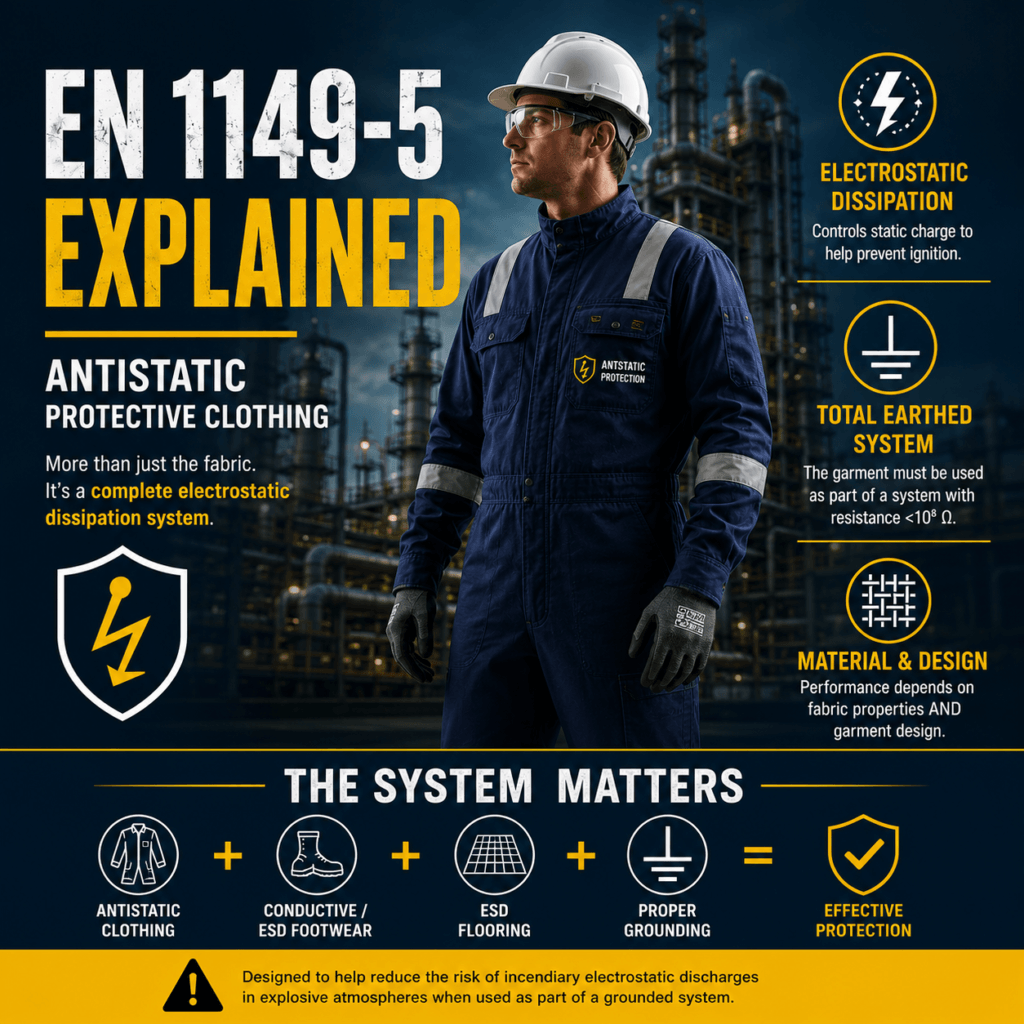
EN 1149-5:2018 specifies material performance and design requirements for electrostatic dissipative protective clothing. The clothing is intended to be used as part of a total earthed system to reduce the risk of incendiary electrostatic discharges in certain explosive atmospheres.
But there is an important detail that is often missed:
EN 1149-5 is not simply a “fabric test.” The clothing, wearer, footwear, and grounding system all have to work together.
That changes the way PPE buyers should evaluate antistatic workwear.
What Is EN 1149-5?
EN 1149-5 is part of the EN 1149 series covering the electrostatic properties of protective clothing.
The 2018 edition is titled:
Protective clothing — Electrostatic properties — Part 5: Material performance and design requirements
It specifies requirements for electrostatic dissipative protective clothing, including certain hoods and caps, when used as part of a grounded system.
The standard is intended to help reduce the possibility of incendiary electrostatic discharges in explosive atmospheres where the minimum ignition energy is not less than 0.016 mJ.
The standard also defines the concept of a total earthed system. In the BSI description, this means personnel and other conductors are connected to earth through a resistance of less than 10⁸ Ω.
This leads to the first key takeaway:
EN 1149-5 is about controlled electrostatic dissipation—not simply making clothing “non-static.”
Why Can Static Electricity Be Dangerous?
Static charge can accumulate when materials or surfaces come into contact and separate.
In industrial environments, charge may build up through:
- Movement of workers
- Friction between materials
- Synthetic materials
- Powder handling
- Liquid transfer
- Conveyor operations
- Packaging processes
- Hose and pipe movement
- Equipment contact
The problem begins when accumulated charge suddenly discharges.
A visible spark is an electrostatic discharge.
In an environment containing an ignitable atmosphere, that discharge can potentially become an ignition source.
This is why electrostatic control becomes particularly important in industries such as:
- Chemical processing
- Pharmaceutical manufacturing
- Petrochemical operations
- Paint and coating production
- Solvent handling
- Powder processing
- Certain food and agricultural processing environments
- Other areas where explosive atmospheres may occur
The exact PPE requirements should always be determined through the site’s hazard assessment and applicable regulations.
EN 1149-5 Is Not the Same as “Antistatic Fabric”
This is probably the most important distinction for PPE buyers.
A supplier may say:
“This fabric is antistatic.”
That statement alone does not tell you whether the complete protective garment meets EN 1149-5.
Why?
Because EN 1149-5 addresses both:
Material performance
and
Garment design.
The 2018 edition introduced or clarified several design-related requirements, including requirements concerning grounding and the thickness and dimensions of certain non-dissipative outer layers and attachments.
So the question should not simply be:
“Is the fabric antistatic?”
Instead, ask:
“Does the complete garment meet the applicable EN 1149-5 material and design requirements?”
That is a much better procurement question.
How Does EN 1149-5 Relate to EN 1149-1 and EN 1149-3?
The EN 1149 series can be confusing because different parts address different aspects of electrostatic performance.
A simplified way to understand the relationship is:
| Standard | Main Role |
|---|---|
| EN 1149-1 | Test method for measuring surface resistance |
| EN 1149-2 | Test method for measuring electrical resistance through a material |
| EN 1149-3 | Test methods for measuring charge decay |
| EN 1149-5 | Material performance and design requirements for protective clothing |
EN 1149-5 therefore works together with relevant test methods from the series rather than functioning as a standalone fabric test.
For example, EN 1149-1 and EN 1149-3 are used as test methods for assessing certain electrostatic properties covered by EN 1149-5.
This distinction is useful when reviewing a supplier’s technical documentation.
What Does “Electrostatic Dissipative” Actually Mean?
Electrostatic dissipative clothing is designed to allow accumulated electrical charge to be controlled and dissipated rather than remaining concentrated on the garment.
The goal is not to make the garment behave like a conventional electrical conductor.
The goal is controlled dissipation.
Depending on the material construction, EN 1149-5 can use different performance routes involving characteristics such as surface resistance or charge decay. For example, published summaries of the 2018 requirements identify criteria involving surface resistance and charge-decay performance.
This is why simply measuring whether a fabric “feels static-free” is meaningless from a compliance perspective.
Electrostatic performance needs to be measured using defined test methods.
The Hidden Part of the Standard: Garment Design
A technically suitable fabric can still become part of a poorly designed garment.
This is why EN 1149-5 contains design requirements.
For example, the 2018 edition addresses:
- Non-dissipative outer layers
- Non-dissipative attachments
- Grounding requirements
- Closures
- Exposed conductive components
- Design elements that could affect electrostatic dissipation
BSI specifically notes that the 2018 edition introduced limits concerning the thickness of non-dissipative outer layers and attachments and added a requirement relating to earthing electrostatic dissipative garments.
Why does this matter?
Imagine an antistatic coverall made from a suitable dissipative fabric.
Then imagine adding:
- Large non-dissipative patches
- Decorative components
- Oversized reflective elements
- Certain labels or accessories
- Conductive metal components
If those elements are not properly considered during design, the finished garment may not behave in the intended way.
The fabric is only one part of the solution.
Why Grounding Matters So Much
This is the part that many product descriptions leave out.
An electrostatic dissipative garment does not magically eliminate electrostatic risk by itself.
The wearer must be properly grounded as part of the overall system.
EN 1149-5 is intended for use within a total earthed system, and the resistance between the person and earth is specified as less than 10⁸ Ω in the standard’s context.
In practical workplace systems, this may involve suitable combinations of:
- Electrostatic-dissipative footwear
- Suitable flooring
- Grounding systems
- Appropriate workplace procedures
The exact grounding arrangement must be evaluated for the specific workplace.
This creates a simple principle:
Antistatic clothing + appropriate grounding = electrostatic control system
Not:
Antistatic clothing = complete protection
Why Footwear Is Part of the Equation
Consider a worker wearing an EN 1149-5 garment.
The garment can dissipate accumulated charge.
But if the charge cannot effectively move from the worker to earth, the intended electrostatic control system may not function as expected.
This is why clothing cannot be evaluated independently from the rest of the grounding path.
For PPE procurement, it can therefore be useful to evaluate:
Garment → Person → Footwear → Floor → Earth
as one system.
This is particularly important in environments where electrostatic discharge could create an ignition hazard.
EN 1149-5 Is Not for Mains Voltage Protection
This is another important distinction.
EN 1149-5 does not provide protection against mains electrical voltage.
BSI explicitly states that the standard does not apply to protection against mains voltages.
Therefore:
Antistatic clothing ≠ electrical insulating clothing.
A worker dealing with energized electrical systems requires PPE selected according to the electrical hazard and the applicable electrical protection standards.
EN 1149-5 addresses electrostatic properties and the control of electrostatic discharge—not protection from electrical shock caused by mains voltage.
EN 1149-5 Is Also Not a Standalone Explosion-Proof Solution
Another common misunderstanding is:
“If workers wear EN 1149-5 clothing, the workplace is safe from explosions.”
No.
Electrostatic dissipative clothing is only one part of a broader risk-control strategy.
Explosion risks can involve:
- Flammable gases
- Flammable vapors
- Combustible dust
- Ignition sources
- Process equipment
- Ventilation
- Grounding and bonding
- Electrical equipment
- Operating procedures
- PPE
The clothing helps address one particular ignition mechanism: electrostatic discharge from the wearer and clothing system.
It does not replace engineering controls, process safety measures, hazardous-area classification, or other required protective measures.
Where Is EN 1149-5 Commonly Relevant?
EN 1149-5 may be relevant in workplaces where electrostatic control is necessary and protective clothing forms part of a grounded system.
Examples can include:
Chemical Processing
Workers may handle flammable liquids, solvents, or other materials capable of creating hazardous atmospheres.
Paint and Coating Operations
Solvent vapors combined with ignition sources can create serious hazards.
Pharmaceutical Manufacturing
Certain powder handling operations can create electrostatic concerns.
Powder Processing
Fine combustible powders can present explosion risks under suitable conditions.
Petrochemical and Industrial Processing
Workers may operate in environments where flammable gases or vapors are present.
Specialized Manufacturing
Certain electronics, materials, packaging, and process environments may also require controlled electrostatic conditions, although the appropriate PPE standard depends on the specific application.
The presence of static electricity alone does not automatically mean EN 1149-5 is required.
The workplace hazard assessment determines whether this type of protective clothing is appropriate.
EN 1149-5 and EN 1149-1: Don’t Mix Them Up
A common procurement mistake is seeing:
EN 1149-1
and assuming it means:
EN 1149-5
They are not interchangeable.
EN 1149-1 is a test method for surface resistance.
EN 1149-5 establishes material performance and design requirements for protective clothing.
A technical document might therefore state that a garment meets EN 1149-5:2018 based on testing performed according to an applicable EN 1149 test method.
For buyers, this distinction is important when reviewing:
- Certificates
- Test reports
- Declarations of conformity
- Technical datasheets
- Product labels
What Should You Check When Buying EN 1149-5 Workwear?
If you are sourcing antistatic protective clothing for industrial use, don’t stop at the product title.
Check these seven points.
1. The Exact Standard
Confirm that the garment is specified to EN 1149-5:2018, rather than relying on a generic claim such as “anti-static.”
2. Test Evidence
Ask which relevant test methods were used and review the supporting documentation.
3. Complete Garment Design
Check whether:
- Closures
- Pockets
- Labels
- Reflective elements
- Accessories
- Outer layers
have been considered in the garment design.
4. Grounding Requirements
Confirm how the garment is intended to be grounded during use.
5. Footwear Compatibility
The clothing should be considered together with the user’s footwear and flooring system where electrostatic dissipation is required.
6. Intended Hazardous Area
Confirm whether the product is appropriate for the specific workplace and hazardous-area conditions.
7. Care and Maintenance
Electrostatic performance can be affected by:
- Washing
- Contamination
- Wear
- Aging
- Material damage
- Improper repairs
The manufacturer’s care instructions should therefore be followed.
Customization Can Affect Antistatic Performance
This is especially important for OEM and private-label PPE.
A customer may request:
- Large logo printing
- Embroidery
- Reflective strips
- Custom labels
- Additional pockets
- Different closures
- Special fabric panels
- Decorative accessories
But every modification can potentially affect the original garment design.
For EN 1149-5 clothing, customization should therefore be evaluated before production, rather than simply adding modifications after certification.
The 2018 requirements specifically address non-dissipative attachments and certain design limitations, making this particularly relevant for customized workwear.
A better OEM/ODM process is:
Application → Hazard assessment → Garment design → Material selection → Testing → Documentation → Production
rather than:
Standard garment → Add logo → Add accessories → Hope the performance remains unchanged
For professional PPE procurement, the first approach is far more reliable.
What About Reflective Tape?
This is another interesting issue for industrial workwear.
A customer may want an antistatic garment with high-visibility features.
That can be possible, but the reflective components and their attachment need to be considered as part of the complete garment design.
The question is not simply:
“Can we add reflective tape?”
It is:
“Can the reflective element be integrated without compromising the applicable electrostatic design requirements?”
This is why combined-performance workwear should be developed carefully rather than treated as ordinary workwear with several labels added to it.
EN 1149-5 vs. Other PPE Standards
EN 1149-5 often appears alongside other protective clothing standards.
For example:
| Hazard / Requirement | Possible Standard |
|---|---|
| Electrostatic properties | EN 1149-5 |
| Heat and flame | EN ISO 11612 |
| Welding | EN ISO 11611 |
| High visibility | EN ISO 20471 |
| Rain protection | EN 343 |
| Electrical arc | IEC 61482 |
The combination depends on the actual workplace hazards.
For example, workers in a petrochemical environment may need clothing combining flame protection and electrostatic dissipation, while road workers may prioritize high visibility and weather protection.
This is why PPE selection should be based on the hazard profile, not simply the number of standards listed on the garment.
A Better Way to Write an RFQ for Antistatic Workwear
Instead of sending a supplier:
“Please quote EN 1149-5 coveralls.”
give the supplier more information.
For example:
Application: Chemical processing
Main hazard: Flammable solvent atmosphere
Required electrostatic standard: EN 1149-5:2018
Garment: Coverall
Additional protection: Flame resistant
Visibility: Reflective elements required
Color: Navy
Customization: Company logo
Quantity: 2,000 pcs
Documentation: Declaration of Conformity and test reports required
This gives the PPE supplier a much clearer technical starting point.
It also helps avoid the common situation where a low-cost garment technically carries an “antistatic” claim but does not match the buyer’s complete application requirements.
The Biggest Mistake: Treating Antistatic Clothing as Ordinary Workwear
Antistatic workwear can look almost identical to ordinary industrial clothing.
That can make its function easy to underestimate.
The difference is in the:
Material
Construction
Design
Testing
Grounding
Intended application
Maintenance
This is why EN 1149-5 should be viewed as a system-oriented protective clothing requirement, rather than simply a fabric specification.
CHEAMY: Building Antistatic Workwear Around the Application
At CHEAMY PPE, we believe protective clothing should be selected according to the hazards workers actually face.
For industrial customers and distributors, we can support requirements for protective workwear such as:
- Antistatic workwear
- Flame-resistant antistatic clothing
- Antistatic coveralls
- Antistatic jackets and trousers
- High-visibility antistatic workwear
- Customized industrial workwear
- OEM & ODM protective clothing
Depending on the application, customers may need to combine electrostatic control with other protective functions such as:
Electrostatic Dissipation + Flame Protection
or
Electrostatic Dissipation + High Visibility
or
Electrostatic Dissipation + Chemical Protection
The right combination depends on the workplace.
Our approach is to start with the application and hazard profile, then work toward the appropriate garment specification.
Because protective clothing should not simply carry the right standard.
It should provide the right protection for the job.
Final Thoughts
EN 1149-5 is often reduced to one word:
“Antistatic.”
But that description is too simple.
The standard addresses material performance and garment design for electrostatic dissipative protective clothing used as part of a total earthed system.
For PPE buyers, the most important lessons are:
- Antistatic fabric is not the same as a compliant protective garment.
- EN 1149-5 is different from the EN 1149 test-method standards.
- Grounding is an essential part of the system.
- EN 1149-5 does not protect against mains voltage.
- Garment design and accessories matter.
- Customization should be evaluated before production.
- The standard should be selected according to the actual workplace hazard.
When electrostatic discharge can become an ignition source, the right PPE specification matters.
Don’t just ask for “antistatic clothing.”
Ask:
What electrostatic hazard are we controlling, how will the garment be grounded, and what other protection does the worker need?
That is the better way to specify EN 1149-5 workwear.
Safety Meets Comfort — with protection designed around the job.